
Budget for a supercar by separating the purchase funds, the costs of taking ownership, the recurring running costs and a repair reserve. Before you commit to a supercar for sale, replace assumptions with insurance quotes, service records and an independent pre-purchase inspection. Keep the reserve separate from the money you need to complete the deal.
- Evaluate a supercar for sale against your ownership budget, not just the funds available to buy it.
- Use insurance quotes, service records and a pre-purchase inspection to identify costs before committing.
- Keep immediate repairs and an ownership reserve separate from purchase funds.
- SV Sourcing suits buyers seeking private exotic-car sourcing and coordinated transactions, not public inventory browsing.
Why this matters
A car can fit your purchase budget and still exceed your ownership budget. Insurance, servicing, storage and unresolved maintenance all belong in the decision before you agree to buy.
For your 2026 search, begin with the specific car rather than a generic estimate for the model. Its records and condition determine what needs attention. Use the guide to what a pre-purchase supercar inspection should cover to define the checks before arranging an inspection.
Affordability means you can buy the car, maintain it and absorb an interruption without depending on a quick resale. That is the test. Access to purchase funds alone does not answer it.
How do you budget for ownership before buying a supercar?
Build the budget around a defined ownership period. A 12-month worksheet shows the first year; a 24-month view helps separate initial catch-up work from recurring expenses. These are planning horizons, not predictions of when a repair will occur.
Keep each expense in its own line. A single running-cost allowance hides the difference between a known obligation and an uncertain repair.
| Budget category | What belongs here | What you need before committing |
|---|---|---|
| Acquisition | Purchase commitment, applicable taxes, registration and transaction expenses | Written transaction terms and requirements for your location |
| Taking possession | Inspection, transport and any immediate work | Inspection findings and written scope from the relevant providers |
| Recurring ownership | Insurance, scheduled service, fuel and storage | Vehicle-specific quotes and a realistic usage plan |
| Contingency | Unplanned repairs and unresolved condition questions | Accessible funds separate from the purchase budget |
| Exit planning | Loan obligations, sale preparation and coordination | A clear understanding of the ownership and financing documents |
Do not treat every line as a fixed expense. Taxes depend on the transaction and jurisdiction. Maintenance depends on the vehicle. Repairs remain uncertain until a specialist identifies the work.
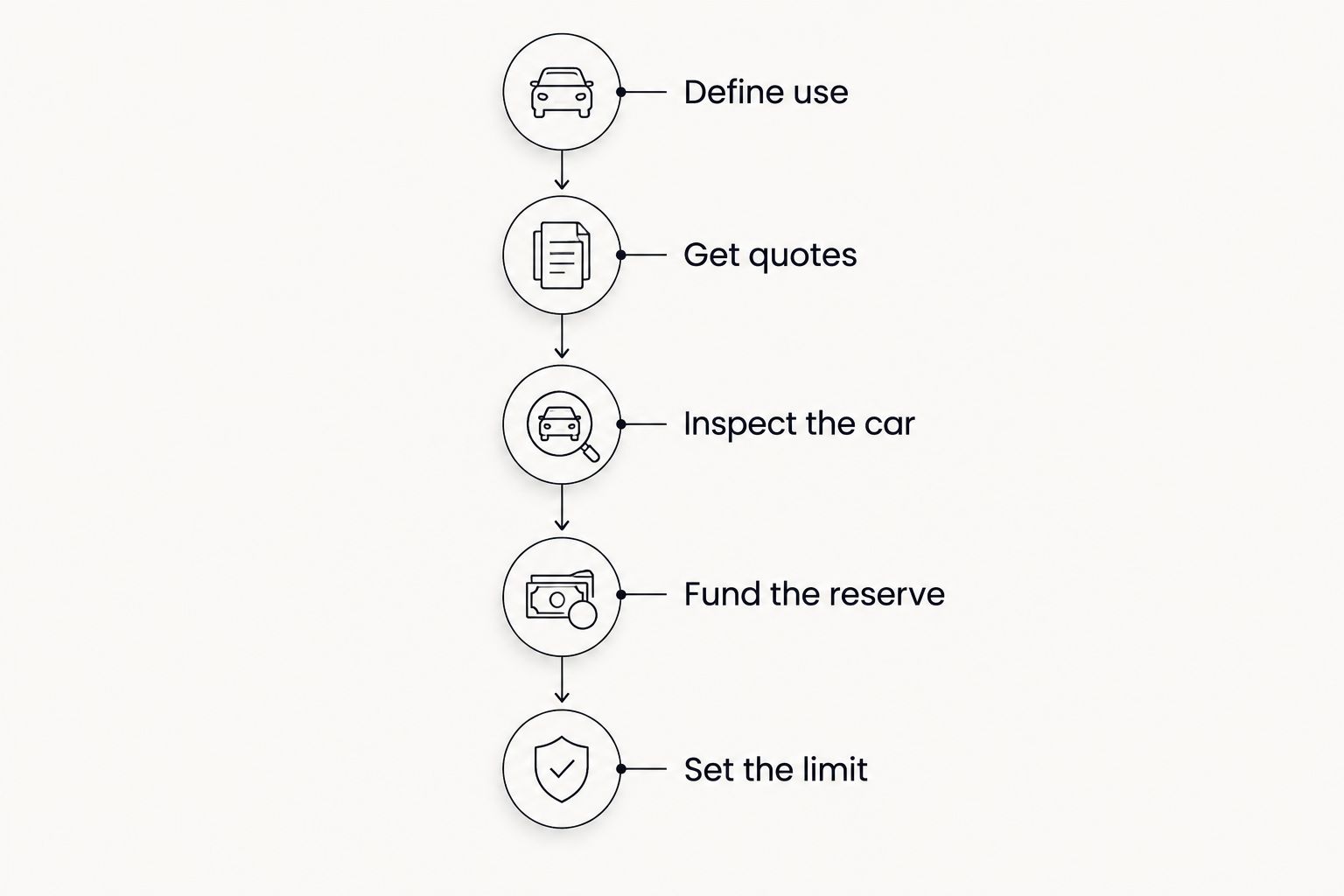
1. Define use
Decide what you are buying the car to do. Occasional leisure driving, regular road use and track use create different questions for insurers and service providers. Describe your intended use accurately rather than choosing the cheapest-looking assumptions.
Write down where the car will live, who will drive it and how you expect to use it. Include your preferred ownership period. If you intend to keep it for 3 years, review that entire period rather than judging affordability only at handoff.
Separate essential specifications from preferences. A particular configuration can be desirable without being necessary. Keeping that distinction clear prevents the search from consuming funds you intended to retain for ownership.
2. Get quotes
Obtain an insurance quote for the actual vehicle and your circumstances before committing. Ask about coverage, deductibles, permitted use, storage requirements and exclusions. A quote for a different car or a different driver is not your budget.
Speak with a service provider familiar with the model. Ask what scheduled work is due by time or mileage, what the records establish and what requires inspection. Request a written scope rather than an unsupported annual maintenance allowance.
Include transport and storage where relevant. For an out-of-state purchase, confirm the handoff arrangements and the registration requirements where you will keep the car. Keep each provider's responsibilities clear.
3. Inspect the car
Commission an independent pre-purchase inspection suited to the vehicle. Ask the specialist to distinguish immediate concerns, scheduled maintenance and items that need further investigation. The report should inform your decision, not merely document the car after you have decided to buy it.
Read the service history alongside the inspection. The guide to reading service records for a supercar for sale helps you organize that review. A record of completed work is useful; it does not establish the current condition of every component.
If a finding remains unresolved, investigate it before treating the ownership budget as settled. Ask for a diagnosis and an estimate from the appropriate specialist. Do not convert uncertainty into a reassuring number of your own.
4. Fund the reserve
Keep a repair reserve accessible after the transaction. Its purpose is to cover uncertainty, not to make the purchase appear affordable on paper. Do not count the same funds as both acquisition money and contingency money.
Set the reserve after reviewing the car's condition and the work already identified. Known repairs belong in the immediate-work budget. The contingency line serves a different purpose: expenses that are not yet established.
Also consider your tolerance for downtime. A repair can involve arranging transport, appointments and storage as well as paying for work. A budget should leave room to manage the car without forcing a rushed sale.
5. Set the limit
Bring the written quotes, inspection findings and ownership plan into one worksheet. Establish the maximum purchase commitment only after protecting the other categories. Reduce the purchase limit before you remove necessary maintenance or the repair reserve.
For a 2026 purchase, keep a dated copy of the assumptions supporting your decision. Note which figures are written quotes, which are estimates and which items still need verification. Update the worksheet when the vehicle or transaction terms change.
If the car does not fit, pause. A different specification, a different vehicle or a later purchase is a better decision than completing a deal that leaves no room to own the car properly.
Cash purchase or financing: what changes in the budget?
Cash and financing change how you fund the transaction. Neither removes the operating expenses or the need for due diligence. Compare the effect on your available funds, not just the payment arrangement.
| Approach | Best for | Advantage | Limitation |
|---|---|---|---|
| Cash purchase | Buyers who can complete the purchase while preserving their reserve | No loan payment attached to the purchase | More funds committed to the car at acquisition |
| Financing | Buyers choosing to spread acquisition payments under agreed loan terms | Less acquisition funding paid immediately | Interest, payment obligations and lender conditions remain part of ownership |
For financing, review the total obligation, payment schedule, interest terms and any requirements affecting insurance or resale. Keep loan payments separate from maintenance. They serve different purposes and continue on different schedules.
For a cash purchase, test the remaining liquidity. Owning the car without a loan does not help if you have exhausted the funds needed to maintain it. In either case, a future sale is not a substitute for a funded reserve.
Why supercar ownership budgets vary
Use the same budget categories for every candidate, but do not assume the totals transfer from one car to another. These factors determine which questions you need to resolve:
- Condition and maintenance history. Completed work, overdue maintenance and unresolved inspection findings change the immediate-work budget.
- Specification and modifications. Confirm the equipment fitted to the car and ask the inspecting specialist what it means for servicing and repair.
- Intended use. Road use, storage periods and track use belong in discussions with the insurer and service provider.
- Insurance circumstances. The vehicle, drivers, location, coverage and permitted use belong in the quote request.
- Location and handoff. Transport, registration, storage and access to a suitable service provider affect the ownership plan.
- Funding and holding period. Loan obligations and the time you intend to keep the car change the cash-flow worksheet.
Revisit these assumptions during your 2026 search whenever you switch candidates. An inspection report or insurance quote for one vehicle does not settle the budget for another.
What should sellers prepare for a buyer's budget review?
If you are selling privately, prepare the documents that allow a buyer to assess the car without unnecessary disclosure. Organize service records, known maintenance needs, relevant modifications and any loan-payoff requirements. Share personal or sensitive information only through an agreed process.
A clear record supports a serious conversation. It does not remove the buyer's need for an independent inspection, nor does it promise that every buyer will accept the same ownership costs.
Felipe Cimino, CEO and co-founder of SV Sourcing, identifies unrealistic asking prices leaving cars unsold and owners entrusting cars to unsuitable intermediaries as firsthand concerns. Treat those observations as reasons to set clear terms and evaluate the intermediary, not as claims about every dealership or private transaction.
Where does private sourcing fit in the budget?
SV Sourcing is suited to buyers seeking private off-market exotic-car sourcing and one person coordinating the deal. It serves buyers and sellers in South Florida and nationwide. It is not a public inventory dealership.
That service fits a buyer who has defined the specification, budget, timing and due-diligence requirements. The boundary is equally clear: private access does not replace independent inspection, insurance review or your own affordability decision. Ask what the coordination includes and what you must arrange separately.
When comparing private brokers, establish whom each broker represents, how compensation works and who handles inspection, documents and handoff. Confirm the scope before sharing funds or making commitments. Discretion and a defined process should work together.
Discuss your ownership brief
Clarify your specification, budget, timing and due-diligence requirements for a private search.
How much should I reserve for maintenance?
For a 12-month ownership plan, use the car's service schedule, records and inspection findings to identify known maintenance. Keep unresolved repairs and the contingency reserve separate. An unsupported percentage of the purchase commitment is not a vehicle-specific maintenance plan.
Can I budget accurately before choosing a specific car?
A 24-month worksheet gives you a useful structure before selecting a car, but the vehicle-specific entries still require quotes and inspection. Use the early worksheet to set boundaries. Complete it when you have an actual candidate.
Should I budget for a resale loss?
For a 3-year holding plan, test whether you can keep the car without relying on a particular resale outcome. Future value is not guaranteed. Do not use an assumed sale result to fund known ownership obligations.
FAQ
What should I budget for beyond buying a supercar?
Budget for acquisition expenses, inspection, transport, insurance, scheduled maintenance, storage where relevant and a separate repair reserve. Obtain vehicle-specific quotes before committing.
How do I know whether a supercar for sale fits my budget?
A supercar for sale fits your budget only when you can complete the purchase and retain the funds needed for ownership. Check the records, arrange an independent inspection and confirm insurance before making the decision.
Is paying cash better than financing a supercar?
Neither arrangement replaces a funded ownership budget. Cash avoids loan payments but commits more funds immediately; financing adds interest, payment obligations and lender conditions.
Should I get an insurance quote before buying a supercar?
Yes. Obtain a quote for the actual vehicle, drivers, location and intended use, then review coverage, deductibles and exclusions before committing.
Does an inspection guarantee I will avoid repair bills?
No. A pre-purchase inspection informs your decision about the car's condition; it does not guarantee future reliability or eliminate the need for a reserve.
How can a private broker help me stay within my budget?
A private broker can coordinate a search around a defined specification, budget and timing. Confirm the broker's representation, compensation and scope; keep independent due diligence separate.
Does SV Sourcing sell from public inventory?
SV Sourcing provides private, off-market sourcing and sales coordination for exotic and collector cars. The service is suited to qualified buyers and sellers seeking a coordinated private transaction.
One last thing
Add a stop condition to your 2026 buying brief. State which unresolved inspection findings, document questions or funding gaps would cause you to pause. This makes the budget a decision rule rather than a worksheet you abandon when the right specification appears.
Felipe's stated concerns include buyers skipping a pre-purchase inspection and buying internationally. Those are reasons to examine the process carefully, not evidence that every overseas purchase is unsafe. Keep the inspection and document review in the plan, even when the car is difficult to find.