Read the service records for a supercar for sale by matching the vehicle identification number, arranging invoices by date and mileage, and comparing completed work with the manufacturer’s maintenance schedule. Verify unclear entries with the workshop, then use an independent pre-purchase inspection to assess the car’s current condition. For a purchase in 2026, an orderly history supports due diligence; it does not replace it.
- For a supercar for sale, verify invoice identity, chronology, maintenance requirements, and evidence that work was completed.
- Service records describe past work; a pre-purchase inspection assesses current condition.
- Missing paperwork requires verification, not an automatic rejection or an assumption of good maintenance.
- SV Sourcing suits buyers and sellers seeking private exotic-car sourcing and deal coordination.
How do you read service records for a supercar for sale?
Read for evidence, not volume. A thick folder can contain estimates, duplicate invoices, and unrelated receipts. A shorter file can be useful when its entries identify the car, explain the work, and form a consistent chronology.
Use the records to prepare the scope of your pre-purchase supercar inspection. Tell the inspector what the paperwork establishes, what remains uncertain, and which repairs need particular attention.
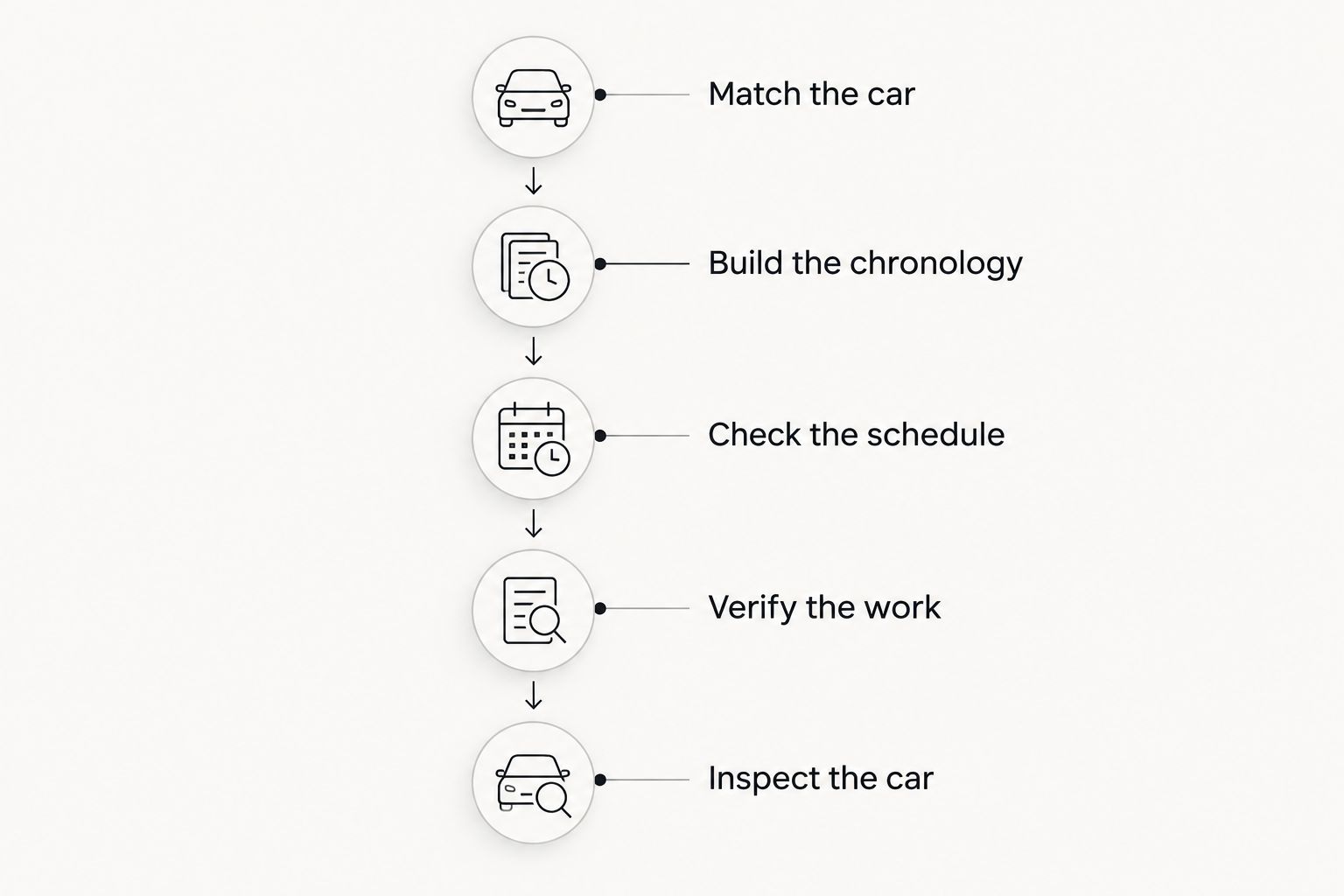
1. Match the car
Start with the vehicle identification number, or VIN. Compare the identifier on each available invoice with the car and its ownership documents. Do not rely on the model name or a previous owner’s name alone.
Check the workshop name, invoice date, recorded mileage, and description of the vehicle. If an invoice lacks a VIN, ask the workshop what information it needs to confirm that the document belongs to this car. Owner authorization can be necessary before a workshop discusses its records.
A discrepancy needs an explanation. It can be a clerical error, but you should not decide that yourself. Keep the document separate until its connection to the car is established, and avoid treating it as proof of completed maintenance.
2. Build the chronology
Arrange the records from earliest to latest. Create a simple working list with the date, odometer reading, workshop, work performed, and any unresolved recommendation. Keep original files alongside your summary so you can return to the source.
Look for mileage moving backward, conflicting readings, and changes between miles and kilometers. Ask whether an instrument replacement or recording error explains a discrepancy. A service invoice alone does not settle the car’s mileage history.
For a 2026 review, bring the chronology through the latest available service rather than stopping at the last major repair. Identify periods without documentation. Mark them as unverified periods, not as proof that the car received no maintenance.
3. Check the schedule
Use the manufacturer’s maintenance information for the exact model and configuration. Compare each required item with evidence of completion. Follow any time-based requirements as well as mileage-based requirements stated in that schedule.
Do not substitute another model’s intervals or a generic exotic-car checklist. Different engines, transmissions, and production configurations require their own references. Ask a specialist familiar with the car to resolve uncertain requirements.
When checking a supercar for sale in 2026, separate work that is documented, work that is due under the applicable schedule, and work whose status remains unclear. Low mileage is not evidence that every maintenance requirement has been met. Record the requirement and its supporting invoice together.
4. Verify the work
Read the line items. Look for named tasks, parts descriptions, workshop findings, and a clear distinction between completed work and recommendations. A broad entry such as a general service description leaves questions about its actual scope.
Separate an estimate from a final invoice. An estimate describes proposed work; it does not establish completion. Likewise, an invoice supports the stated work but does not independently establish the repair’s quality or the car’s present condition.
For significant repairs, ask what prompted the work, what was replaced or repaired, and whether follow-up checks were recorded. Repeated entries for the same concern deserve clarification. They do not, by themselves, establish either a successful repair or an unresolved fault.
5. Inspect the car
Give the organized records to an independent inspector familiar with the model. Ask the inspector to compare the documented work with the car’s condition and identify discrepancies within the agreed inspection scope.
A documented repair should inform the inspection, not remove that area from it. The inspector can assess accessible components and report limitations. An inspection is not a guarantee against hidden defects or future failures.
Keep the purchase decision separate from the paperwork review. Decide which unanswered questions must be resolved before you proceed, and put any inspection or document conditions into the transaction agreement. Do not let an approaching handoff turn unanswered questions into assumed answers.
Why this matters
A service history answers a narrow question: what maintenance and repairs can you document? It does not answer every question about ownership, accident history, modifications, or present mechanical condition.
For buyers, that distinction keeps a well-presented folder from becoming a substitute for inspection. For sellers, it helps establish what you can substantiate without making promises about the car’s future performance.
The useful outcome is a list of verified work and unresolved questions. That list gives the buyer, seller, workshop, and inspector something specific to address. It also prevents a vague statement about maintenance from carrying more weight than its evidence supports.
Which service documents carry useful evidence?
Different documents answer different questions. Keep them together, but do not treat them as interchangeable. Use this comparison to decide what each document establishes and what still needs checking.
| Document | Best for | Useful evidence | Limitation |
|---|---|---|---|
| Itemized final invoice | Verifying the stated scope of work | Vehicle details, dated tasks, parts, and workshop information | Does not establish current condition or independently verify workmanship |
| Service-book entry | Locating recorded service events | Dates, mileage, and workshop entries | Can omit the actual scope of work |
| Digital service record | Tracing entries in a service system | Recorded events associated with the vehicle | Completeness depends on what was entered into that system |
| Estimate or repair recommendation | Identifying proposed or deferred work | Suggested tasks and recorded concerns | Does not prove the work was completed |
| Independent inspection report | Assessing condition at inspection | Findings within the agreed inspection scope | Does not reconstruct every past service event |
Keep the distinction between a workshop’s finding and an owner’s explanation visible. Both can help your review, but they are different sources. If the owner says a recommendation was addressed elsewhere, request the corresponding record rather than deleting the concern from your list.
Why service-record quality varies
The quality of a service file depends on its contents and continuity, not simply on whether the car visited a dealership or an independent specialist.
- Document detail: Itemized tasks give you more to verify than an unexplained service entry. Ask what the entry includes.
- Workshop changes: Records can sit with several service providers. Request the relevant documents rather than assuming the current folder contains everything.
- Ownership changes: A seller’s file can cover only part of the car’s history. Identify which periods the documents actually support.
- Record format: Paper invoices, service books, and digital entries present different levels of detail. Compare them rather than choosing one format as automatically decisive.
- Repair complexity: A substantial repair needs an explanation of the original concern, the work performed, and any documented follow-up. A brief invoice description leaves that explanation incomplete.
Avoid turning any of these factors into an automatic verdict. A missing invoice is a verification task. An unexplained contradiction is a reason to pause until you understand it.
Does a full service history mean the supercar is sound?
A full service history does not establish current mechanical condition. It supports the maintenance chronology to the extent that the records are accurate and complete. The inspection still needs to assess the actual car.
Treat the phrase full service history as a claim to unpack. Ask whether it means all scheduled maintenance is documented, all ownership periods are represented, or simply that a service book accompanies the car. These are not the same statement.
Should you reject a supercar with missing service records?
Missing service records are not an automatic rejection. They leave part of the maintenance history unverified, which changes the questions you need answered before buying.
Ask the seller to seek duplicate records from the relevant workshops, with appropriate authorization. If the evidence cannot be recovered, decide whether the inspection findings and remaining uncertainty meet your purchase criteria. Do not describe an undocumented interval as verified maintenance.
Are dealership records better than specialist records?
Dealership records are not automatically more informative than specialist records. Judge the document by its connection to the car, its detail, and whether the issuing workshop can clarify the work.
An independent specialist’s itemized invoice can explain tasks that a brief dealership entry does not. The reverse is also possible. The workshop’s identity matters to your verification, but its category does not replace scrutiny of the actual record.
What should private sellers prepare before sharing records?
Prepare the file before introducing the car to a serious buyer. For a private sale in 2026, organize the available records chronologically and identify known gaps without trying to disguise them.
Separate service evidence from personal information. Remove unnecessary addresses, payment details, and previous owners’ contact information from the copies you share. Preserve the vehicle identifiers, workshop details, dates, mileage, and work descriptions needed for review. Keep the unaltered originals securely.
- Label estimates and final invoices distinctly.
- Keep unresolved recommendations visible.
- Note which questions require workshop confirmation.
- Explain any redactions without changing the substance of the record.
- Agree how an inspector will receive the supporting documents.
Discretion should protect people, not obscure the car’s history. A qualified buyer needs enough evidence to evaluate the car, even when the sale remains off-market. Agree on a controlled way to share that evidence.
Where private deal coordination helps
SV Sourcing is for buyers and sellers seeking private exotic-car sourcing and deal coordination. The service provides off-market sourcing and sales coordination in South Florida and nationwide, with one person coordinating the deal rather than a public inventory model.
For a buyer, the starting point is a clear specification, budget, timing, and due-diligence brief. For a seller, it is a clear account of the car, its supporting records, and the information needed for discreet introductions to serious buyers. Coordination does not replace the workshop’s explanation or the independent inspector’s assessment.
Felipe Cimino, CEO and co-founder of SV Sourcing, has identified buyers skipping a pre-purchase inspection as a firsthand concern. Use that distinction here: access to a car and confidence in its condition are separate matters. Neither a private introduction nor an orderly service file removes the need to verify the vehicle.
Discuss a private purchase or sale
Clarify your car specification, timing, and due-diligence questions.
FAQ
What should I check first in a supercar’s service records?
Check that the records belong to the car by comparing the VIN and other vehicle details. Then arrange the documents by date and mileage before assessing the work described.
Can service records replace a pre-purchase inspection?
Service records cannot replace a pre-purchase inspection. They document past work, while an independent inspection assesses current condition within an agreed scope.
What does a gap in service history mean?
A gap means you lack documentation for that period. It does not prove that maintenance was skipped, but you should seek supporting records rather than assume it was completed.
Is a service-book stamp enough to verify maintenance?
A service-book stamp does not establish the complete scope of maintenance. Request the corresponding itemized invoice or clarification from the workshop where available.
Should I ask about repeated repairs for the same problem?
Ask the workshop to explain repeated repairs for the same problem. Establish what prompted each visit, what work was completed, and whether follow-up findings were recorded.
How can I share service records without exposing personal details?
Share copies with unnecessary personal and payment information removed while preserving the vehicle and maintenance evidence. Retain the original documents and explain any redactions.
Does SV Sourcing replace the inspecting workshop?
SV Sourcing provides private exotic-car sourcing and sales coordination, not a substitute for independent inspection. Keep document verification and the inspector’s condition assessment as distinct parts of your purchase decision.
One last thing
For a 2026 purchase, keep unresolved recommendations beside completed repairs in your review. The invoice for work that was done can distract from a workshop’s separate note about work still requiring attention.
Ask what remains unresolved before asking whether the folder is complete. A clear answer gives you a better inspection brief and a firmer basis for deciding whether to proceed.