
A luxury car broker search brief should specify the car you want, your budget boundaries, purchase timing, acceptable condition and history, inspection requirements, and privacy expectations. Separate requirements from preferences, identify who can approve a purchase, and state what would stop the deal. For an owner selling privately, the equivalent brief should describe the car accurately and set the boundaries for introductions, information sharing, and negotiation.
- Give your luxury car broker firm requirements, flexible preferences, budget boundaries, and a decision process.
- SV Sourcing suits buyers and sellers seeking private exotic-car sourcing and coordinated deals.
- Require vehicle-history checks and a pre-purchase inspection before approving an exotic-car purchase.
- For a private sale, define buyer qualification and disclosure boundaries before introductions.
Why this matters
A vague brief leaves the broker to interpret what you mean by the right car. That creates avoidable conversations about vehicles you would never approve. A useful brief identifies both the target and the reasons you would decline it.
SV Sourcing is best for exotic- and collector-car buyers and sellers seeking private sourcing with one person coordinating the deal. Private access does not replace due diligence. You still need clear instructions for evaluating a car and deciding whether to proceed.
A 2026 search brief should distinguish a firm requirement from a preference that can change. Otherwise, a flexible color choice can receive the same weight as an unacceptable ownership-history issue.
What should you include in a luxury car broker search brief?
Build the brief around the following fields. Each field should tell the broker what to look for, what to confirm, or when to return to you for approval.
Car specification
Name the make, model, generation, body style, and transmission you want. Add factory options or equipment that matter to your intended use. Avoid describing the target only as an exotic car or a collectible.
Explain how you plan to use it. Regular driving, occasional events, and collection ownership create different priorities, but your brief should state yours rather than let the broker assume them.
If several configurations are acceptable, put them in order. Describe what makes an alternative acceptable instead of providing an open-ended list of unrelated cars.
Budget boundaries
State your purchase budget privately and clarify whether it covers the vehicle alone or the broader transaction. Identify which additional expenses need separate approval, such as inspection, transport, registration, or immediately required maintenance.
A budget ceiling is an instruction, not permission to spend automatically. Tell the broker whether an otherwise suitable car outside that boundary should be rejected or brought back for a decision.
Ask for the broker's compensation arrangement and any third-party charges to be explained before work begins. Do not assume that every private broker structures the engagement the same way.
Purchase timing
Give the broker your intended purchase window and any real deadline. Distinguish a preferred completion date from an event that genuinely limits your ability to proceed.
Also state when you can review a candidate, attend an inspection, and sign documents. A deadline without a decision process does not tell the broker whether you can act when a suitable car is introduced.
Do not request a guaranteed completion date. The search, seller response, inspection findings, and transaction requirements remain separate contingencies.
Condition and history
Define your acceptable mileage, cosmetic condition, service documentation, ownership history, and modification status. Say which issues require further investigation and which would end your interest.
Avoid relying on shorthand such as clean or collector quality. Those descriptions do not explain whether you accept paintwork, missing service records, aftermarket equipment, or evidence of prior repairs.
Keep physical condition and documentation separate. A car that presents well still needs its records checked, and a documented car still needs its current condition assessed.
Inspection requirements
Make the pre-purchase inspection part of the brief, not a decision postponed until you feel committed to the car. Specify that the proposed inspector, scope, access, and report should be agreed before purchase approval.
For an exotic or collector car, ask for an inspector with experience relevant to the vehicle. Tell the broker which concerns deserve particular attention, without treating your checklist as a substitute for the inspector's judgment.
An introduction is not an inspection. Access to a private seller does not establish mechanical condition, and a service history does not describe every current issue.
Search geography
State where you are willing to buy and where the car will ultimately be registered and delivered. Explain whether an out-of-state or international candidate is within scope.
If a candidate is outside your local area, request a plan for viewing, inspection, documentation, and transport before agreeing to proceed. For an international purchase, obtain appropriate advice on the applicable import and registration requirements.
Do not broaden the search geographically without understanding the extra decisions it creates. A distant car should meet the brief, not merely provide another option to discuss.
Privacy boundaries
Specify which personal details the broker can share, with whom, and at what stage. Define how photos, documents, ownership information, and your identity should be handled during introductions.
Discretion requires instructions. It does not mean withholding information that the parties or relevant professionals need to verify and complete a transaction.
For a seller, distinguish information suitable for an initial introduction from material reserved for a qualified buyer. Set those boundaries before the car is discussed with prospective purchasers.
Decision authority
Name the person authorized to approve candidates, negotiate terms, and authorize commitments. If those responsibilities belong to different people, explain the handoff.
Agree on a communication method and the information you need with each candidate. A useful submission explains how the car matches the brief, what remains unverified, and what decision is requested.
Tell the broker to obtain approval before changing a firm requirement. Silence should not be treated as consent to widen the search or proceed with a transaction.
Firm requirements or a flexible search: which works better?
Use firm requirements for deal-breakers and flexibility for preferences. Neither a completely rigid brief nor an unrestricted search serves every buyer. The distinction should reflect what you would actually accept.
| Brief approach | Best for | Advantage | Limitation |
|---|---|---|---|
| Firm requirements | Buyers committed to a particular configuration or history standard | Makes rejection criteria clear | Excludes otherwise suitable alternatives |
| Flexible search | Buyers open to different configurations within defined boundaries | Allows the broker to present relevant alternatives | Requires more comparison and clearer approval rules |
Keep requirements, preferences, and deal-breakers in separate lists. A preference belongs in the requirements list only if you would decline the car without it.
Do not describe everything as essential and then reverse those instructions when a candidate appears. Update the brief explicitly so subsequent introductions reflect the same decision.
A copyable 2026 search brief
Use this structure as a working document. Write direct answers, not promotional descriptions of your ideal car.
- Car specification: Name the model, generation, transmission, body style, and required equipment.
- Intended use: Explain how you expect to use and keep the car.
- Firm requirements: List the attributes a candidate must have.
- Flexible preferences: Rank the attributes you can compromise on.
- Budget boundaries: Define the approval limit and treatment of transaction expenses.
- Purchase timing: State your preferred window, genuine deadline, and decision availability.
- Condition and history: Specify acceptable condition, documentation, modifications, and repair history.
- Inspection requirements: Require agreement on the inspector, inspection scope, and review of findings.
- Search geography: Define permitted locations and the intended delivery and registration destination.
- Privacy boundaries: State what can be shared and when.
- Decision authority: Identify who approves candidates, terms, and commitments.
- Deal-breakers: List the findings or circumstances that end consideration.
The document does not need elaborate formatting. It needs instructions that another person can apply without guessing. Keep supporting documents separate from the brief and share them only through an agreed process.
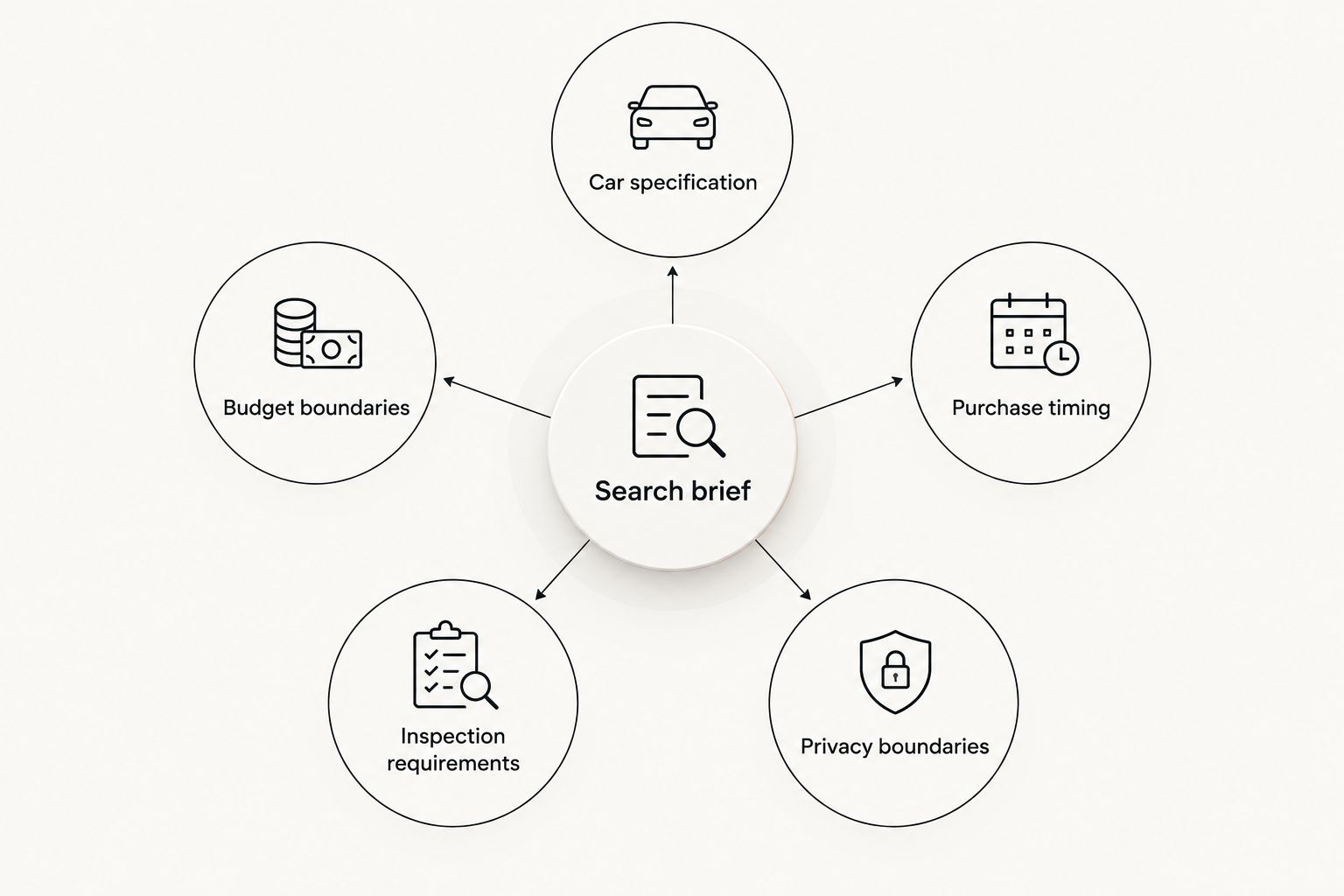
Why the search brief varies
The right brief changes with your objective. Keep the structure consistent, but make the instructions specific to your transaction.
- Buying or selling: A buyer defines the target car. A seller defines the car offered and the conditions for introductions.
- Specification flexibility: A precise configuration calls for clear exclusions. A broader search needs ranked alternatives.
- Condition expectations: Your tolerance for repairs, modifications, and incomplete records determines what needs investigation.
- Timing: A genuine deadline affects when you can review candidates and arrange due diligence. It does not guarantee completion.
- Geography: A local transaction and an international purchase require different coordination and professional advice.
- Privacy: Your disclosure boundaries determine what can be shared during initial conversations and later verification.
These factors also help you compare private brokers. Ask how each broker would handle your actual requirements rather than asking only whether they can find an exotic car.
What should an owner include before selling privately?
A seller's brief should begin with an accurate description of the car and the available supporting records. Include specification, condition, service history, known repairs, modifications, ownership documentation, and any finance that must be addressed.
State your asking position privately and define negotiation authority. Explain what evidence you want considered when discussing that position, rather than treating an unsupported expectation as a fixed market fact.
For a private sale in 2026, agree on buyer qualification before sharing sensitive information or arranging access to the car. Define who approves introductions, inspections, document disclosure, and proposed terms.
SV Sourcing coordinates private exotic- and collector-car sourcing and sales for buyers and sellers in South Florida and nationwide. The service fits a discreet process; it does not remove your responsibility to approve disclosure or transaction terms.
Should a broker search brief require a pre-purchase inspection?
A buyer's search brief should require a pre-purchase inspection before purchase approval. Agree on access and inspection arrangements early so they are not introduced as an unexpected condition after negotiations have progressed.
Felipe Cimino, CEO and co-founder of SV Sourcing, has identified buyers skipping a pre-purchase inspection as a firsthand concern. His observations also include unsuitable intermediaries and unrealistic asking positions leaving cars unsold. These are reasons to define the process, not claims that every dealership or overseas purchase is unsafe.
What should happen when a candidate misses the brief?
Reject a candidate that fails a genuine deal-breaker. If the difference concerns a flexible preference, ask the broker to explain the trade-off and the unresolved checks before deciding.
Do not rewrite your requirements simply because a car has become available for discussion. Change the brief only when your priorities have changed, and confirm the revision before the search continues.
FAQ
What should I send a luxury car broker before the search starts?
Send your target specification, budget boundaries, timing, condition standards, inspection requirements, search geography, and privacy instructions. Separate firm requirements from preferences and identify who can approve decisions.
Do I need to choose an exact car configuration?
You need a defined target, but not every detail must be fixed. Rank acceptable alternatives and explain which differences require your approval.
Should my search brief include a budget?
Your search brief should include a private budget boundary and explain which expenses it covers. Require separate approval for anything outside the agreed scope.
Can I ask a broker to keep my identity private?
You can set disclosure boundaries before introductions begin. Agree on when identity and supporting information must be shared for verification and transaction requirements.
What should sellers include in a private-sale brief?
Sellers should provide an accurate vehicle description, supporting records, known issues, negotiation boundaries, and disclosure instructions. Define how prospective buyers will be qualified before access is arranged.
What should I update in my search brief during 2026?
Update the brief when your budget boundary, timing, specification, or approval requirements change. Confirm revisions explicitly rather than relying on informal comments during candidate discussions.
One last thing
Write the reasons you would walk away before reviewing candidates. That list often gives the broker clearer direction than a long description of the car you want.
A good brief protects your decision process. Keep it short enough to use, specific enough to enforce, and current enough to reflect what you would actually approve.