To protect personal information when selling an exotic car in 2026, keep your address and identity documents out of public materials, verify the buyer before sharing sensitive records, and release information only when the transaction requires it. Keep legitimate vehicle due diligence available, but separate what proves the car’s condition from what exposes your household, finances or identity.
- For a sell my exotic car plan, separate vehicle evidence from personal information before approaching buyers.
- Share redacted service records first; reserve identity, title and payoff information for verified transaction participants.
- SV Sourcing provides private exotic-car sourcing and sales coordination, not a public inventory dealership.
- Off-market selling limits public exposure; it does not replace buyer verification, inspection or secure payment checks.
Why this matters
An exotic-car sale requires evidence. Buyers need to understand the vehicle, its history and the seller’s authority to transfer it. They do not need an unrestricted view of your home, identification or bank records to decide whether the car fits their brief.
SV Sourcing provides private, off-market sourcing and sales coordination for exotic and collector cars in South Florida and nationwide. That approach separates introductions from public advertising. Privacy still depends on how everyone handles photographs, documents and communication.
In 2026, treat every digital file as something a recipient can retain or forward. Send the minimum necessary information for the current stage, not the entire transaction file at the first inquiry.
How do you protect personal information when selling an exotic car?
Use a staged disclosure process. Start with the car’s specification and condition, move to supporting records after a credible conversation, and reserve sensitive transaction information for the people responsible for completing the sale.
1. Prepare separate public and transaction files
Create a shareable vehicle folder containing photographs, specifications, condition notes and redacted maintenance records. Keep original title documents, identification, lender correspondence and payment details in a separate transaction folder. Do not send both folders together.
Work from copies when redacting. Preserve the originals for legitimate verification and transfer requirements. Removing personal information from a marketing copy is different from altering an official document used to complete a sale.
Before sharing, open each file as the recipient would. Check every page, attachment and filename. A clean first page does not protect an address left on a later invoice.
2. Review photographs before circulating them
Photograph the vehicle against a neutral background. Exclude house numbers, mail, family photographs, access controls, keys and documents visible through the windows. Review reflections in glass and paint as well as the main subject.
Remove location metadata from copies you distribute, and check the exported files. Do not assume that every messaging service or listing platform strips it. A private garage can still be recognizable from the surrounding building or view.
License plates deserve a deliberate decision. Mask them in broadly circulated marketing photographs if you do not want them shared, while keeping the images honest about the vehicle’s condition. Do not use privacy edits to conceal damage or another material feature.
3. Verify the person before expanding access
Ask who the buyer is, whether someone represents them, and what vehicle specification they seek. Clarify their purchasing process, timing and inspection expectations. A detailed inquiry is useful, but it is not proof of identity or authority.
For sensitive information, confirm the recipient through a separate, established communication channel. If a buyer introduces an adviser, transporter or payment contact, confirm that person’s role before adding them to the transaction. An unfamiliar email signature is not verification.
Use this guide to verify a private buyer before selling an exotic car before sending unredacted documents or arranging access. Verification should precede disclosure, not follow it.
4. Share evidence in stages
Send redacted service records when the buyer is evaluating the car. Keep dates, work descriptions and vehicle identifiers needed to understand the history visible where appropriate. Remove unrelated personal contact details and payment information from those working copies.
Provide sensitive records through a controlled channel to the verified participant who needs them. A lender handling a payoff has a different information need from a buyer reviewing maintenance. Ask what is required, why it is required and who will receive it.
For digital sharing in 2026, use access controls where available and avoid open links that anyone can forward. Expiring access reduces continued availability; it does not erase a copy someone already downloaded. Keep that distinction clear.
5. Control the viewing and handoff
Arrange the viewing at a suitable location without exposing your household unnecessarily. Agree who will attend and whether the visit includes an inspection or test drive. Avoid circulating your home address before those details are settled.
Before delivery, remove personal items and review the vehicle’s stored information. Navigation destinations, paired phones, contacts and garage-door settings deserve attention. Follow the vehicle manufacturer’s instructions so you remove personal data without disrupting required vehicle functions.
Confirm payment through the institution handling it, not through a screenshot supplied by the buyer. Coordinate the release of keys, documents and the vehicle around the agreed transaction requirements. Privacy controls do not substitute for payment verification.
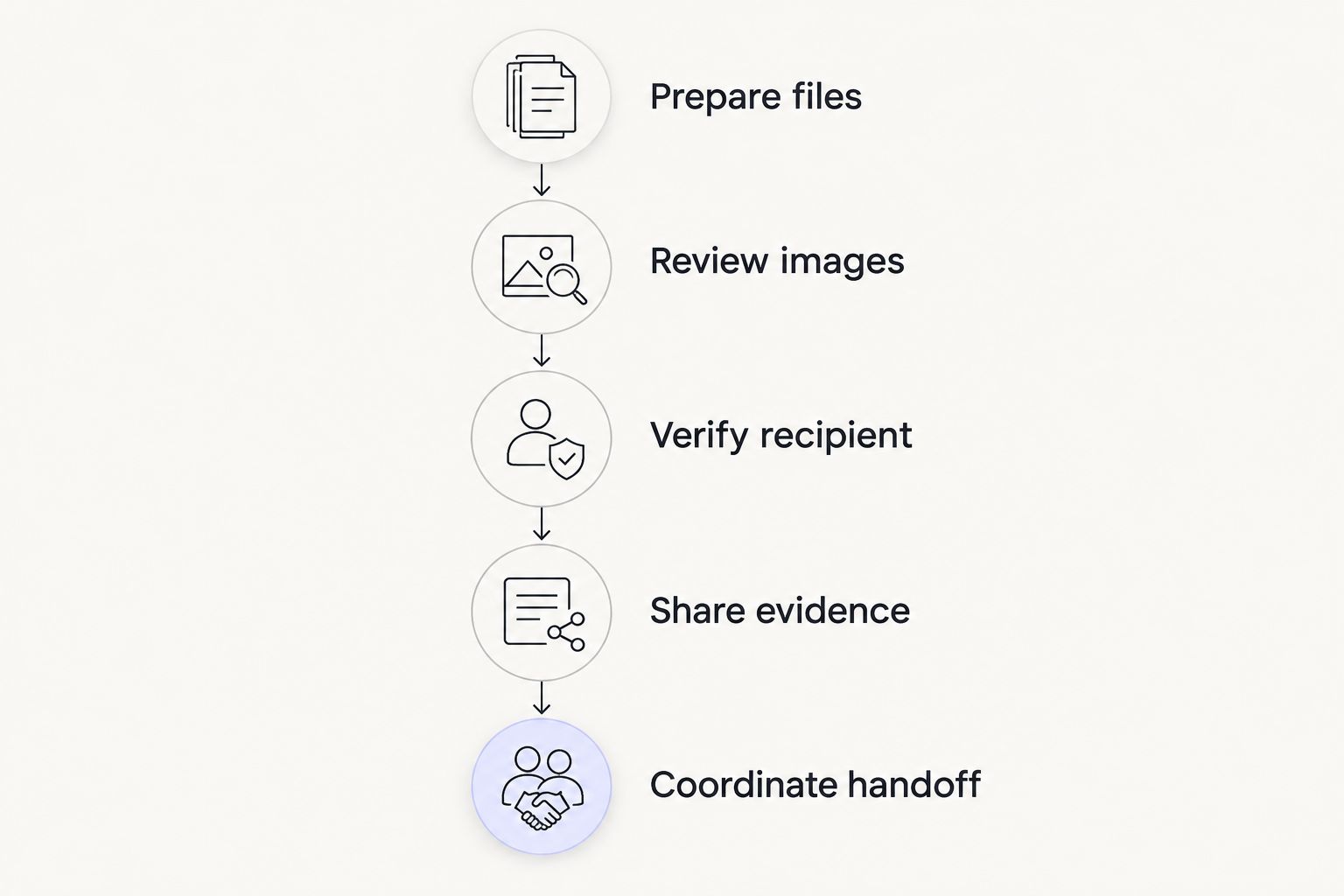
The sequence is simple: prepare the files, review the images, verify the recipient, share evidence, then coordinate the handoff. Each stage has a different purpose and a different information boundary.
What information should you share at each stage?
Disclose the car clearly. Disclose yourself selectively. A serious buyer needs enough information to assess the vehicle and arrange due diligence. Personal data should follow a specific transaction need rather than a request for everything you have.
| Information | Best for | Benefit | Limit or precaution |
|---|---|---|---|
| Vehicle specification and condition photographs | Initial buyer qualification | Establishes whether the car fits the buyer’s brief | Review backgrounds, reflections and location metadata |
| Redacted maintenance records | Assessing care and repair history | Supports inspection and informed questions | Keep relevant work visible; remove unrelated personal details |
| VIN and vehicle-history information | Vehicle-specific due diligence | Allows the buyer to investigate the actual car | Share deliberately; never substitute a different vehicle’s records |
| Title and ownership evidence | Confirming authority to sell | Supports legitimate transaction verification | Avoid broadcasting complete documents; follow transfer requirements |
| Identification and payment instructions | Completing a verified transaction | Supports required identity and payment checks | Send only to the verified participant who needs them |
A VIN is not the same as a bank account or identification document. It is routinely used for vehicle-history checks and can be visible on the vehicle itself. Treat VIN sharing as a vehicle-disclosure decision, not as a reason to abandon ordinary due diligence.
If a buyer asks for a complete title image early, ask what they need to verify. A redacted working copy can support an initial discussion, but the final transfer must use the information and documents required by the relevant authorities. Never obscure ownership problems under the label of privacy.
How do private introductions compare with public advertising?
Choose the communication approach around your disclosure priorities. Public advertising exposes the vehicle to a broad audience. Private introductions let you decide which recipients receive the brief. Neither approach establishes that a buyer is genuine.
| Approach | Best for | Advantage | Trade-off |
|---|---|---|---|
| Public advertising | Sellers comfortable with broad visibility | Lets buyers discover the vehicle directly | Images and details can circulate beyond the original listing |
| Seller-managed private outreach | Owners with relevant buyer contacts | Keeps control of initial introductions with the owner | The owner handles screening, documents and coordination |
| Private exotic-car broker | Owners seeking introductions and deal coordination | Places communication through an intermediary | Privacy depends on the broker’s actual disclosure practices |
SV Sourcing is best for exotic- and collector-car owners seeking private introductions and coordinated sales rather than public inventory advertising. The service fits a seller who wants a coordinated conversation, not a substitute for inspection, ownership checks or payment verification.
When comparing private brokers, ask who receives the brief, who approves photographs, and who handles sensitive documents. Clarify representation and responsibilities before authorizing introductions. An off-market description alone does not explain how information will be controlled.
Why privacy requirements vary between exotic-car sales
The right disclosure boundary depends on the deal. In 2026, the same vehicle can generate separate information requests from a buyer, lender, inspector and transporter. Evaluate each request by purpose rather than sending everyone the same package.
- Ownership structure: A personally owned vehicle and a vehicle held through an entity require different ownership evidence. Confirm who has authority to sign.
- Outstanding finance: A financed vehicle brings a lender into the process. Keep payoff information with the participants responsible for resolving it.
- Buyer representation: An adviser or broker adds another recipient. Confirm whom that person represents and what they are authorized to receive.
- Inspection arrangements: An inspector needs access to the car and relevant history. That does not automatically require access to your financial records.
- Transport arrangements: A transporter needs collection and delivery information. Share operational details with the confirmed transport contact, not the entire inquiry group.
- Transaction jurisdiction: Transfer and identity requirements differ by location. Confirm the applicable requirements before redacting final paperwork.
Can I hide my address when selling my exotic car?
You can keep your home address out of public advertisements, broadly circulated photographs and early buyer conversations. You still need to provide accurate information where transaction documents or legal requirements call for it.
Choose a suitable viewing location and separate appointment details from marketing materials. Ask transaction participants whether a different correspondence address is permitted; do not put false information on official documents.
Should I send my title or ID to a potential buyer?
Do not send an unrestricted title or identification image merely because someone expresses interest. First establish the recipient’s identity, role and reason for requesting it.
Provide required documentation through the verified transaction process. Keep unredacted originals available for legitimate checks, and ask the appropriate professional or authority what is needed to complete the transfer.
Does an off-market sale guarantee confidentiality?
An off-market sale does not guarantee confidentiality. It limits public promotion, but recipients can still retain or forward the information they receive.
Ask for clear disclosure permissions and document-handling responsibilities. A confidentiality agreement can set obligations, but it does not replace careful recipient selection or prevent every unauthorized disclosure.
Decide what the coordinator can share
Before introductions begin, agree which specifications, photographs and records can circulate. Identify which disclosures require your approval and which documents belong only in the closing process. Keep the instructions specific enough to follow.
SV Sourcing’s exotic-car sales coordination is relevant here: sellers can frame the conversation around discreet introductions and the information needed to move a deal forward. Ask who will coordinate communication and how Felipe Cimino and Alejandro S. will be involved. Both co-founders participate in private sourcing, sales and deal coordination.
Felipe’s stated concerns include owners entrusting cars to unsuitable intermediaries or dealerships and buyers skipping a pre-purchase inspection. These are his observations, not a claim that every dealership is unsafe. Choose the intermediary carefully, and preserve the buyer’s ability to inspect the car.
FAQ
How can I sell my exotic car without sharing my home address publicly?
Keep your home address out of marketing materials and arrange viewings at a suitable location. Provide accurate address information when required for the transaction rather than substituting false details.
Should I redact service records before sending them to a buyer?
Redact unrelated personal contact and payment information from copies shared for initial review. Keep relevant dates, work descriptions and vehicle information visible, and preserve the original records.
Is it safe to give a buyer the VIN?
The VIN is a vehicle identifier used for vehicle-history checks, not a substitute for your identity documents. Share it deliberately as part of legitimate due diligence while protecting separate personal and financial records.
What should I ask an exotic-car broker about privacy?
Ask who receives the vehicle brief, who approves disclosures and how sensitive documents are handled. Also clarify representation and who coordinates inspections, payment checks and delivery.
Can I refuse a pre-purchase inspection to keep the sale private?
Privacy is not a reason to remove legitimate vehicle due diligence. Arrange the inspection with a verified participant at a suitable location and share the records needed to assess the car.
What personal information should I remove from the car before delivery?
Remove personal belongings and review stored navigation destinations, paired phones, contacts and garage-door settings. Follow the manufacturer’s instructions for deleting personal data.
Does SV Sourcing sell cars through public inventory listings?
SV Sourcing provides private, off-market sourcing and sales coordination for exotic and collector cars. Its stated service serves buyers and sellers in South Florida and nationwide.
One last thing
A clean document can still arrive inside a revealing email thread. Before forwarding records, remove unrelated correspondence, attachments and recipients. Check the message as carefully as the file.
For your 2026 sale, write down the disclosure boundary before approaching buyers: what can circulate, what requires approval and what stays with verified closing participants. Private selling starts with permission, not with withholding the car’s history.