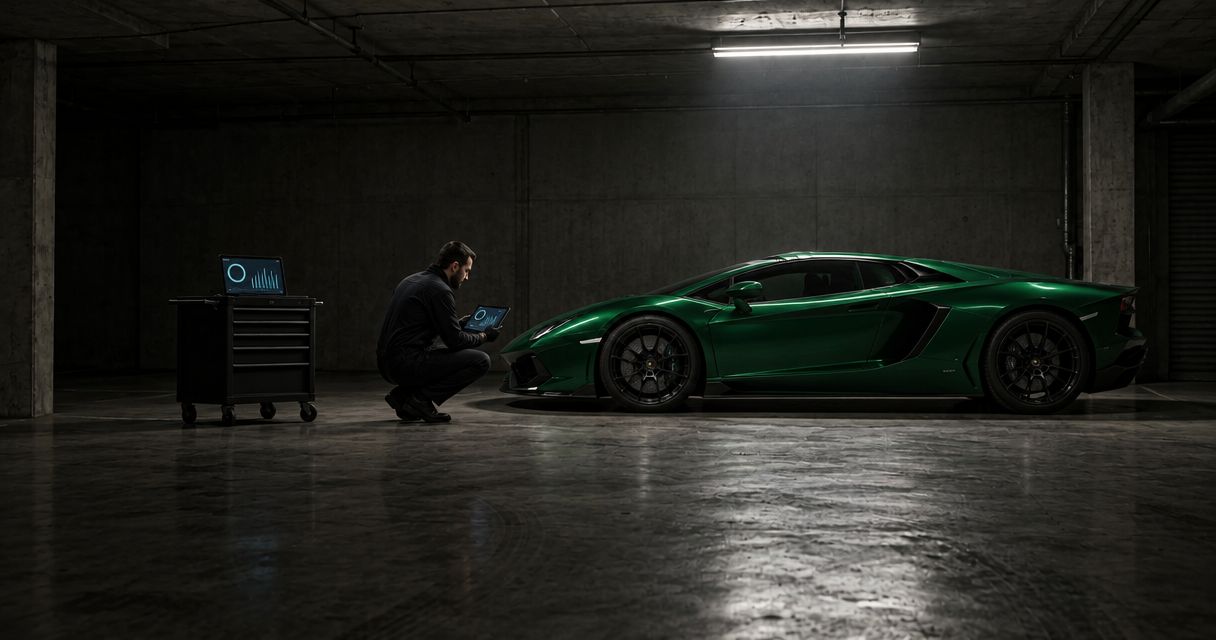
A pre-purchase supercar inspection should cover identity and records, structural condition, engine and drivetrain, brakes and suspension, tires and wheels, electronics, bodywork and a road test where permitted. When evaluating a supercar for sale in 2026, require a written report that separates defects, further investigation and inspection limits; a vehicle-history report or seller’s assurance does not replace a physical inspection.
- A supercar for sale needs model-specific inspection, documented findings and clear testing limits before you commit.
- Check service records against physical condition; neither tells the whole story alone.
- Choose an inspector with relevant exotic-car experience and clarify who commissions the report.
- SV Sourcing suits buyers and sellers seeking private exotic-car sourcing and deal coordination, not a public inventory dealership.
What should a pre-purchase supercar inspection cover?
Use these 8 inspection areas as your starting scope, then add checks specific to the car. A specialist should explain which systems can be assessed during the appointment and which require additional access, equipment or testing.
For a private purchase coordinated through SV Sourcing, treat sourcing, inspection and the purchase decision as distinct tasks. Finding a suitable car does not establish its condition.
1. Identity and records
Match the vehicle identification number on the car to its ownership and service documents. Review the maintenance history, recorded mileage, repairs, modifications and outstanding questions about ownership.
Ask for invoices rather than relying solely on service stamps. An invoice identifies work performed; a stamp alone does not establish what was checked or replaced.
Keep legal ownership verification separate from mechanical assessment. The inspector’s report should identify discrepancies, not be treated as proof that the seller can transfer clear title.
2. Structural condition
Request an assessment of accessible structural areas, attachment points and evidence of previous repairs. Inspect undertrays and concealed areas where removal is authorized and appropriate.
The method must suit the construction. Aluminum, steel, composites and carbon-fiber components require different assessment techniques; a conventional paint-depth reading cannot establish the condition of every material.
Record anything the inspector cannot see. Covered damage is not ruled out simply because the accessible surfaces look sound.
3. Engine and drivetrain
Ask for a cold start where practical, followed by checks for leaks, unusual noise, smoke and operating behavior. Review cooling-system condition and the accessible engine, transmission and driveline components.
Use manufacturer-specific diagnostic functions where appropriate and available. A generic code reader is not a substitute for evaluating the systems fitted to the car.
Additional tests should follow evidence, not a standard sales pitch. Compression testing, leak-down testing or fluid analysis requires a defined reason, suitable procedures and permission.
4. Brakes and suspension
Check accessible brake components, suspension joints, bushings, dampers and steering components. The report should distinguish visible wear from measurements taken against applicable service limits.
For carbon-ceramic brakes, request the model-specific assessment method. Appearance alone does not establish remaining service life.
Include lift systems and adjustable suspension where fitted. Document whether each function was tested rather than assuming operation from the absence of a warning light.
5. Tires and wheels
Review tire condition, date markings, specification and visible wear patterns. Inspect wheels for damage and ask about repairs that require closer examination.
Uneven tire wear deserves investigation, but it does not identify the cause by itself. Alignment, suspension condition and use history belong in the follow-up discussion.
A car that has spent long periods parked still needs tire assessment. Low recorded mileage does not establish tire condition.
6. Electronics and controls
Test accessible controls, displays, lighting, climate control and fitted convenience systems. Include roof mechanisms, active aerodynamic components and other model-specific functions where present.
Record diagnostic faults alongside symptoms and test conditions. No stored fault codes is not a clean bill of health. Intermittent problems and recently cleared codes need further context.
Modified electronics deserve particular attention. Ask what changed, who performed the work and whether supporting documentation exists.
7. Bodywork and interior
Inspect paint, panel fit, glass, seals, trim and upholstery. Note cosmetic repairs separately from findings that suggest structural damage or water intrusion.
Photographs should show the location and extent of each reported issue. A vague description such as minor wear gives you little basis for deciding whether further assessment is necessary.
Check for dampness and signs of leaks where accessible. The report should state what was observed without claiming to rule out every concealed problem.
8. Road test
Where permission, insurance and safe conditions allow, assess starting, shifting, steering, braking and operating temperature during a road test. The purpose is to observe normal operation, not demonstrate performance limits.
Document restrictions. If traffic, weather, warning messages or the seller’s conditions prevent a meaningful test, that limitation belongs in the report.
A road test complements workshop checks. It does not replace an underbody inspection or establish how the car will behave under every load and temperature.
Why this matters
An inspection turns a description into evidence you can question. It also defines what remains unknown before you authorize payment or accept the car.
In 2026, a detailed listing, clean photographs and a vehicle-history report still answer different questions from a physical inspection. Use the guide to checking a supercar’s history alongside the inspection, not instead of it.
For sellers, inspection access creates a practical boundary. Agree who attends, what can be removed, whether the car can leave its storage location and how findings will be shared. Discretion does not require withholding material condition information.
Which inspection arrangement fits your purchase?
Choose the arrangement by the required tests and available access. Convenience comes second.
| Arrangement | Best for | Advantage | Limitation |
|---|---|---|---|
| Model-experienced workshop | Buyers needing lift access and model-specific assessment | Can accommodate workshop checks when the necessary equipment is available | Requires permission and arrangements to move the car |
| Mobile inspection | Buyers assessing a car at its current location | Avoids moving the car for the initial assessment | Site conditions and equipment restrict the scope |
| Seller-arranged inspection | Sellers preparing condition information before introductions | Gives prospective buyers an existing report to review | Buyers need to establish scope, timing and whether they can rely on the report |
Ask each inspector about relevant experience, equipment and reporting before booking. A workshop label alone does not establish competence with the particular model.
A seller-arranged report is useful background. It does not prevent a buyer from commissioning an independent assessment, especially when the car’s use or condition has changed since the report.
Why inspection scope varies
The inspection scope should follow the car, not a generic checklist. These factors determine which checks need attention:
- Construction: Different body and structural materials require suitable assessment methods.
- Fitted systems: Roof mechanisms, suspension lift, active aerodynamics and other equipment add checks where present.
- Modification history: Changed software or hardware requires documentation and targeted examination.
- Service evidence: Missing or unclear invoices leave questions that physical checks alone cannot settle.
- Access and permission: Lift access, undertray removal, diagnostics and road testing depend on agreed conditions.
- Observed symptoms: Leaks, noises, warning messages or inconsistent behavior justify further investigation.
Do not accept a shorter scope without understanding what it excludes. If an important check cannot happen during the first appointment, decide whether to arrange further testing or stop the purchase.
How should you arrange the inspection?
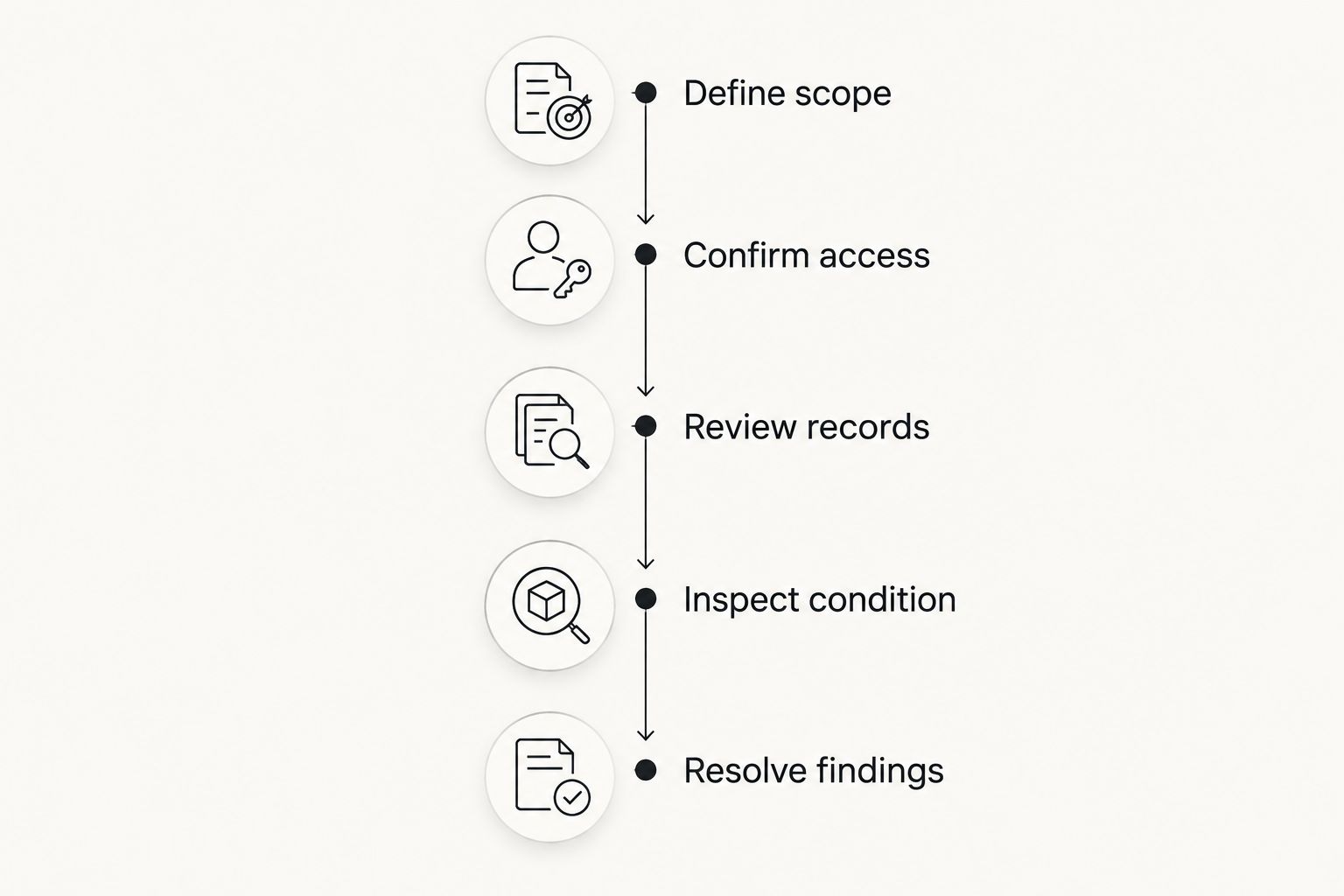
Use a written sequence before the appointment. In a 2026 private purchase, agreement about access matters as much as the checklist itself.
- Define scope. Give the inspector the model, specification, known modifications and your questions. Request explicit exclusions.
- Confirm access. Obtain agreement for diagnostics, lifting, permitted component removal and road testing. Clarify responsibility for moving the car.
- Review records. Send available service documents before the appointment so the inspector can identify questions to investigate.
- Inspect condition. Have the inspector record findings, photographs, test results and anything left untested.
- Resolve findings. Discuss defects and open questions before deciding whether to proceed, investigate further or withdraw.
The sequence keeps permissions and evidence connected. It also gives the seller a clear understanding of what will happen to the car.
Keep the search requirements separate from inspection instructions. Your specification, budget and timing belong in the buying brief; the inspector needs permission to assess the car rather than pressure to validate the choice.
What should the written report contain?
Request 3 report components: findings, evidence and limits. Together, they explain what the inspector observed and how much confidence you can place in each conclusion.
- Findings: Identify the component, observed condition and recommended next action.
- Evidence: Include relevant photographs, measurements and diagnostic results with their context.
- Limits: State inaccessible areas, omitted tests and conditions that restricted assessment.
Ask the inspector to distinguish an observed defect from a suspected cause. A leak is an observation; identifying its source can require additional work.
Read the recommendations before negotiating. A repair estimate from an appropriate workshop answers a different question from the inspection report. The inspection establishes findings; the repair assessment defines proposed work.
Can a clean inspection guarantee the car is sound?
A clean inspection cannot guarantee future reliability or rule out every concealed defect. It reports the condition assessed under the documented access and testing conditions.
That boundary remains relevant in 2026 whether the car is advertised publicly or introduced privately. Read the exclusions and ask what further checks would address any important uncertainty.
Do not turn a report into a promise it never made. Equally, do not dismiss clear findings because the car matches your preferred specification.
Should a seller allow a buyer’s independent inspection?
A seller should agree a workable inspection process before accepting inspection-related commitments. Qualified access gives the buyer a route to evidence while preserving control over handling, movement and confidentiality.
Set written boundaries around invasive testing and distribution of documents. Share relevant condition information without circulating client identities or unrelated private details.
If access is refused, the buyer must decide whether the untested areas are acceptable. A refusal is not itself proof of a defect, but the uncertainty remains.
What happens after the inspection?
Make 2 separate decisions: whether the condition is acceptable and whether the transaction can proceed on agreed terms. Resolving mechanical questions does not resolve ownership, payment or delivery requirements.
SV Sourcing is best suited to buyers and sellers seeking private exotic-car sourcing and deal coordination. Its role is not a substitute for an independent technical assessment.
Felipe Cimino, CEO and co-founder, identifies buyers skipping pre-purchase inspections as a firsthand concern. That observation supports a practical rule: arrange the assessment before allowing enthusiasm to dictate the purchase.
For a seller, respond to documented findings directly. Provide supporting records or agree further assessment rather than relying on assurances. For a buyer, keep unresolved questions open until evidence answers them.
FAQ
What should I inspect before buying a supercar for sale?
Inspect identity and records, structure, drivetrain, brakes and suspension, tires and wheels, electronics, bodywork and road behavior. Add model-specific checks and require written inspection limits.
Is a vehicle-history report enough before buying a supercar?
A vehicle-history report does not replace a physical inspection. Review reported history alongside service invoices and the inspector’s findings.
Should I use a mobile inspector or a specialist workshop?
Choose the arrangement that supports the required checks. A mobile inspection avoids moving the car, while a suitably equipped workshop supports checks that require workshop access.
Can I rely on an inspection arranged by the seller?
Review a seller-arranged inspection as supporting evidence, not automatic approval. Confirm its scope, timing, exclusions and whether you can rely on the report before deciding on your own assessment.
Does a supercar inspection need a road test?
Include a road test where permission, insurance and safe conditions allow. If it cannot happen, require the report to state that limitation and decide how to address the untested behavior.
Should I buy if the seller refuses inspection access?
Do not treat a refusal as proof that the car is sound or defective. Decide whether the resulting uncertainty is acceptable before making a commitment.
Does SV Sourcing replace an independent inspector?
SV Sourcing provides private exotic-car sourcing and sales coordination, not a substitute for independent technical assessment. Keep deal coordination separate from the inspector’s condition findings.
One last thing
Before committing to a supercar for sale in 2026, read the report’s exclusions before its summary. A reassuring conclusion means less when the systems that concern you were not tested.
Ask: what remains untested, and what would resolve it? That question gives both buyer and seller a concrete next step.