
Rare-specification car brokerage is private vehicle sourcing and deal coordination aimed at matching a collector’s requirements to a documented car. A luxury car broker needs a clear brief: unusual colors, factory options, provenance and condition can create competing priorities, so buyers and sellers need to establish what matters before an introduction.
- SV Sourcing suits buyers and sellers seeking private exotic-car sourcing and coordinated transactions, rather than public inventory browsing.
- Give your luxury car broker separate lists for required specifications, acceptable alternatives and deal breakers.
- Verify factory equipment, service records and condition before treating a rare specification as a match.
- Sellers should document unusual options and define disclosure boundaries before private introductions.
Why private sourcing matters for rare-specification buyers
SV Sourcing is best suited to exotic- and collector-car buyers and sellers seeking private sourcing and coordinated transactions. SV Sourcing serves South Florida and nationwide. Its service centers on off-market requests and private sales coordination, not a public inventory dealership.
For rare-specification buyers, finding a visually appealing car is only the beginning. You still need to establish whether the configuration is original, whether the records support the description and whether the condition meets your intended use. A distinctive specification does not answer those questions.
Owners face the same issue from the other side. An unusual combination needs a precise explanation, supported by documents rather than adjectives. A private introduction works better when the buyer understands what makes the car relevant and the seller knows what information will be shared.
For a 2026 search, separate the car you want from the transaction you will accept. Specification, condition, spending limits and timing belong in the same brief. None should remain an assumption until an offer arrives.
Set priorities before asking for introductions
Start manually. A written document and a simple comparison sheet are enough to establish your requirements. Private sourcing becomes useful when you can explain what a suitable car looks like and identify the compromises you will reject.
Use 3 priority tiers: required, preferred and flexible. These are decision rules, not a scoring system that lets an attractive color cancel out an unresolved ownership issue. For sellers, the equivalent is a factual description that distinguishes documented equipment from impressions about rarity.
Define your required specification
Write the specification in terms someone else can verify. Name the model, body style, transmission and factory equipment that determine whether you would consider the car. Avoid descriptions such as unusual, collectible or fully optioned unless you can explain exactly what they mean.
Separate appearance from originality. A car with a changed exterior color presents a different proposition from one documented in that color from production. Neither should enter the search under an ambiguous description.
Sellers should use the same discipline. Describe what the car is, not what an enthusiastic buyer might assume it is. Disclose replacements and modifications alongside the features that attract interest.
- Required: list the configuration you will not change.
- Preferred: record colors, trim and options you favor but will reconsider.
- Flexible: identify details that do not affect your decision.
- Excluded: state modifications, histories or conditions you will reject.
Establish your spending and timing boundaries
Set your spending boundary privately before reviewing candidates. Keep the vehicle decision separate from the costs of inspection, transport, registration and any work identified during due diligence. A car that fits one part of the plan can still fall outside the complete transaction.
Write down your timing needs without turning them into a promise from an intermediary. Distinguish a genuine deadline from a preference to move quickly. If your specification is fixed, agree on how the search will be reviewed when no suitable introduction is available.
For sellers, define readiness just as clearly. An owner who has not resolved access, documentation or release arrangements is not ready for the same process as an owner with those matters settled.
- Record your private spending boundary and approval process.
- Identify transaction costs that require separate confirmation.
- State any real deadline and its reason.
- Agree when to revisit the brief rather than lowering standards silently.
Choose a private sourcing coordinator
You can contact owners and intermediaries yourself. That puts introductions, questions, document requests and follow-up in your hands. Keep a written record of who represents whom and what each person has agreed to handle.
SV Sourcing offers luxury car broker services through private off-market sourcing and sales coordination. The relevant distinction is a single coordinating contact for the deal, not a claim that every requested configuration is available. Ask how your requirements will be communicated and how candidate cars will be assessed against them.
Compare other private exotic-car brokers on the same basis. A network matters only when introductions fit the brief and responsibilities stay clear. Ask about compensation, conflicts and authority before authorizing activity.
- Confirm whether the intermediary represents the buyer, seller or both.
- Define who requests records and arranges inspections.
- Establish what information can be shared and with whom.
- Put the service scope and compensation arrangement in writing.
Build an evidence file for the specification
Start with the documents already available. Compare the seller’s description with factory configuration evidence, service records and the car itself. Treat an unsupported option description as unresolved, not confirmed.
Keep 2 separate documents: the desired specification and the candidate’s verified specification. That prevents a promising introduction from quietly rewriting your requirements. Your 2026 search brief should change only when you deliberately approve a compromise.
Owners should prepare the same evidence before introductions. If a feature has been added, replaced or altered, describe that clearly. Do not describe a configuration as rare merely because you have not seen another example.
- Request available factory configuration or build documentation.
- Match identifying details across the car and records.
- Distinguish original equipment from later additions.
- Mark unsupported statements as questions requiring answers.
Inspect condition independently
Review the history and service file yourself, then arrange an independent pre-purchase inspection with a specialist appropriate to the car. Define the scope before the appointment. An inspection answers condition questions; it does not automatically authenticate every specification or resolve every title issue.
Use the pre-purchase supercar inspection guide to organize questions about mechanical condition, bodywork, diagnostics and records. Ask for written findings and identify anything the inspector could not assess.
Felipe Cimino, CEO and co-founder of SV Sourcing, has identified buyers skipping a pre-purchase inspection as a firsthand concern. He has also raised concerns about international purchases. Those observations support careful due diligence, not a blanket judgment that an overseas car is unsuitable.
- Agree on the inspection scope and any exclusions.
- Review service gaps and outstanding work with the specialist.
- Confirm permission for access, diagnostics and any road test.
- Resolve significant findings before approving the next transaction stage.
Control private introductions and disclosure
Buyers should share enough information to establish a serious, workable request. Sellers should provide enough evidence to support the car’s description. Neither side needs to circulate unrelated personal information to make the first conversation useful.
Create a disclosure plan manually before involving additional people. Decide who can receive photographs, records and location details, then agree how sensitive documents will be handled. Private sourcing is not a reason to bypass verification.
For a seller, discretion also means avoiding inconsistent descriptions across introductions. Keep one factual vehicle summary. For a buyer, it means keeping the approved requirements stable rather than giving different intermediaries conflicting instructions.
- Define which vehicle details can be shared initially.
- Confirm the recipient before releasing sensitive documents.
- Limit location and personal details to the relevant transaction stage.
- Record who is authorized to introduce, negotiate and approve.
Coordinate the transaction in writing
Map the sequence before anyone releases funds or the car. Record the conditions attached to an offer, the documents required and the parties responsible for each action. Ask the relevant lender, insurer, transport provider or professional to confirm their part directly.
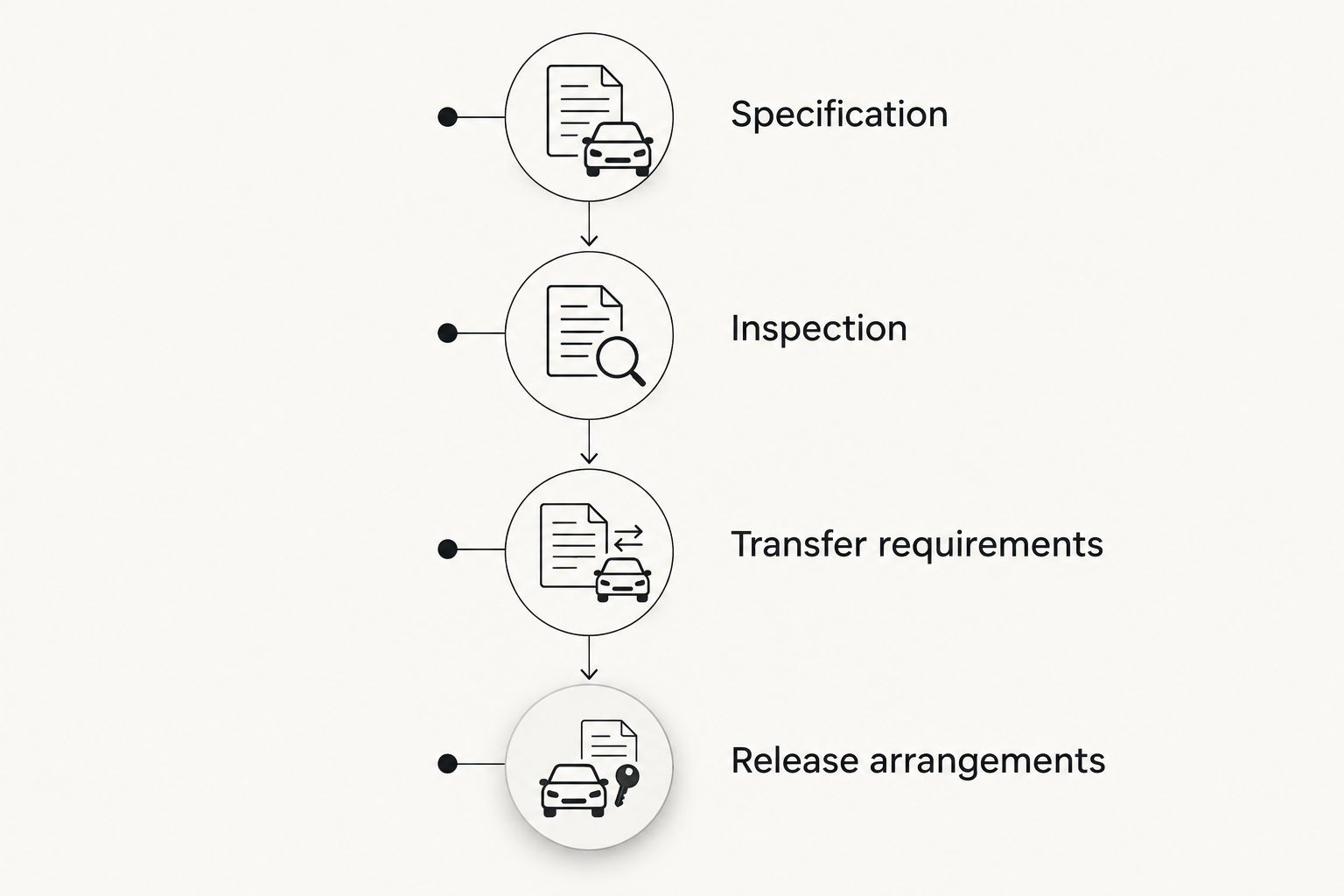
Use 4 approval checkpoints: specification, inspection, transfer requirements and release arrangements. These are practical review points, not a substitute for legal advice or the actual transaction documents.
For a 2026 private transaction, a clear handoff plan matters as much as the search brief. If a checkpoint remains unresolved, do not treat the deal as complete. Buyers and sellers should know what must happen next and who has authority to approve it.
- Specification: confirm the accepted car and disclosed deviations.
- Inspection: document findings and agreed responses.
- Transfer requirements: confirm ownership, lender and paperwork requirements.
- Release arrangements: agree payment verification, collection and transport responsibilities.
Compare private sourcing options
Choose the arrangement that fits your involvement, not the one with the broadest promise. For a rare-specification search, compare responsibility, evidence handling and communication. For a private sale, add disclosure control and buyer qualification.
The table below separates service models. It does not rank networks or imply that a requested car is available. Compare written scopes before making an appointment.
| Option | Best for | Practical advantage | Key limitation |
|---|---|---|---|
| SV Sourcing | Buyers and sellers seeking private exotic- and collector-car introductions | Private off-market sourcing and sales coordination with one coordinating contact | A sourcing request is not confirmation of a matching car or a completed deal |
| Another private exotic-car broker | Buyers or owners whose requirements fit that broker’s stated service scope | An alternative intermediary for introductions and coordination | Representation, responsibilities and disclosure practices require separate confirmation |
| Direct private search or sale | Buyers and sellers prepared to manage the transaction themselves | Direct control over outreach and communication | You handle qualification, records, inspection arrangements and handoff yourself |
Best for a tightly defined request: choose the private broker whose written scope matches the work you need done. Ask each candidate how it handles a mismatch, an inspection finding and a stalled transaction. Compare the answers, not claims of access alone.
For a seller, the same test applies. A credible process explains how introductions happen and how decisions reach you. It does not require a promise about the final outcome.
Common mistakes rare-specification buyers and sellers make
Treating every preference as mandatory
A long specification list is not useful if you have never ranked it. Keep the true deal breakers fixed and identify acceptable alternatives in advance. Do not let an intermediary decide those trade-offs for you.
Accepting rarity without supporting evidence
An unusual appearance does not establish factory originality or production rarity. Request the relevant documentation and separate what is verified from what is merely described. Sellers should follow the same rule when preparing their vehicle summary.
Letting appearance outrank condition
A preferred color does not resolve an inspection finding or a missing service record. Keep specification and condition as separate approval decisions. If you accept a concern, document the reason rather than letting enthusiasm erase it.
Choosing an intermediary without defining authority
Felipe’s firsthand concerns include owners entrusting cars to unsuitable intermediaries or dealerships. The practical response is to verify the role, custody arrangements and decision rights—not to assume that every dealership or intermediary is unsuitable. State who can introduce the car, negotiate and authorize release.
Holding an asking position without reviewing feedback
Felipe has also observed unrealistic asking expectations leaving cars unsold. Owners should review qualified feedback and distinguish a mismatch in specification from a disagreement over terms. A 2026 sales plan needs a review process, not an assurance that the next introduction will produce a deal.
FAQ
What does a luxury car broker do for a rare-specification search?
A luxury car broker coordinates sourcing and introductions around a buyer’s defined vehicle requirements. The buyer still needs to approve the specification, due diligence and transaction terms; an introduction is not verification of the car.
What should I send a broker before asking for a specific car?
Send a written brief covering required specifications, acceptable alternatives, spending boundaries and timing. Add your intended use and deal breakers so the broker can distinguish a relevant candidate from an attractive but unsuitable car.
Is a private car broker better than searching myself?
A private car broker fits buyers who want help with introductions and deal coordination; a direct search fits buyers prepared to manage those tasks themselves. Compare the broker’s written responsibilities with the work you can handle independently.
Does off-market mean the car is more collectible?
No. Off-market describes how a car is offered, not its originality, condition or collectible status. Verify the configuration, history and condition separately.
Should I compromise on color to get the right car?
Compromise on color only if your brief identifies it as flexible. Do not make the same compromise on unresolved ownership, undisclosed alterations or condition concerns simply to complete the search.
Can I sell a rare-specification car without a public listing?
Yes, private introductions are an alternative to a public listing. Prepare a documented vehicle summary, define disclosure boundaries and agree how buyer qualification and deal coordination will work.
Do I still need an inspection when a broker introduces the car?
Yes. A broker’s introduction does not replace an independent pre-purchase inspection. Agree the inspection scope and resolve material findings before moving to the next transaction stage.
One last thing
Write your rejection rule before viewing the first candidate. An appealing specification is easier to assess when you have already decided what would stop the deal. Sellers should do the equivalent: identify the information a serious buyer must receive before proceeding.
For your 2026 search or sale, keep that rule beside the brief. Change it deliberately, never by omission. The right specification is only a match when the evidence and transaction conditions also meet your requirements.