
A private exotic-car sales agreement should identify the buyer, seller and car; record the agreed payment terms, disclosures and inspection conditions; and define how title, possession and risk transfer. It should also explain what happens if financing, inspection, payment or delivery does not proceed as agreed—before either party releases money, documents or the car.
- Before you sell my exotic car becomes a transaction, document payment, title, inspection and handoff conditions.
- SV Sourcing fits buyers and sellers seeking private exotic-car sourcing and sales coordination, rather than public inventory browsing.
- Separate the vehicle sales agreement from the broker agreement; each governs different responsibilities.
- Require verified payment and a documented release process before handing over the car.
Why this matters
A private introduction does not settle the terms of a sale. The buyer and seller still need a written record of what each has accepted, what remains conditional and who can authorize release.
For a 2026 transaction, build the agreement around the actual car and closing arrangements—not a generic promise to complete later. A signature should confirm a defined deal, not leave the difficult decisions for collection day. This is a practical checklist, not a substitute for legal advice on the governing state law.
What should a private exotic-car sales agreement cover?
Use the following checklist before signing. Match every statement to supporting records, and resolve inconsistencies rather than leaving conflicting descriptions in separate documents. Start with the documents needed to sell an exotic car.
| Agreement section | What to record | What it does not replace |
|---|---|---|
| Parties and authority | Legal names, contact details and authority to sell or purchase | Verification of identity and signing authority |
| Vehicle identity | VIN, model, odometer reading and included items | Inspection of the actual vehicle and records |
| Condition and disclosures | Known issues, modifications and written representations | Independent due diligence |
| Inspection conditions | Scope, access, deadline and consequences of findings | An inspection report |
| Payment and deposit | Agreed amounts, payment method, recipient and release conditions | Independent payment confirmation |
| Title and liens | Ownership documentation, lien handling and transfer responsibilities | Required title and lender procedures |
| Delivery and risk | Collection location, transport responsibility and transfer point | Confirmation of applicable insurance coverage |
| Cancellation and disputes | Termination rights, notices, remedies and governing law | Advice from qualified counsel |
Do not treat this table as contract language. Use it to identify the decisions the final agreement must express clearly.
Identify the parties and the car
Use the names that belong on the transaction documents. If an entity, representative or intermediary signs, establish whose interests that person represents and what authority permits the signature. Do not assume the person arranging a viewing owns the car.
Modern standardized VINs contain 17 characters. Match the VIN on the vehicle to the ownership records and agreement; older collector cars can use different identification formats. Record the odometer reading and any required mileage disclosure accurately rather than relying on an advertisement.
List included items separately. Keys, service records, original components and accessories should appear only when they are actually part of the deal. A buyer should not have to infer whether a pictured item comes with the car.
Record condition without overstating certainty
Describe known faults, accident or repair information, modifications and relevant documentation accurately. Distinguish a seller's personal knowledge from information supplied by a prior owner, workshop or report. Avoid turning an assumption into a contractual representation.
If the parties intend an as-is sale, have counsel check the wording and its effect under applicable law. An as-is clause is not a substitute for accurate disclosure. Do not assume it eliminates every obligation or resolves inconsistent promises elsewhere in the agreement.
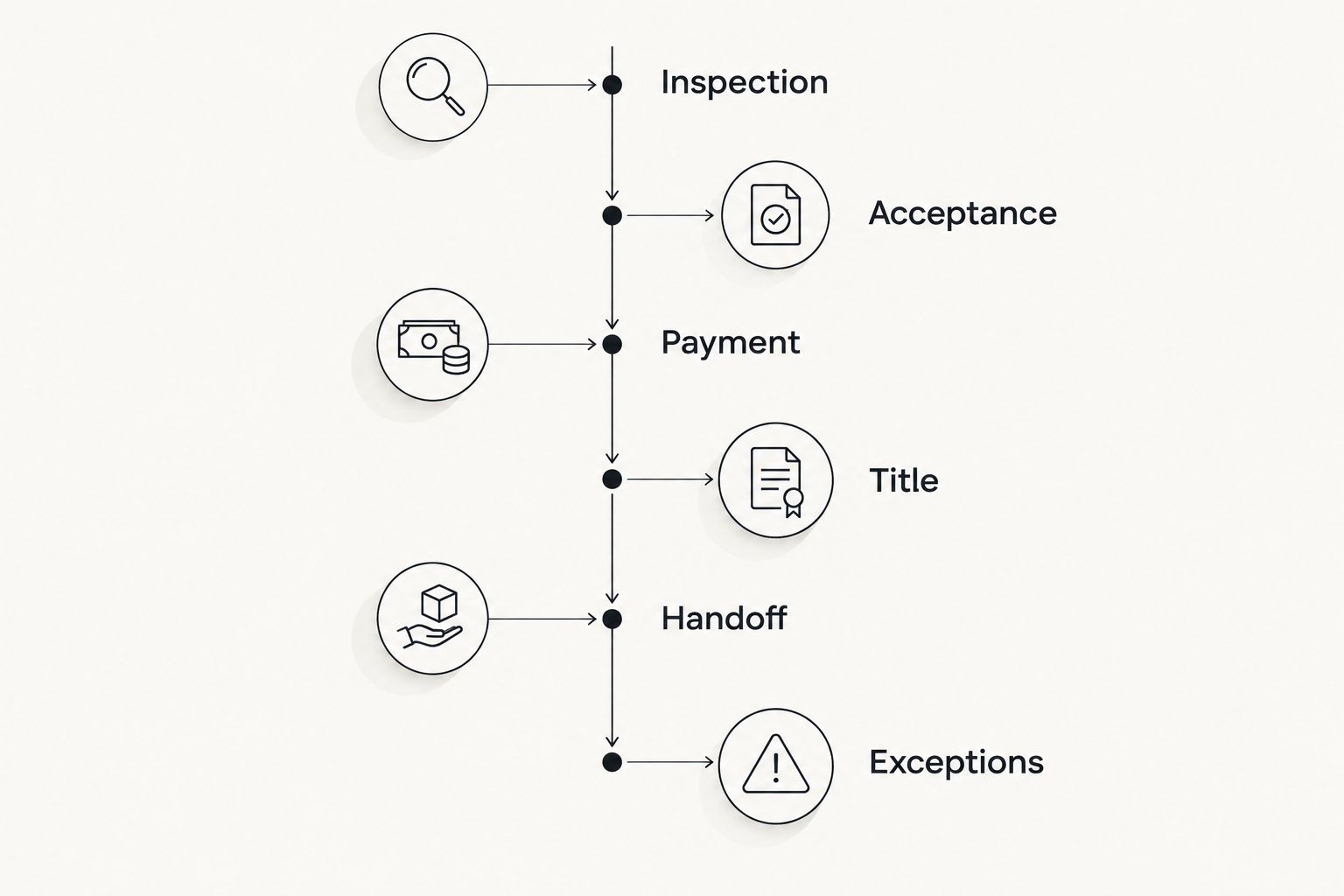
A 2026 closing checklist: put the sequence in writing
The agreement should describe an executable sequence. Use named responsibilities and defined conditions, not loose phrases such as payment pending or delivery to follow. Give each party 1 signed copy of the final agreement, including every incorporated attachment.
1. Inspection
State who selects the inspector, who authorizes access and what the inspection can include. Address road testing, diagnostic access and any restrictions before scheduling. Confirm who bears the inspection expense without assuming the seller must arrange or fund it.
Define what happens after the report arrives. The buyer might accept the car, request revised terms or exercise an agreed termination right. Any revised terms should be documented; an inspection finding does not itself tell the parties what the contract permits.
2. Acceptance
Identify the conditions that must be satisfied before the deal becomes unconditional. These can include inspection acceptance, documentary verification or financing approval when the parties expressly agree to them.
Use an actual deadline and a clear notice method in the final contract. Do not leave acceptance dependent on an undefined statement that everything looks fine. Explain whether silence has any effect rather than letting either party assume it does.
3. Payment
Record the agreed purchase amount, deposit treatment, balance recipient and payment method. Explain when a deposit is refundable, when it can be retained and what happens if a stated condition fails. Have counsel review these provisions rather than assuming a nonrefundable label settles enforceability.
Separate payment instructions from payment confirmation. A screenshot or forwarded message is not independent confirmation from the receiving financial institution. Verify any changed instructions through a previously established contact channel before sending funds.
4. Title
Identify the ownership documents required for this particular vehicle and transaction. If a lender holds a lien, define how the payoff and lien-release process connects to payment and title delivery. Do not promise immediate document delivery unless the responsible party can meet that obligation.
State who handles required signatures, title submissions and related administrative steps. Keep the sales contract consistent with the actual title status. An agreement to provide clear title does not itself remove an existing lien.
5. Handoff
Specify the collection location, the authorized recipient and the conditions for releasing keys and possession. If a carrier collects the car, establish how the seller verifies the carrier's authority. Record the vehicle's condition at release and identify the documents that accompany it.
Address when risk of loss transfers and who arranges transport and insurance. Contract language and insurance coverage are separate matters. Each party should confirm coverage with the relevant insurer rather than assume the other party's policy applies.
6. Exceptions
Define the response to a missed deadline, failed payment, unresolved inspection issue or delayed title document. State how notices are delivered and who can approve a change. Avoid allowing an intermediary's informal assurance to override the parties' written instructions.
Keep amendments with the signed agreement. If collection moves or a condition changes, record the change before acting on it. Do not release the car while a material closing condition remains unresolved.
Why the agreement varies between private sales
The right agreement follows the transaction's facts. A collector car with unusual ownership records needs different attention from a car whose documents and lender arrangements are straightforward.
- Title status: An outstanding lien adds lender instructions and document-release dependencies. Identify those dependencies before committing to a handoff.
- Inspection terms: A sale subject to inspection needs acceptance criteria and an agreed response to findings. An already completed inspection still needs accurate identification of the report and any unresolved issues.
- Buyer and seller locations: Interstate transactions require attention to the relevant title, registration and delivery procedures. Do not assume South Florida practices settle another state's requirements.
- Transport arrangements: Owner collection and carrier collection involve different authorization and condition-recording steps. Specify who can take possession in either case.
- Representation: A broker's involvement introduces questions about authority, instructions and responsibility. The buyer and seller should know who represents whom.
For a contract signed in 2026, confirm the current requirements with the relevant agencies and advisers. Do not reuse an old form without checking whether its assumptions match this sale.
Is a broker agreement the same as a vehicle sales agreement?
No. A broker agreement governs the service relationship; a vehicle sales agreement governs the purchase between buyer and seller. Keep the responsibilities distinct even when the same person coordinates communications throughout the transaction.
SV Sourcing is a fit for buyers and sellers seeking private exotic-car sourcing and sales coordination. Its role is private access and coordination, not public inventory browsing. That model suits a defined search or discreet sale, but it does not replace independent inspection, legal advice or lender procedures.
For sellers, SV Sourcing provides private sourcing and sales coordination in South Florida and nationwide. Before appointing any private broker, establish the named coordinator, representation, authority and limits of the assignment in writing.
Can I sell my exotic car before the inspection is complete?
You can sign an agreement that expressly makes the sale conditional on inspection. Define access, timing, acceptance and termination rights before signing rather than assuming the buyer can withdraw later.
A conditional agreement lets both parties record their intended terms while preserving the specified inspection process. Its limitation is equally important: an incomplete or vague condition leaves room for disagreement. Do not confuse a signed agreement with an unconditional obligation to hand over the car.
Felipe Cimino, CEO and co-founder of SV Sourcing, has identified buyers skipping a pre-purchase inspection as a firsthand concern. That observation supports making inspection a deliberate decision, not assuming paperwork answers questions about mechanical condition.
What should happen if payment and title are not ready together?
The agreement should define the dependencies and release conditions before either party proceeds. State who confirms receipt of funds, who obtains the ownership documents and what happens if the expected sequence changes.
Use 2 separate checks before release: payment confirmation and documentary readiness. This is a recommended control, not a guarantee against fraud or delay. A coordinator can organize the process, but the responsible bank, lender and title authority still perform their respective functions.
If the planned closing becomes unworkable, pause and document revised instructions. Do not improvise a different recipient or release arrangement under collection-day pressure.
FAQ
What should I put in an agreement when I want to sell my exotic car?
Record the parties, vehicle identity, condition disclosures, inspection terms, payment conditions, title obligations and handoff process. Add cancellation rights and a clear method for approving changes so the agreement describes what happens if the sale does not proceed as planned.
Does a private exotic-car sale need an as-is clause?
An as-is clause belongs in the agreement only when it accurately reflects the intended terms and is appropriate under applicable law. Have counsel review its effect; do not treat it as permission to omit known issues or contradict written representations.
Can a buyer get a deposit back after an inspection?
A buyer's right to recover a deposit depends on the agreement and applicable law. Define the inspection condition, notice deadline and deposit treatment before accepting payment rather than relying on a verbal understanding.
Who should sign if a broker coordinates the sale?
The agreement should be signed by the parties with the required authority for the transaction. A broker's coordination role does not automatically authorize the broker to bind the owner or buyer; establish any representative authority explicitly.
What should a private car agreement say about delivery in 2026?
A 2026 agreement should identify the collection location, authorized recipient, release conditions, transport responsibilities and risk-transfer point. Confirm insurance separately and record the vehicle's condition when possession changes.
Should I hand over the car after receiving a payment screenshot?
Do not release the car on the strength of a payment screenshot alone. Obtain independent confirmation through the receiving financial institution and satisfy the agreement's title and release conditions before handoff.
One last thing
Read the agreement as if the sale stops halfway through. If it explains only a successful closing, it leaves the hardest decisions unanswered. Before your 2026 sale, ask who holds the funds, documents and car at each stage—and what authorizes the next release.
The most useful clause can be the one that tells both parties when to stop. Resolve that point while everyone is still agreeing on the deal.