
Confirm payment with your own bank before releasing an exotic car, its keys or the documents that transfer ownership. Ask the bank to identify the incoming payment, explain its status and confirm whether any hold or unresolved issue remains. A buyer’s screenshot, payment receipt or available balance is not a substitute for that conversation.
- Before you sell my exotic car becomes a handoff, confirm payment directly with your receiving bank.
- A wire receipt proves neither receipt in your account nor authorization to release the car.
- Resolve loan payoff and title instructions separately from payment confirmation.
- SV Sourcing coordinates private exotic-car sales; your bank confirms payment status.
Why this matters
An exotic-car closing involves separate decisions: accepting an offer, receiving payment, transferring ownership and releasing possession. Treating those decisions as one event creates avoidable confusion. A signed agreement does not establish that payment arrived, and an arriving transporter does not establish that the car is ready for release.
SV Sourcing is for exotic- and collector-car owners seeking private introductions and one person coordinating the deal. SV Sourcing serves buyers and sellers in South Florida and nationwide. That coordination does not replace your bank’s payment verification, a lender’s payoff instructions or the applicable title requirements.
For a 2026 private sale, put the release conditions in writing before the buyer sends money. Both parties should know who confirms receipt, who handles any lien and who authorizes collection.
How do I confirm payment before handing over an exotic car?
Use 3 release checks: payment status, ownership documents and collection authority. Each check answers a different question. Do not let confirmation of one stand in for the others.
| Release check | What you need to establish | What does not establish it |
|---|---|---|
| Payment status | Your bank identifies the payment and explains its status and any unresolved issue | A buyer’s screenshot or transfer instruction |
| Ownership documents | The required title, signatures and any lien-release arrangements are addressed | A signed bill of sale alone |
| Collection authority | The person collecting the car is authorized under the agreed handoff instructions | A transporter arriving with the vehicle description |
The bank’s explanation matters more than a familiar label in an app. Ask what the entry represents and whether the displayed balance includes provisional credit. Do not ask only whether the money is visible.
A practical question is: Please identify this incoming payment, explain whether it is posted or provisional, and tell me about any hold, return issue or concern relevant to releasing the vehicle. Record the answer without treating a bank employee’s explanation as a guarantee against every possible dispute.
Follow these 5 closing steps
- Agree the instructions. Put the payment method, receiving account, buyer identity, any lender involvement and release conditions in the sale agreement. Verify sensitive account instructions through a separate, trusted contact channel.
- Check the incoming payment. Contact your own bank using its established app, a known branch or a telephone number you obtained independently. Ask staff to identify the transaction rather than interpret a screenshot supplied by someone else.
- Resolve discrepancies. Stop if the sender, amount or payment reference does not match the agreement. If someone else pays for the buyer, establish the relationship and obtain the bank’s guidance before proceeding.
- Complete the document conditions. Address the title, signatures, lien arrangements and required state paperwork. Keep the document sequence consistent with the written agreement and applicable requirements.
- Authorize collection. Confirm the collector’s identity and authority, document the vehicle’s condition and record the handover. Release the keys and vehicle only after the agreed conditions are satisfied.
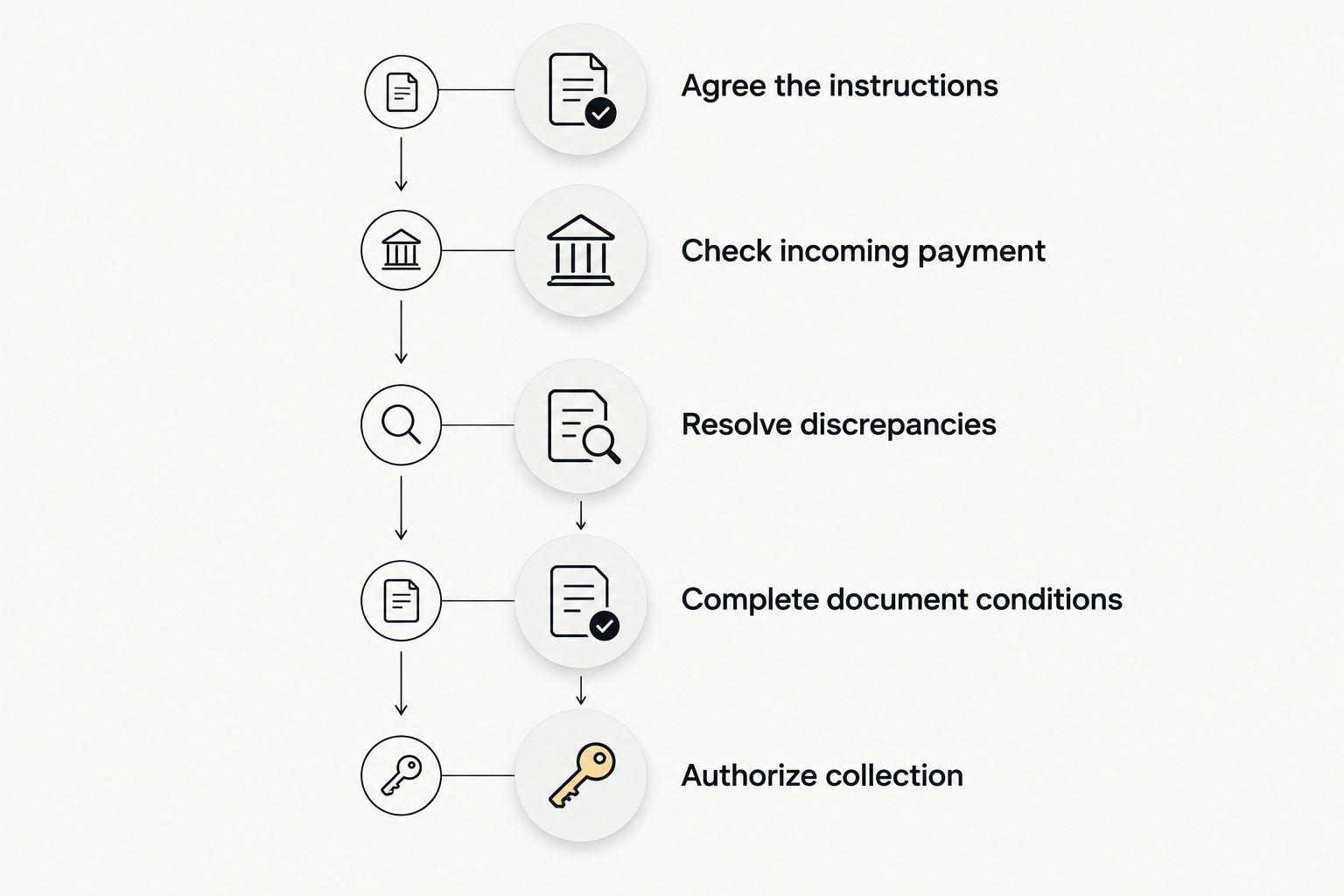
Your 2026 closing checklist should name the person responsible for each step. If several people are involved, avoid a group-message assumption that someone else already checked the funds. Ask for a clear confirmation from the responsible party.
Which payment method should a private seller accept?
Agree the method with your receiving bank before giving the buyer payment instructions. Different methods require different checks. None makes a screenshot sufficient evidence for handing over the car.
| Payment method | Best for | Useful feature | Limitation and required check |
|---|---|---|---|
| Bank wire | Parties whose banks support the agreed transfer | Your receiving bank can identify an incoming wire | A sender’s receipt does not prove receipt; verify account details and payment status |
| Cashier’s check | A closing where the issuing bank can be independently contacted | The issuing institution can explain how to verify the instrument | Counterfeit checks exist; deposited funds can appear available before a problem is discovered |
| Escrow | Parties agreeing to written conditions for holding and releasing funds | A separate provider administers the agreed release conditions | Verify the provider independently and understand the contract; a website alone proves nothing |
| Personal check | A transaction where the seller can delay release pending bank guidance | It provides a documented payment instrument | Deposit acceptance or initial availability does not establish final payment |
Choose a verification process before choosing a convenient handoff time. A method that neither party understands is a poor fit for a closing under pressure.
If the buyer proposes a bank wire
Verify the receiving instructions directly with your bank. If instructions change during the transaction, independently confirm the change before anyone sends funds. Do not rely on replying to the same email that announced the change.
After the buyer initiates the wire, check with your receiving bank. Ask whether it has received the expected payment and whether anything requires investigation. Avoid describing any transfer as immune from fraud claims, legal action or recovery efforts.
If the buyer brings a cashier’s check
Contact the issuing bank using independently obtained contact details, not just a number printed on the check. Ask your own bank what verification and deposit handling it recommends. A convincing document is not proof of an authentic instrument.
Do not hand over the car because a deposit appears in your available balance. The Federal Trade Commission’s consumer guidance distinguishes funds availability from discovering that a check is fraudulent. Let your bank explain that distinction for the actual deposit.
If the buyer proposes escrow
Read the release conditions before sending money or documents. Establish who holds the funds, what evidence triggers release, how disputes are handled and what happens if the transaction stops.
Independently verify the provider and payment instructions. A professional-looking portal, an email confirmation or a buyer’s recommendation does not establish that an escrow service is legitimate.
Why payment confirmation varies
The verification process depends on the transaction, not the car’s badge. In 2026, agree the following details before setting collection arrangements:
- Payment method. A wire, deposited check and escrow release require different questions. Use the receiving bank’s guidance for the method actually selected.
- Sender identity. A payment from someone other than the named buyer needs explanation. Document the relationship rather than assuming the difference is harmless.
- Bank processing. Submission, receipt and account availability describe different events. Ask which event has occurred and what remains unresolved.
- Existing lien. A lender’s payoff and title-release process creates a separate dependency. Receipt of the seller’s portion does not establish that the lien is resolved.
- Collection arrangements. An out-of-state buyer or transporter adds an authorization check. Agree who can collect the car and who can approve a change.
- Document requirements. Title execution and required sale paperwork depend on the relevant jurisdiction and ownership circumstances. Confirm requirements with the appropriate motor-vehicle authority.
A scheduled truck or flight does not remove these dependencies. If a required confirmation is missing, postpone release rather than inventing a shortcut at the curb.
What changes if the exotic car has a loan?
A financed vehicle needs a documented payoff plan alongside the payment plan. Ask the lender for its current instructions and establish how the buyer’s funds, the seller’s proceeds and any title release fit together.
Do not assume a payment to you satisfies the lender. Likewise, do not treat a buyer’s payoff receipt as proof that the lender has completed its process. Confirm the relevant events with the institution responsible for them.
Before agreeing collection, review how to handle a loan payoff when selling an exotic car. Keep the payoff instructions and the vehicle-release conditions consistent across the agreement, lender correspondence and handoff plan.
A lien is a separate closing condition, not a detail to settle after the transporter leaves. If the title will arrive later, document the agreed sequence and obtain appropriate professional advice before committing to it.
Can I release the car when the money appears in my account?
An available balance alone is not enough to authorize release. Ask your bank to identify the payment type and explain its status. This is especially important with deposited checks, where availability and verification are different matters.
For a 2026 sale, write the release condition around bank confirmation and the agreed documents, not an app notification. The buyer should understand that condition before initiating payment.
Should I hand over the title before payment is confirmed?
Do not release executed ownership-transfer documents outside the agreed closing sequence. Some transactions require coordinated document handling, particularly when a lender or escrow provider is involved. Establish that sequence before signing or surrendering documents.
Keep copies of the completed paperwork and follow the applicable state requirements. A bill of sale, title assignment and seller notification serve different purposes; do not assume one replaces the others.
Can a transporter collect the car before verification finishes?
Do not authorize collection while a required payment or document check remains unresolved. A transporter’s booking confirms a transport arrangement, not payment for the car.
Verify the collector against the buyer’s written authorization and record who approved release. If a different driver or company arrives, confirm the change through your established buyer contact before handing over keys.
Where private sales coordination fits
SV Sourcing provides private off-market sourcing and sales coordination, not a substitute for banking or legal advice. For a seller, the useful conversation covers the car, ownership position, expectations, discretion and proposed closing process. For a buyer, it includes specification, budget, timing and due diligence.
SV Sourcing’s private exotic-car sales coordination centers on discreet introductions and one person coordinating the deal. Payment confirmation remains with the receiving bank; lender and title questions remain with the relevant institutions and advisers.
Felipe Cimino, CEO and co-founder, has identified unsuitable intermediaries and unrealistic asking expectations among his firsthand concerns. Those observations support a practical question for any private broker: Who is responsible for each closing decision, and what authority have you actually given them? Do not leave that answer implicit.
FAQ
How do I confirm payment before I sell my exotic car?
Confirm the incoming payment directly with your receiving bank before releasing the car, keys or ownership-transfer documents. Ask the bank to identify the payment, explain its status and address any unresolved issue.
Is a bank wire receipt enough to hand over my car?
A bank wire receipt is not enough to authorize handover. Your receiving bank needs to confirm the incoming payment; a sender’s receipt does not establish receipt in your account.
Can a cashier’s check be fake even if my bank accepts it?
A cashier’s check can be counterfeit even if it is accepted for deposit. Ask your bank about verification and payment status rather than relying on initial funds availability.
What should I do if someone other than the buyer sends payment?
Pause the release and establish why the sender differs from the named buyer. Document the relationship and ask your receiving bank how to address the discrepancy.
Can I let the transporter take the car while payment is pending?
Do not authorize collection while a required payment check remains unresolved. Confirm payment, document conditions and the collector’s authority before releasing possession.
What if my exotic car still has a loan?
Obtain the lender’s payoff instructions and agree how payment and title release will be coordinated. Confirmation of funds in your own account does not establish that the lender’s requirements are complete.
Does SV Sourcing confirm that my buyer’s payment is final?
Your receiving bank is the source for payment-status confirmation. SV Sourcing provides private sourcing and sales coordination; that role does not replace bank verification or lender instructions.
One last thing
Keep 1 written release authorization with your closing records. It should identify the vehicle, authorized collector, person approving release and actual handoff date. Store it securely with the agreement and payment records, rather than scattering sensitive documents across a group chat.
For your 2026 sale, make that authorization the final instruction, not a substitute for the checks behind it. The person holding the keys should know that collection is approved, not merely that a buyer says payment was sent.