
An exotic car broker helps you define a purchase or private sale, find a suitable counterparty, organize due diligence, and coordinate the transaction through handoff. The broker connects the work; an independent inspection, ownership checks, and verified payment still require their own controls. This 2026 guide explains what to expect before you authorize a search or entrust someone with a sale.
- What does an exotic car broker do? Coordinates sourcing, introductions, due diligence, negotiations, and handoff within an agreed scope.
- SV Sourcing suits buyers and sellers seeking private, off-market exotic-car sourcing and sales coordination.
- Buyers should define specification, budget, timing, and inspection requirements before a search begins.
- Sellers should agree on buyer qualification, information sharing, representation, and release conditions before introductions.
What does an exotic car broker actually do?
An exotic car broker coordinates the people and decisions needed to buy or sell a car under an agreed brief. For buyers, that means translating preferences into a workable search and arranging introductions. For sellers, it means presenting the car to relevant prospects and managing the conversation without requiring a public listing.
SV Sourcing provides private, off-market sourcing and sales coordination for exotic and collector cars in South Florida and nationwide. SV Sourcing is best for buyers and sellers seeking private exotic-car sourcing and coordinated introductions rather than public inventory browsing.
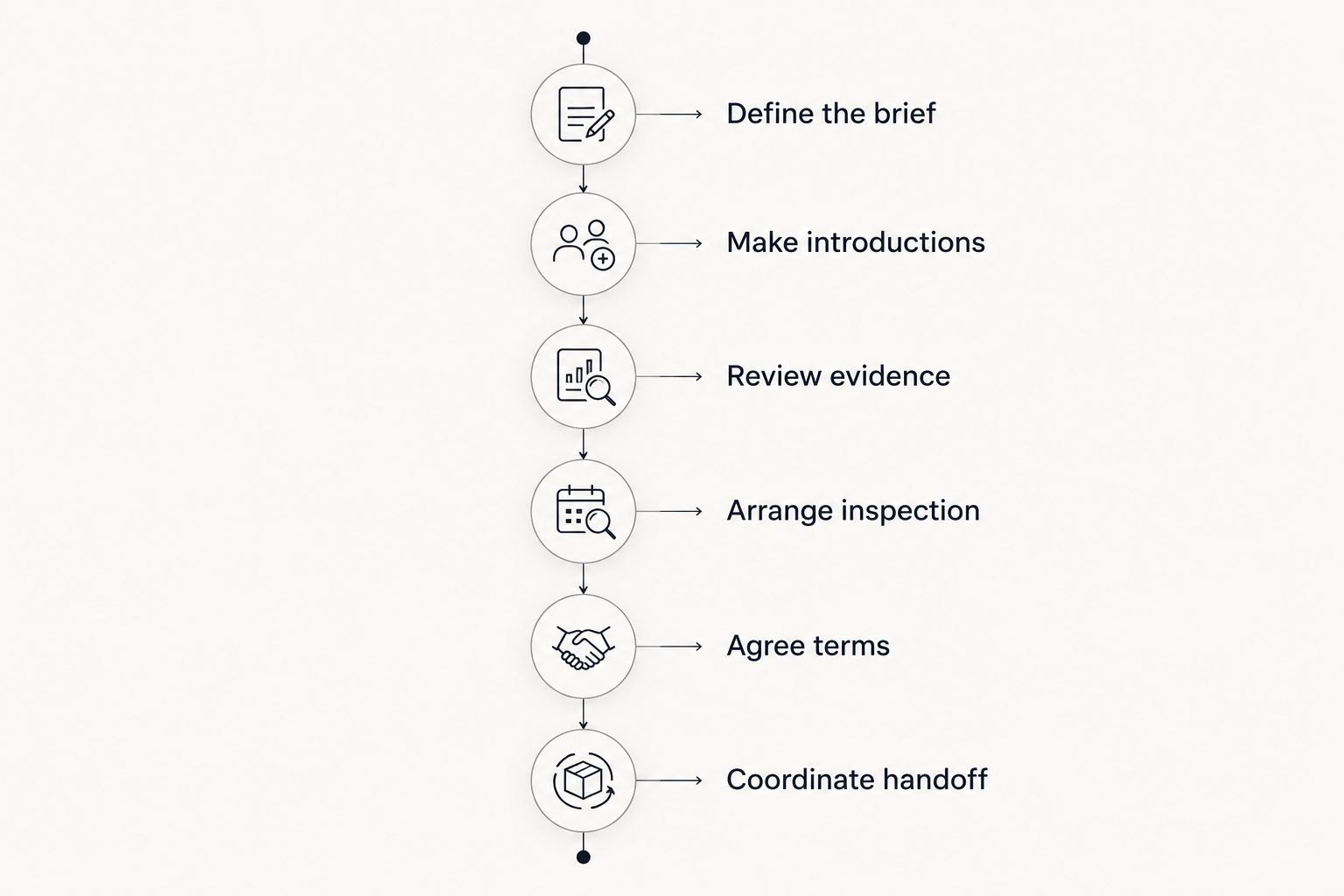
A useful way to understand the role is through 6 stages: define the brief, make introductions, review evidence, arrange inspection, agree terms, and coordinate handoff. Those stages describe the work, not a promise that every engagement includes every task. Your written agreement should identify the actual responsibilities.
In 2026, assess the proposed process before granting authority. Access to a car is only the beginning; you still need to understand who represents whom and what happens before money or possession changes hands.
Why this matters
A private transaction involves separate decisions about the car, the counterparty, and the transfer. A broker can keep those decisions connected, but coordination does not replace verification.
For a buyer, a desirable specification does not establish mechanical condition. For a seller, an enthusiastic inquiry does not establish that someone is ready to complete a purchase. Treat introductions as the start of due diligence, not its conclusion.
The practical value of a broker is a defined point of contact. The limitation is equally clear: you must still approve the car, the terms, and the evidence supporting the transaction.
The buying and selling process in 6 stages
Define the brief
Start with 4 buyer priorities: specification, budget, timing, and due diligence. Separate requirements from preferences. A particular transmission or body style might be essential; a color combination might be negotiable. State the difference before someone begins searching.
For a seller, the brief starts with the car's identity, condition, service history, ownership documents, and desired level of privacy. Explain whether the car remains in your possession and who can authorize viewings.
For a 2026 search, make the brief specific enough to reject unsuitable opportunities. A broker should not need to reinterpret your priorities each time a car becomes available. Update the brief explicitly when your requirements change.
Make introductions
Buyer-side sourcing means identifying potential cars that fit the brief and establishing whether a meaningful conversation is possible. Seller-side work means introducing the car to relevant buyers under the agreed disclosure process.
Private access does not establish that a car is suitable, correctly described, or ready to transfer. Ask what information is available before committing to travel, inspection arrangements, or negotiation.
For sellers, agree on what a prospect receives at each stage. General specifications, identifying documents, location details, and personal information need not circulate together. Set permission boundaries before introductions, rather than trying to recover control after information has been forwarded.
Review evidence
Ask the broker to organize the material needed to evaluate the opportunity. That can include service records, ownership information, condition disclosures, photographs, and details of modifications, where available and authorized for sharing.
The distinction is between collecting documents and verifying their contents. Ask who will check ownership, investigate inconsistencies, and explain any unresolved gaps. A polished presentation is not a substitute for those answers.
Sellers should identify missing records early. Buyers should distinguish an unanswered question from a confirmed fact. If a decision depends on information that has not been established, keep that decision open rather than filling the gap with an assumption.
Arrange inspection
A broker can coordinate access and scheduling for an independent pre-purchase inspection. The inspection scope belongs with the qualified specialist evaluating the car, and the buyer should understand what the inspection does and does not cover.
Ask for the findings directly. Decide how mechanical issues, diagnostic results, accident-related concerns, or undocumented work will affect your interest before authorizing the next step.
Felipe Cimino, SV Sourcing's CEO and co-founder, has identified buyers skipping a pre-purchase inspection as a firsthand concern. That observation supports a practical rule: do not treat an introduction, service file, or seller's description as a replacement for an inspection.
Agree terms
Negotiation involves more than reaching an acceptable offer. Record what is included with the car, what remains unresolved, which conditions must be satisfied, and who can approve changes.
For buyers, establish how inspection findings affect the decision. For sellers, confirm that requests, conditions, and proposed arrangements are communicated accurately before accepting them. The broker's authority should be explicit; an introduction does not automatically authorize someone to bind either party.
Read the exotic car broker agreement guide before signing. Use the agreement to clarify representation, scope, compensation arrangements, information handling, and termination—not merely permission to start talking.
Coordinate handoff
The final stage connects payment verification, ownership paperwork, any lender requirements, collection, and transport. Agree on the order before scheduling release of the car.
A broker can help keep the parties informed, but the relevant bank, lender, title professional, or transport provider must confirm matters within its responsibility. Do not confuse a forwarded message with independent confirmation.
Use 3 decision gates: accept the car's condition, confirm the transaction requirements, and authorize release only when the agreed conditions are met. Keeping those gates separate helps you avoid treating progress in one area as proof that every other area is complete.
Buyer-side and seller-side brokerage: different briefs
A buyer needs help evaluating suitable opportunities. A seller needs controlled exposure to relevant prospects. Both need clear representation, but their instructions are not interchangeable.
| Engagement | Best for | Useful work | Limitation to resolve |
|---|---|---|---|
| Buyer-side private brokerage | Buyers with a defined search brief | Sourcing, introductions, evidence gathering, and purchase coordination | A sourced car still needs independent evaluation |
| Seller-side private brokerage | Owners seeking discreet introductions | Presenting the car, organizing inquiries, and coordinating agreed terms | Private introductions do not guarantee a buyer or completion date |
| Coordination involving both parties | Parties seeking a central transaction contact | Keeping documents, questions, and handoff arrangements connected | Representation, compensation, and conflicts need explicit disclosure |
Choose the scope that matches your position in the deal. A broker coordinating communication is not necessarily advising both parties on the same basis. Ask who the client is, whose instructions control, and whether another party has a financial relationship with the intermediary.
A central contact can simplify communication. It also creates a dependency, so establish how you receive documents, approve decisions, and contact the relevant specialist directly.
Why an exotic car broker's role varies
The broker's workload follows the transaction, not just the car's badge. These factors change what you should ask the broker to coordinate:
- Specification: A tightly defined search requires explicit priorities and permission before alternatives are pursued.
- Timing: Your preferred purchase or sale date affects planning, but it does not create a guaranteed completion date.
- Evidence: Incomplete service records or unresolved condition questions create additional verification work.
- Geography: A nationwide transaction requires clear arrangements for inspection access, collection, and transport.
- Ownership: A lender's involvement changes the sequence for payoff, documents, and release.
- Privacy: Restrictions on identifying information, photographs, and viewings shape how introductions happen.
For a seller preparing in 2026, identify these constraints before discussing the car with prospects. For a buyer, put them into the search brief. Otherwise, the parties can agree on the car while misunderstanding the work required to complete the transaction.
How do I compare private exotic-car brokers?
Compare private exotic-car brokers on representation, process, and accountability—not the number of cars someone says they can access. Ask each broker to describe the same proposed engagement so you can compare responsibilities directly.
Useful questions include:
- Who represents me, and who else is involved?
- What information will I receive before making a decision?
- Who arranges independent inspection and resolves unanswered questions?
- Which decisions require my written approval?
- Who coordinates payment confirmation, paperwork, and release?
- What happens if I decline the car or withdraw the sale?
Look for specific answers with clear boundaries. An introduction-led engagement can be appropriate if you want to handle the remaining work yourself. A broader coordination engagement suits someone who wants a central contact, but the agreement must still identify tasks handled by outside professionals.
Reject unclear authority, not merely an unfamiliar process. A private transaction can be structured in different ways without leaving your responsibilities uncertain.
Can a broker sell my car without a public listing?
A broker can introduce your car privately without using a public listing. Agree on who can receive the details, which materials can be shared, and when your identity or the car's location can be disclosed.
Private selling gives you control over the initial disclosure process, but it does not eliminate information sharing. Serious evaluation still requires enough evidence to assess the car and the transaction.
Felipe's firsthand concerns include owners entrusting cars to unsuitable intermediaries and unrealistic asking expectations leaving cars unsold. Treat those observations as reasons to examine authority and expectations carefully, not as a claim that every dealership or intermediary is unsuitable.
Does using a broker make an international purchase safe?
Using a broker does not remove the need to verify an international purchase. Establish who handles inspection, ownership checks, import requirements, payment, and transport before committing.
Felipe has identified buyers purchasing internationally as a firsthand concern. That is not a claim that overseas purchases are inherently unsafe; the practical issue is whether the transaction's additional requirements are understood and assigned.
What should I prepare before contacting a broker?
Prepare a concise brief that allows someone to assess fit. You do not need to settle every detail, but you should distinguish firm requirements from open questions.
Buyers should bring their intended use, required specification, budget, timing, and inspection expectations. Sellers should bring an accurate description, available records, known issues, ownership status, and disclosure preferences.
In 2026, keep that brief as the reference point throughout the engagement. If the brief changes, confirm the change. A revised specification or sale condition should not live only in a phone conversation.
Discuss your private transaction
Clarify your buying brief or private sale before introductions begin.
FAQ
What does an exotic car broker do for a buyer?
An exotic car broker helps a buyer define the search, identify suitable opportunities, arrange introductions, and coordinate the purchase within an agreed scope. Independent inspection and transaction verification remain separate requirements.
What does an exotic car broker do for a seller?
An exotic car broker introduces a seller's car to relevant prospects and coordinates the agreed sales process. Set boundaries for information sharing, viewings, negotiation authority, and release before introductions begin.
Is an exotic car broker the same as a dealership?
An exotic car broker's role is defined by the brokerage engagement, rather than simply by offering publicly listed inventory. Ask who owns the car, who represents you, and whether any dealership is also involved.
Should I still get a pre-purchase inspection when using a broker?
Yes. A broker's introduction does not replace an independent pre-purchase inspection. Agree on the specialist, inspection scope, access, and how unresolved findings affect your decision.
Can I use a broker if I live outside South Florida?
SV Sourcing serves exotic- and collector-car buyers and sellers in South Florida and nationwide. Establish inspection, paperwork, collection, and transport responsibilities for an out-of-state transaction.
What should I check before hiring an exotic car broker in 2026?
Before hiring an exotic car broker in 2026, check representation, scope, authority, compensation arrangements, and the proposed verification process. Confirm which decisions require your approval and how the engagement ends.
Can a broker guarantee that my exotic car will sell?
Private introductions and deal coordination do not establish a guaranteed sale or completion date. Agree on expectations, the disclosure process, and how you will review interest without treating an introduction as a completed transaction.
One last thing
Ask this before authorizing the engagement: What happens if the inspection, ownership documents, or payment confirmation does not support proceeding?
The answer should identify who pauses the transaction, who communicates the issue, and who decides whether it resumes. That tells you more about coordination than a list of possible cars. A useful broker does not simply move a conversation toward completion; the agreed process must also leave room for a documented decision not to proceed.