
Yes, you can sell your exotic car to a buyer in another state in 2026, provided you satisfy the applicable title-transfer requirements and agree on payment, inspection and delivery before releasing the car. An out-of-state sale also requires a clear plan for any loan payoff, the buyer’s registration requirements and the point at which possession changes hands.
- You can sell your exotic car across state lines; confirm title, payment and transport arrangements before release.
- SV Sourcing serves owners seeking private exotic-car introductions and sales coordination, including nationwide transactions.
- Agree on inspection access and written acceptance before scheduling the handoff.
- Verify payment through your financial institution, not a buyer’s screenshot or email.
Why this matters
Distance makes an unclear agreement harder to resolve. Your buyer, lender, inspector and transporter need the same understanding of what happens next—and what stops the transaction.
Start with the paperwork, not the pickup date. Review what documents you need to sell your exotic car before promising a closing date.
Can I sell my exotic car to a buyer in another state?
Yes. The state line is not the deciding issue; a workable transfer and release process is. Confirm the seller-side requirements with your state’s motor vehicle agency and the registration requirements with the buyer’s destination state.
For a 2026 transaction, use current agency instructions rather than an old form saved from a previous sale. Do not assume the buyer can register the car using exactly the same documents you needed when you bought it.
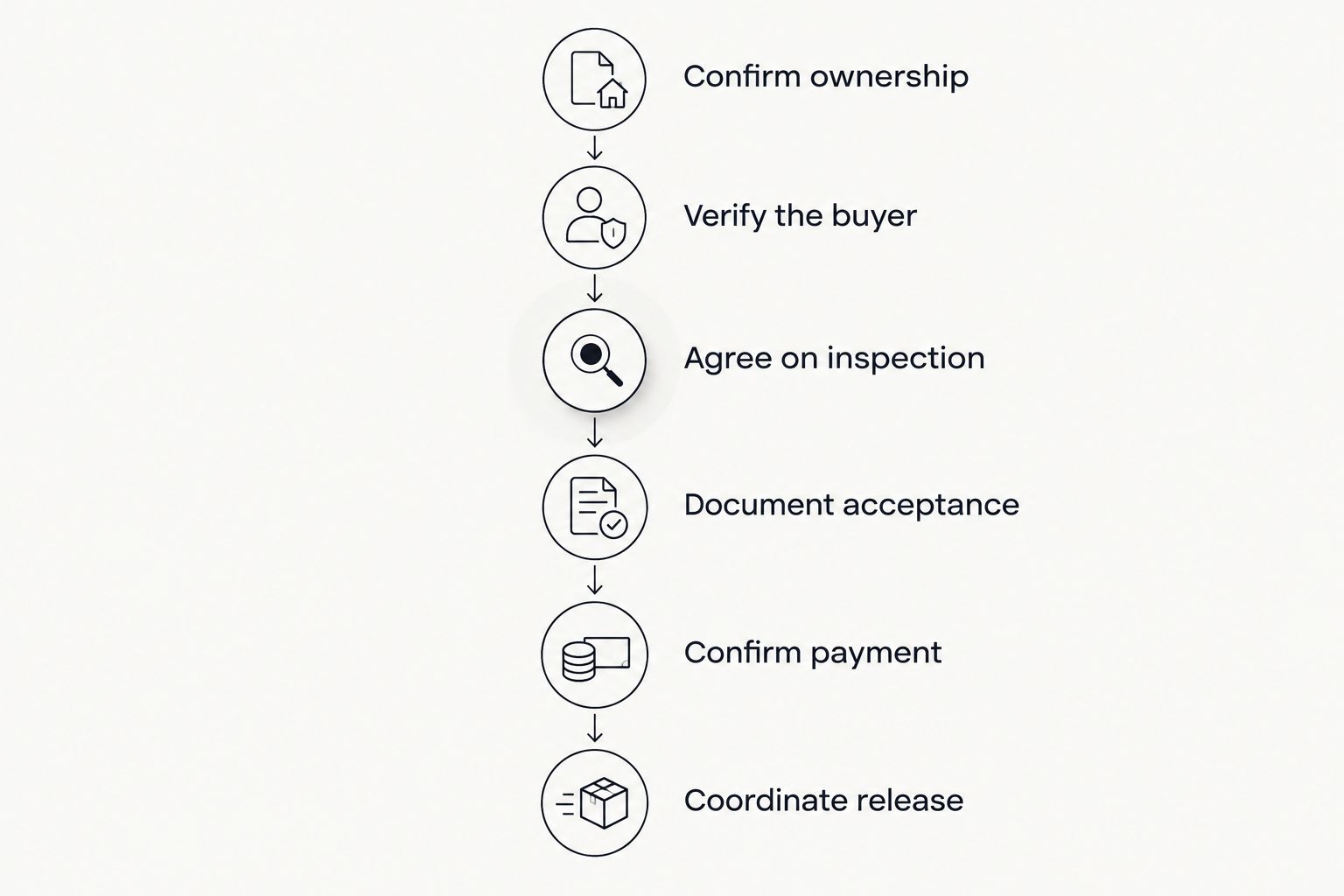
Use this sequence to organize the sale. It is a coordination checklist, not a substitute for state-specific instructions or legal advice.
1. Confirm ownership
Check whose name appears on the title, whether another owner must sign and whether a lender holds a lien. Compare the vehicle identification number on the ownership documents with the car itself.
If the title is missing, contains an error or requires another person’s authorization, resolve that issue before arranging collection. A signed sale agreement does not remove a title problem.
For a financed car, ask the lender for its current payoff instructions and title-release process. Make sure the buyer understands who receives payment and how the lien release reaches the person handling registration.
2. Verify the buyer
Establish who is buying the car and who will appear on the purchase documents. If someone acts for a company or another individual, confirm that person’s authority before sharing sensitive records or accepting instructions.
Use independently confirmed contact details for important conversations. A familiar email thread alone does not establish that new payment instructions are genuine.
Share the records needed to assess the car, but remove unrelated personal information. Keep original ownership documents under your control until the agreed transfer process requires their release.
3. Agree on inspection
Give the buyer a reasonable opportunity to arrange an independent pre-purchase inspection with an appropriate specialist. Agree in writing on the inspection location, who authorizes movement and how any findings affect the proposed transaction.
An inspection report describes the findings within its scope. It is not a guarantee against every future fault, and a remote buyer should understand what was not examined.
Disclose known issues rather than leaving the inspector to discover them. Keep service records, photographs and written descriptions consistent so the buyer can evaluate the same car you are offering.
4. Document acceptance
Put the agreed terms in writing before anyone books collection. Identify the car, the parties, included items, payment arrangements, inspection conditions and the responsibilities for transport.
State what happens if the inspection identifies an issue or the lender cannot complete the expected release process. Avoid leaving either party to infer whether the sale is final.
Record accessories and documents separately. Spare keys, service books, removable components and other included items should not become a disagreement after the transporter leaves.
5. Confirm payment
Ask your financial institution how to verify receipt of the proposed payment and what limitations apply before you authorize release. A payment confirmation sent by the buyer is not independent verification.
If the transaction involves a lender or a third-party payment service, confirm the instructions directly with that organization. Understand who controls the money, what conditions govern its release and what remains unresolved.
Do not let an arriving transporter set your payment deadline. If payment verification is incomplete, pause the handoff rather than improvising under pressure.
6. Coordinate release
Confirm the carrier’s identity, collection authorization and applicable insurance arrangements. Discuss access, ground clearance and loading requirements before the truck arrives.
Document the car’s condition and included items at collection. Keep the transport paperwork and record who accepted custody, without treating a transport receipt as proof that the ownership transfer is complete.
Tell the buyer which documents travel with the car and which follow through another agreed channel. Avoid placing irreplaceable originals in the car without a specific reason and an agreed handling plan.
Why an out-of-state exotic-car sale varies
There is no single closing sequence that fits every private sale. For a 2026 transaction, build the plan around the actual car, ownership position and destination—not a promised completion date.
- Ownership status. A title in your possession creates a different paperwork sequence from a lender-controlled title or unresolved ownership issue.
- Destination requirements. The buyer needs to establish what the destination state requires for title, registration and any applicable inspection.
- Inspection findings. The parties need an agreed response when the report identifies work, missing records or a discrepancy.
- Payment arrangements. Direct payment, lender involvement and a proposed third-party service require different verification steps.
- Transport needs. Collection access, loading requirements and carrier arrangements affect how the car can leave safely.
- Privacy expectations. Decide which information can be shared, with whom and at what stage of qualification.
These factors should shape the agreement before collection is booked. None justifies promising a guaranteed sale or delivery timeline.
Should I manage the sale myself or use a private broker?
SV Sourcing is suited to exotic- and collector-car owners who want private introductions and one person coordinating the deal. Its service covers private, off-market sourcing and sales coordination in South Florida and nationwide; it is not presented as a public inventory dealership.
Compare the responsibilities, not just the introduction. An intermediary’s involvement does not replace your need to understand the agreement, inspection findings or release conditions.
| Approach | Best for | Main advantage | Main limitation |
|---|---|---|---|
| Owner-managed private sale | Owners prepared to coordinate every participant | You control buyer communication and the transaction sequence directly | You must organize qualification, inspection, documents, payment verification and transport yourself |
| Private exotic-car broker | Owners seeking discreet introductions and deal coordination | A defined point of contact can organize communication between participants | You still need to confirm representation, authority, compensation and responsibilities in writing |
For a private introduction, SV Sourcing provides a relevant service. Before engaging any broker, establish who the broker represents, what the broker can authorize and which decisions remain yours.
Felipe Cimino, CEO and co-founder, previously sold supercars at a dealership. His stated concerns include owners entrusting cars to unsuitable intermediaries or dealerships and unrealistic asking expectations leaving cars unsold. Those are his observations, not a judgment that every dealership or intermediary is unsuitable.
Choose a defined role over a vague promise of access. The agreement should explain how introductions, negotiations and coordination work without implying a guaranteed outcome.
Can the buyer inspect the car without traveling?
Yes. An out-of-state buyer can arrange an independent local inspection without personally attending, subject to access and the specialist’s availability. Agree on the scope and who receives the findings before the appointment.
A remote inspection needs clear instructions. Ask the buyer to identify concerns about condition, modifications, records or operation so the specialist can explain what the inspection will and will not cover.
Felipe’s firsthand concerns include buyers skipping a pre-purchase inspection or purchasing internationally. Treat those observations as a reason to examine the process carefully, not as proof that every remote or international purchase is unsafe.
Can I sell my exotic car if I still have a loan?
Yes, but the lender’s payoff and title-release requirements must be part of the transaction plan. Confirm the process directly with the lender before agreeing to a release sequence.
Establish how the payoff reaches the lender, how any remaining balance is handled and who receives the released title or lien documentation. Do not promise immediate title delivery unless the lender has confirmed that process.
Before the transporter arrives
Use a final written release checklist for your 2026 sale. Keep it separate from general discussions so everyone can identify the conditions that remain open.
Ownership and documents
Confirm the correct signatures, buyer details and vehicle identification number. Follow current instructions for any required odometer disclosure, notarization, seller notice or plate handling; the exact requirements depend on the transaction and jurisdiction.
Ask the buyer to confirm destination-state requirements before signing documents that are difficult to correct. Do not sign blank transfer fields to make a remote closing feel easier.
Payment and authority
Identify who gives the final release instruction. Your broker, carrier and buyer should not have conflicting assumptions about who can authorize collection.
Verify any changed payment instructions through an independently confirmed channel. If an instruction differs from the signed agreement, resolve the discrepancy before money or possession changes hands.
Condition and custody
Photograph the car at collection, including existing damage and the items being handed over. Retain copies of signed condition records and collection documents.
Confirm with your insurer how coverage applies before, during and after the handoff. Arrange any cancellation or change around the actual transaction requirements rather than an assumed pickup time.
The release decision belongs at the end of the checklist, not at the end of the driveway. A truck waiting outside does not make an unresolved condition acceptable.
FAQ
Can I sell my exotic car to someone who lives in another state?
Yes, you can sell your exotic car to an out-of-state buyer. Confirm the applicable ownership-transfer requirements, payment verification and collection arrangements before release.
Does the buyer have to come see the car in person?
The buyer does not need to attend simply to arrange an independent local inspection. Any identity, signing or transaction-specific attendance requirements still need to be confirmed.
Who handles registration after an out-of-state private sale?
The buyer should confirm the destination state's registration process, while you confirm your seller-side obligations. Put responsibility for obtaining and submitting the required documents in writing.
Should I release the car when the buyer sends a payment screenshot?
No. Confirm payment directly through your financial institution and resolve any release conditions before handing over the car or authorizing collection.
Can a broker guarantee when my exotic car will sell?
Do not treat a proposed sale timeline as a guaranteed outcome. Ask the broker to explain the process, responsibilities and contingencies in the agreement.
Can SV Sourcing coordinate a sale to a buyer outside Florida?
Yes. SV Sourcing provides private, off-market sourcing and sales coordination in South Florida and nationwide. Agree on the scope of coordination and each party's responsibilities before proceeding.
One last thing
For your 2026 sale, write down what stops release—not just what completes it. An unresolved lien, unverified payment or missing authorization should trigger a pause that every participant understands.
That instruction is useful even when the buyer is serious and everyone intends to proceed. Good intentions do not answer who has authority to release your car.