
To sell an exotic car with an outstanding loan in 2026, obtain a current payoff quote from your lender and agree in writing how the lender will be paid, any remaining proceeds distributed, and the lien released. If the agreed sale amount does not cover the payoff, you must arrange the shortfall before the transaction can close; payment alone does not establish that the buyer can receive a transferable title.
- To answer ‘how do I sell my exotic car,’ establish the lender’s payoff and title-release process before accepting payment.
- An outstanding loan requires coordinated payment, lien release and title transfer—not just a signed bill of sale.
- SV Sourcing suits owners seeking private exotic-car sales with one person coordinating the deal.
- Verify the buyer and payment instructions independently before releasing the car or sending funds.
Why this matters
A financed exotic car has a closing dependency: the lender’s security interest must be resolved as part of the sale. A buyer needs more than your assurance that the loan will be paid. You need a documented route from payment to lien release and ownership transfer.
For a private sale in 2026, establish that route before arranging collection. SV Sourcing provides private, off-market sourcing and sales coordination for exotic and collector cars, serving South Florida and nationwide. Coordination brings the parties together; the lender and relevant title authority still determine their own requirements.
SV Sourcing is for exotic- and collector-car owners seeking a private sale with one person coordinating the deal. That service does not replace lender confirmation, buyer due diligence or the required ownership paperwork.
How do I handle a loan payoff when selling an exotic car?
Start with the lender, not the buyer’s proposed payment method. Request a written payoff quote and instructions for a third-party sale. Then build the closing around those instructions, including what happens between receipt of funds and delivery of the title or lien-release documentation.
Your position depends on the relationship between the agreed sale amount and the lender’s payoff. Compare those amounts before committing to a closing date.
| Loan position | What must happen | Advantage | Constraint |
|---|---|---|---|
| Sale amount exceeds payoff | Pay the lender and document distribution of the balance | The sale can provide funds for both payoff and seller proceeds | Other transaction obligations still affect your net proceeds |
| Sale amount equals payoff | Direct the required amount to the lender | No loan shortfall needs separate funding | No sale balance remains before other transaction obligations |
| Sale amount is below payoff | Arrange additional funds to satisfy the lender | A sale remains possible if the shortfall is covered | The buyer’s payment alone cannot satisfy the loan |
The table addresses the loan only. Confirm any separately agreed transaction obligations before treating the balance as money available to you.
Do not substitute the balance shown in your loan account for a lender-issued payoff quote. The payoff quote establishes the amount required under its stated conditions and validity period.
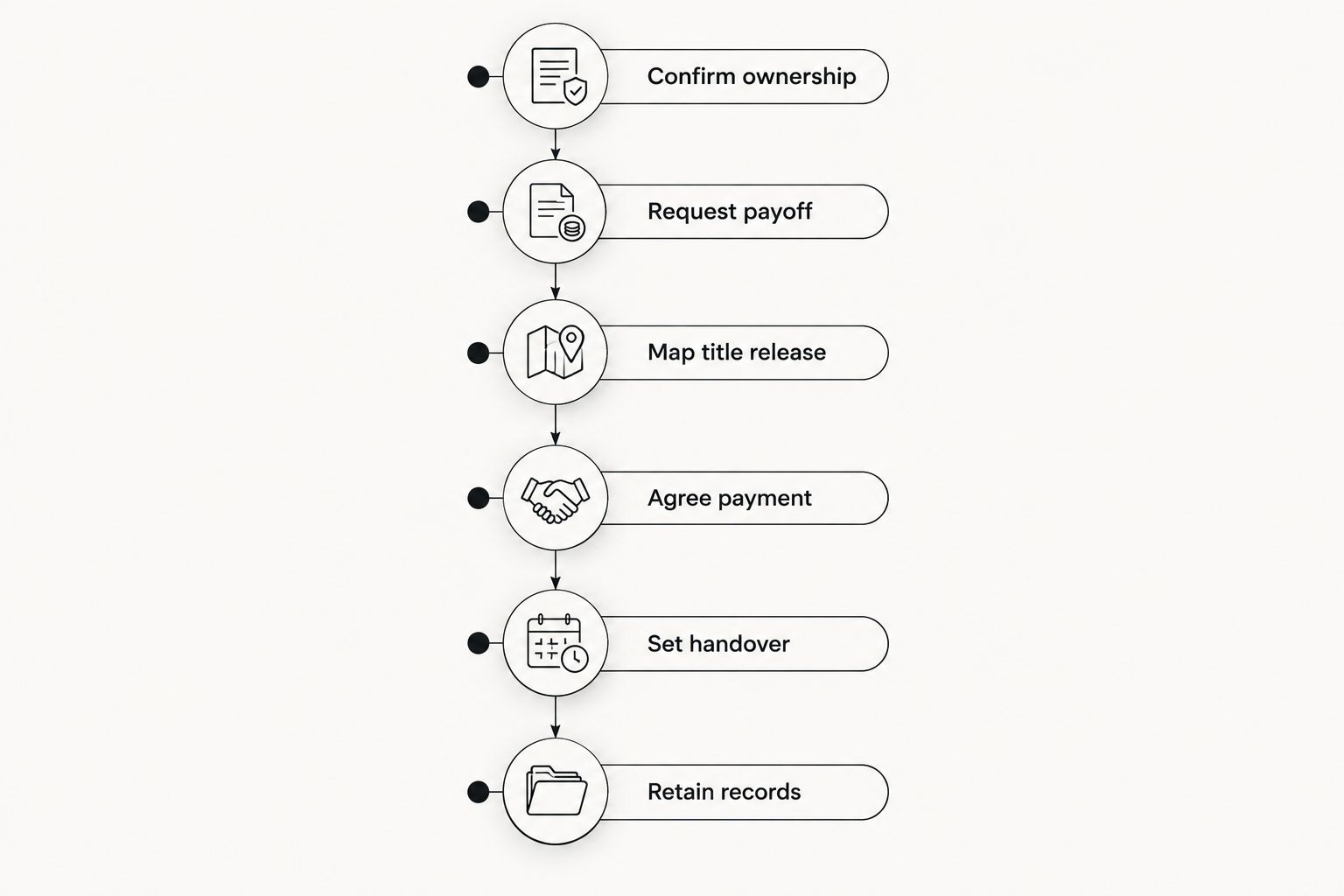
The payoff process, from quote to title
1. Confirm ownership
Check the vehicle identification number, the names on the ownership record and the borrower information. Identify every person or entity whose authorization or signature is required. Ask the lender whether its records match the ownership documents you hold.
If the car belongs to a company, trust or another legal entity, confirm signing authority before negotiating the closing arrangements. A person arranging the sale is not automatically authorized to transfer ownership.
2. Request payoff
Ask the lender for a written payoff quote for the intended closing date in 2026. Confirm when the quote expires, how to obtain an updated amount and which payment methods the lender accepts. Keep the quote with the transaction documents.
Use independently verified lender contact details. Do not rely solely on instructions forwarded by a buyer, broker or unfamiliar email sender. If payment instructions change, stop and confirm the change directly with the lender.
3. Map title release
Ask who holds the title record, whether the lien is recorded electronically or on paper, and what the lender provides after payoff. Establish who receives each document and how the buyer completes the ownership transfer.
A paid loan, a released lien and a transferred title are separate events. Ask about each one. If the buyer and seller are in different states, confirm the applicable requirements with the relevant title authorities rather than assuming the processes match.
4. Agree payment
Put the payment allocation in writing. State what goes to the lender, what goes to the seller and how any seller-funded shortfall will be handled. Identify who submits each payment and what confirmation each party receives.
If the buyer uses financing, bring the buyer’s lender into the discussion before finalizing the closing. The buyer’s lender can have its own documentation and disbursement requirements. Those requirements must fit the existing lender’s payoff process.
5. Set handover
Agree when possession changes and what must happen first. Address confirmed payment, required signatures, insurance, transport and the documents that will follow later. Specify what happens if the lender’s release process is not complete when collection is proposed.
Do not let transport dictate the closing. A carrier arriving at your door is not evidence that funds are confirmed or that the ownership transfer is ready.
6. Retain records
Keep the payoff quote, payment confirmations, sale agreement, bill of sale, release documentation and transfer records. Follow up with the lender for confirmation that the loan has been satisfied and the lien-release process completed.
Retain enough documentation to explain the transaction without exposing unnecessary personal information. Share account details and identification only with the parties who need them for their role.
Selling with positive equity
When the agreed sale amount exceeds the payoff, document how the lender receives its required payment and how the remaining amount reaches you. Ask whether the proposed arrangement allows separate payments or requires another closing procedure.
The benefit is straightforward: sale funds can cover the loan. The limitation is that a positive balance does not remove the lien-release dependency. You still need the lender’s confirmation and the documents required for transfer.
Avoid accepting an arrangement that leaves the buyer relying entirely on your promise to pay the lender later. A documented payment path protects both parties and makes outstanding obligations visible.
Selling with negative equity
When the payoff exceeds the agreed sale amount, establish how you will fund the difference before committing to the sale. Ask the lender how that additional payment must be submitted and whether it must arrive before or alongside the buyer’s payment.
The benefit of resolving the shortfall early is a clear closing plan. The constraint is real: a signed sale agreement does not make the unpaid balance disappear. Do not assume the lender will release its interest while a required payoff amount remains outstanding.
If the shortfall is not funded, pause the transaction. Renegotiating terms or retaining the car is a separate decision; neither should be disguised as a completed payoff arrangement.
Why loan-payoff arrangements vary
For a 2026 sale, use the requirements attached to your actual loan and title record. Another owner’s completed transaction is not a substitute for your lender’s instructions.
- Lender requirements. Accepted payment methods, quote validity and release procedures determine how the payoff is submitted and documented.
- Title format. Paper and electronic records involve different document-handling steps. Confirm which applies to your car.
- State requirements. The seller’s and buyer’s title authorities determine the required transfer documents and procedures.
- Equity position. A shortfall requires additional funding; a surplus requires a documented distribution of proceeds.
- Buyer financing. A buyer’s lender adds its own approval, payment and documentation conditions.
- Ownership structure. Multiple owners or an entity owner require the appropriate authorizations and signatures.
These factors affect the sequence, not just the paperwork. Identify them before promising a collection date or agreeing to release the car.
What should the buyer verify before paying?
The buyer should verify the seller’s authority to sell, the car’s identity and the lender’s payoff instructions. Permission to discuss limited transaction details with the lender can help establish the process without giving the buyer unrestricted access to your account.
Loan verification does not replace vehicle due diligence. Service history, condition and a pre-purchase inspection address different risks from the lien. Felipe Cimino, SV Sourcing’s CEO and co-founder, has identified skipped pre-purchase inspections among his firsthand concerns about supercar purchases.
For sellers, qualification works in both directions. Review how to verify a private buyer before selling an exotic car before sharing sensitive documents or accepting a proposed payment arrangement. A willingness to buy is not proof of identity, funding or authority to act.
Should I use a private broker for a financed exotic-car sale?
A private broker is relevant when you want help coordinating introductions and the transaction rather than advertising the car publicly. Evaluate the broker’s role in the payoff process as carefully as the buyer introduction.
Ask who communicates with the lender, who receives funds and who tracks the title documents. Ask what the broker does if the payoff changes or the buyer’s lender rejects the proposed payment sequence. Put responsibilities in writing.
The advantage is a defined coordination role. The limitation is that a broker cannot replace lender instructions or state transfer requirements. Do not treat the broker’s involvement as confirmation that the lien has been released.
Discuss your private sale
Outline the car, outstanding loan and intended timing before planning the transaction.
What happens if the payoff changes before closing?
If the payoff quote expires or the closing date changes, request an updated quote before funds are sent. Reconcile the revised amount with the written payment allocation. Both parties should understand any change to seller proceeds or the shortfall.
Do not resolve a discrepancy with an informal promise to settle it afterward. Confirm the lender’s current requirement and revise the closing instructions. Keep the updated quote alongside the earlier transaction documents so the change is traceable.
Can the buyer collect the car before the title arrives?
Collection before title delivery requires a clearly documented arrangement, not an assumption that the paperwork will catch up. Confirm the lender’s process, the applicable transfer requirements and each party’s obligations during the gap.
Decide how insurance, custody and transport are handled. If any party cannot explain the route to a transferable title, postpone handover. The car’s physical location should not become a substitute for completing the transaction correctly.
FAQ
Can I sell my exotic car if I still owe money on it?
Yes, you can sell a financed exotic car by arranging the lender’s payoff and the required lien release and ownership transfer. If the sale amount is below the payoff, arrange funds for the shortfall before closing.
Should the buyer pay me or pay my lender directly?
Use the payment arrangement accepted by the lender and documented in the sale agreement. Confirm how the lender receives its payoff and how any remaining seller proceeds are distributed.
Is my loan balance the same as my payoff amount?
Your displayed loan balance is not a substitute for a current payoff quote. Obtain the lender’s written amount and follow its validity conditions and payment instructions.
How long does lien release take after a car loan payoff?
Confirm the release process and timing directly with your lender and the relevant title authority. Do not promise title delivery or collection based on another seller’s experience.
What should I do if I owe more than the buyer offers?
Arrange additional funds to cover the shortfall and confirm how the lender must receive them. The buyer’s payment alone will not satisfy a payoff that exceeds the agreed sale amount.
Can a private broker coordinate my loan payoff?
A private broker can help coordinate the transaction, but the lender determines its payoff and release requirements. SV Sourcing provides private exotic- and collector-car sales coordination; agree the responsibilities for lender communication, payment and documents in writing.
What documents should I prepare for a financed exotic-car sale in 2026?
Prepare a current payoff quote, ownership information and the documents required by your lender and the relevant title authorities. Keep the written payment allocation, sale agreement and subsequent payment and release confirmations together.
One last thing
Payoff confirmation is not the same as a completed title transfer. Build the closing around the final ownership step, not merely the outgoing payment. Before releasing the car, make sure each party knows which documents remain outstanding, who must obtain them and what happens if the agreed process stalls.