
A wire transfer can be safe for a high-value car purchase when you independently verify the recipient, confirm ownership and liens, and agree on payment and release conditions before sending funds. The transfer itself does not protect you against a misrepresented car, defective title or fraudulent instructions, and recovering money after a fraudulent wire is not guaranteed.
- Is a wire transfer safe for a car purchase? Only with verified instructions, ownership checks and controlled vehicle release.
- A bank confirmation establishes payment status, not the car’s condition or the seller’s right to sell.
- SV Sourcing coordinates private exotic-car deals; buyers still need independent inspection, title review and payment verification.
- Stop the closing when account details change unexpectedly or anyone pressures you to bypass verification.
Is a wire transfer safe for a high-value car purchase?
A wire is a payment method, not purchase protection. Your safety depends on who receives the money, what you have verified and what happens after payment. Treat those as separate decisions in a 2026 private-car closing.
For buyers considering SV Sourcing, private sourcing and sales coordination should remain distinct from banking, inspection and title verification. A coordinator connects the process. Your bank confirms payment status, an inspector assesses the car, and the relevant title authority determines transfer requirements.
The useful comparison is not simply wire versus no wire. It is an unprotected payment to a seller versus a payment structure with independently verified release conditions.
| Payment structure | Best for | Main advantage | Main limitation |
|---|---|---|---|
| Direct wire to the verified seller | A closing with ownership, documents and handoff conditions already resolved | Payment goes directly to the agreed recipient | The wire does not hold funds pending inspection or title delivery |
| Wire to an independently verified escrow provider | A closing that needs funds held against written conditions | A separate party administers release under the escrow agreement | A fraudulent provider or vague release terms defeats the intended protection |
| Coordinated payment involving a lienholder | A financed car requiring a documented payoff | Payment can address the secured debt as part of closing | Paying the lender does not itself complete title transfer or vehicle delivery |
None of these structures replaces due diligence. Choose the arrangement that addresses the actual unresolved issue, not the one that sounds most formal.
Why this matters
An exotic-car purchase combines several separate risks: the vehicle’s condition, the seller’s authority, the destination of the money and the transfer of ownership. Resolving one does not resolve the others. A genuine seller can have an outstanding lien; a genuine car can still arrive with undisclosed damage.
Private access does not change that distinction. Discretion should limit unnecessary exposure of personal information, not remove identity checks or written records.
For a 2026 purchase, build the closing around documents and independently confirmed instructions. Do not let a desirable specification or a transport booking dictate when you send money.
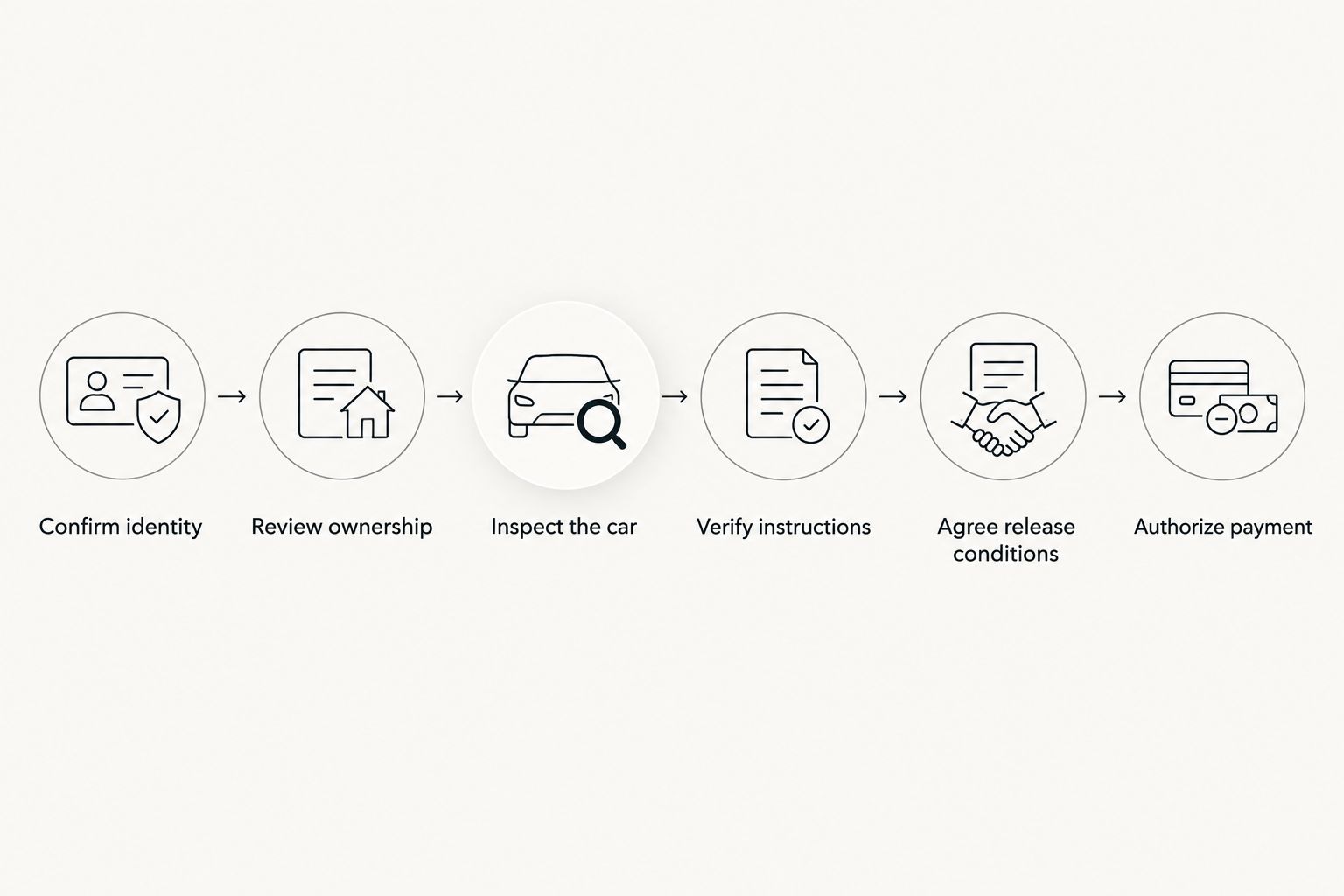
Complete these 6 checks before sending a wire
Use this sequence before authorizing payment. The purpose is to settle the important questions while you still control the funds.
Confirm identity
Establish who owns the car and who has authority to sign. Compare the seller’s identity with the ownership documents. If a business, trust or representative is involved, request documentation establishing signing authority rather than assuming the person arranging the sale can transfer ownership.
Check the buyer’s legal name as well. A purchase through a business needs documents consistent with that buyer. Resolve unexplained differences between the contract, title documents and payment instructions before proceeding.
Review ownership
Match the vehicle identification number on the car to the documents. Review the title status, disclosed liens and any transfer requirements that apply to the transaction. A photograph of a title is a starting point, not a complete ownership investigation.
If a lender holds a security interest, obtain payoff instructions through an independently verified lender channel. Establish where any remaining sale proceeds go and how lien-release documents will reach the correct party. Never assume a seller will clear the debt after receiving the full purchase amount.
Inspect the car
Arrange an independent pre-purchase inspection suited to the vehicle. Review service records and resolve material discrepancies before the inspection contingency ends. Payment verification cannot establish mechanical condition, originality or the quality of prior repairs.
Felipe Cimino, SV Sourcing’s CEO and co-founder, has identified skipped pre-purchase inspections and international purchases as firsthand concerns. That is a reason to examine the process closely, not a claim that every overseas transaction is unsafe.
Verify instructions
Confirm wire instructions through a trusted channel separate from the message containing them. Use a telephone number you established independently, not a new number supplied in an unexpected email. Read back the recipient name, bank details, account information and payment reference.
Ask your bank what beneficiary checks it performs and what information it does not verify. Do not assume that entering the correct account name guarantees the bank will prevent payment to an incorrect account.
Agree release conditions
Put the handoff sequence in writing. Identify who confirms receipt, who releases the vehicle, who controls the signed documents and what happens if a required document is missing. Include arrangements for a lender or escrow provider when either is involved.
Require 2 separate approvals before release: confirmed payment and completed closing conditions. This is a recommended control, not a statutory rule. It prevents a payment notification from becoming the sole reason to hand over the car.
Authorize payment
Recheck the final amount, recipient and account details against the verified instructions. Confirm that inspection and document conditions have been satisfied or expressly addressed in the signed agreement. Then authorize payment through your bank’s established process.
Keep the transfer reference and closing records. The seller should confirm receipt with the receiving bank rather than relying on a buyer’s screenshot, forwarded email or transfer receipt.
Why wire-transfer risk varies between car purchases
The transfer amount alone does not determine whether a closing is well controlled. These factors change what you need to verify:
- Ownership structure. An individual owner, business or authorized representative requires different evidence of signing authority.
- Outstanding finance. A lien introduces a lender, payoff instructions and a separate document-release process.
- Distance. An out-of-state or international purchase requires an explicit inspection, document and transport plan.
- Payment destination. A seller, lender or escrow provider must each have a documented reason to receive funds.
- Unresolved conditions. Missing inspection results, incomplete documents or uncertain release terms are reasons to pause payment.
- Instruction changes. A changed beneficiary or account requires fresh verification, even when the message appears in an existing conversation.
Use those factors to set the closing process for 2026. Do not substitute familiarity with the seller or intermediary for verification of the actual transaction.
Is escrow safer than wiring money directly to the seller?
Escrow adds a release mechanism; it does not make every transaction safe. A legitimate provider holds funds under agreed terms, but you still need to verify the provider and understand exactly what permits release.
Read the escrow agreement before funding it. Identify the inspection rights, required documents, rejection procedure and dispute process. If the agreement permits release before your intended checks are complete, the structure does not meet your needs.
Verify the provider using independently obtained contact details. A convincing website, invoice or email signature does not establish legitimacy. Do not use an unfamiliar escrow service solely because the other party insists on it.
For a 2026 closing with unresolved title logistics, escrow can provide a defined holding arrangement. It is not a substitute for deciding whether the car and ownership documents meet the purchase agreement.
Can I wire payment before the seller clears the loan?
A financed car needs a closing plan that addresses the lender’s interest before you authorize payment. Obtain a current payoff statement and confirm its validity, recipient details and document-release procedure directly with the lender through a verified channel.
Separate the lender payoff from any balance owed to the seller. The agreement should explain who funds each part and who is responsible if the payoff no longer covers the outstanding obligation. Do not leave that difference to an informal promise.
The loan-payoff guide for an exotic-car sale explains the coordination issue in more detail. The central distinction remains: settling the loan, releasing the lien and completing ownership transfer are related steps, not interchangeable events.
When can a seller release the car after a wire?
Release the car only after your receiving bank confirms the incoming payment’s status and the agreed closing conditions are complete. Ask the bank what that status means for your account. Do not infer it from the buyer’s banking screen.
A transport driver’s arrival does not prove payment. Neither does a signed purchase agreement, a transfer reference or a message saying that funds have left the buyer’s account.
Before handing over keys, establish who is authorized to collect the vehicle. Keep a record of the handoff, the vehicle identification number and the documents exchanged. Agree on insurance responsibility during collection and transport rather than discovering a gap after departure.
Stop the closing if any of these details changes
An account change is a reason to restart verification, not a minor administrative update. Pause even when the request appears to come from someone you know.
Other reasons to stop include:
- A request to pay an unrelated person or business without a documented explanation.
- Refusal to provide ownership or signing-authority evidence.
- Pressure to pay before an agreed inspection.
- A request to conceal the payment’s purpose from your bank.
- A demand to release the car based only on a payment screenshot.
- Instructions that conflict with the signed agreement.
If you suspect fraud after sending a wire, contact your bank’s fraud department immediately. Request the available recall or recovery steps and report the incident to the appropriate authorities. A recall request is not a recovery guarantee.
Preserve messages, account details, transaction references and documents. Do not send an additional payment to someone claiming it is necessary to recover the original transfer.
What should a private broker coordinate?
SV Sourcing is suited to exotic- and collector-car buyers and sellers seeking private access with one person coordinating the deal. That role should make responsibilities clear, not blur the line between coordination and independent verification.
Before appointing any private exotic-car broker, ask who the broker represents, who holds money and who confirms that closing conditions are satisfied. Clarify compensation and authority in the agreement. An introduction does not authorize an intermediary to receive purchase funds.
For buyers, the brief should establish specification, budget, timing and inspection requirements. For sellers, it should establish permitted disclosure, buyer qualification and handoff conditions. Both sides need a written path from agreement to payment, documents and delivery.
A broker’s involvement does not guarantee a price, a closing date or a successful transaction. Keep the bank, inspector and relevant document specialists responsible for their respective decisions.
FAQ
Is a wire transfer safe for a car purchase from a private seller?
A wire transfer can be safe when you verify the seller, ownership, recipient details and release conditions independently. The transfer itself does not protect against a misrepresented car or defective title.
Can my bank reverse a wire if the car sale is fraudulent?
Recovery is not guaranteed. Contact your bank’s fraud department immediately and request its available recall or recovery process if you suspect fraud.
Should I trust wire instructions sent by my car broker?
Verify the recipient and instructions independently before sending money. A broker’s involvement does not replace confirmation of the account or the recipient’s authority to receive payment.
Is a screenshot enough to prove a buyer paid for my car?
A screenshot is not sufficient confirmation of receipt. Ask your receiving bank to confirm the incoming payment’s status before releasing the car under the agreed closing conditions.
Should I pay for an exotic car before the inspection?
Complete the agreed inspection before authorizing final payment. Any deposit or inspection contingency needs written terms explaining when money becomes committed and what happens if you reject the car.
What if the seller changes bank accounts just before closing?
Pause payment and independently verify the new instructions. Do not rely on a reply within the same email conversation or a telephone number supplied with the change.
Does escrow guarantee that I will receive a clear title?
Escrow does not guarantee clear title merely because it holds the money. The provider’s legitimacy, written release conditions and required ownership documents still need independent review.
One last thing
A correct bank account can still belong to someone who has no right to sell the car. Verify the payment destination and the seller’s authority separately. That distinction belongs in every 2026 closing checklist.
Before the deal moves to payment, ask everyone involved to state the release conditions in plain language. If the answers differ, stop and reconcile them in writing. A shared understanding matters more than a hurried transfer.