Yes, you can generally sell a used exotic car privately in the United States with an open recall in 2026, subject to applicable state law and the transaction’s circumstances. An open recall does not establish that the car is safe to drive; a manufacturer’s do-not-drive instruction changes how you arrange inspections and handoff. Disclose the recall, verify the current remedy status, and agree in writing who will handle the outstanding work before you close.
- Can I sell my exotic car with an open recall? Generally yes privately, subject to state law and safety instructions.
- Verify the VIN, disclose the recall, and document who handles the remedy before closing.
- A pre-purchase inspection does not replace recall work or manufacturer safety instructions.
- SV Sourcing coordinates private exotic-car sales; recall diagnosis and repairs belong with the appropriate service provider.
Why this matters
A recall affects more than the description of the car. It can change whether a buyer proceeds, whether a test drive is appropriate, and whether the vehicle should move under its own power.
For a 2026 sale, start with the actual recall notice—not an assumption about the model. Your exotic-car sale documents should tell a consistent story: what is outstanding, what has been completed, and what remains a condition of the deal.
The permission to transfer ownership and the permission to drive safely are separate questions. Treat them separately throughout the transaction.
Can I sell my exotic car with an open recall?
Generally, yes, in a private used-car transaction. Federal restrictions on selling recalled new vehicles are not a blanket prohibition on every private sale of a recalled used vehicle. State disclosure, fraud, title, and other applicable rules still matter.
Do not extend that answer automatically to a dealer transaction, an export, or a vehicle with a separate title problem. If the circumstances are unclear, have a qualified attorney confirm the requirements before accepting a binding commitment.
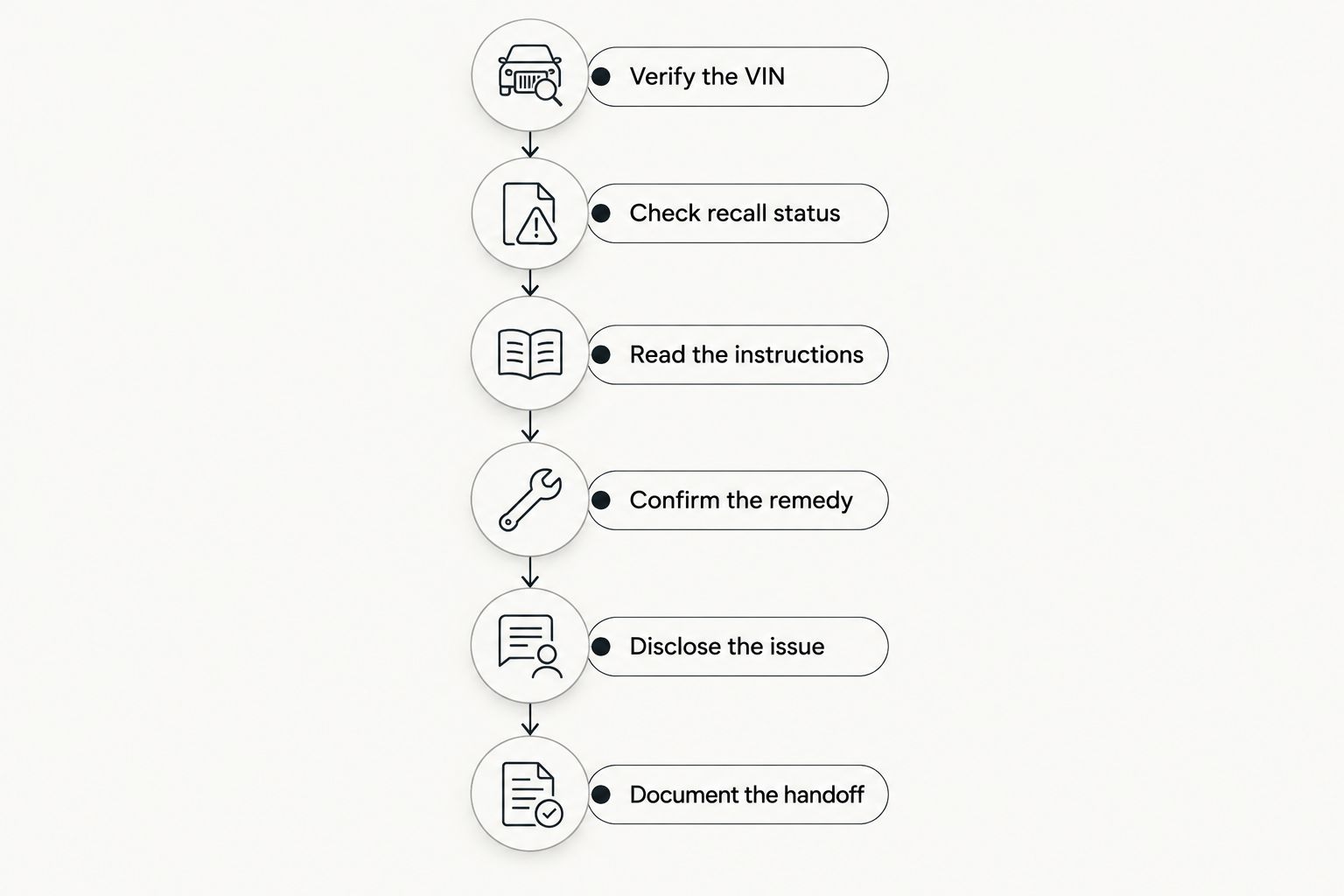
Use this sequence before agreeing to the handoff:
- Verify the VIN. Match the vehicle identification number on the car with the title and service paperwork. A standard modern VIN has 17 characters; older collector cars can use different identification formats.
- Check recall status. Use the National Highway Traffic Safety Administration’s VIN recall lookup and the manufacturer’s recall information. Follow up with an authorized service provider where the information is incomplete.
- Read the instructions. Establish whether the manufacturer permits normal use, restricts parking, or instructs owners not to drive.
- Confirm the remedy. Ask whether a remedy exists, whether the specific car qualifies, and what the service provider needs to complete it. An appointment is not proof of completion.
- Disclose the issue. Give the buyer the recall identification, current status, relevant instructions, and supporting documents before commitment.
- Document the handoff. Record who arranges the repair, whether completion is a closing condition, and how the vehicle will move safely.
Keep dated copies. A verbal assurance becomes difficult to evaluate once the car, funds, and title have changed hands.
Repair before closing or transfer with the recall open?
There is no single answer for every car. The decision depends on the manufacturer’s instructions, the remedy, the buyer’s acceptance, and applicable law—not simply the seller’s preferred closing date.
| Approach | Best for | Advantage | Limitation |
|---|---|---|---|
| Complete the recall before closing | Sellers who can obtain the remedy before transfer | Removes that outstanding repair from the handoff | Closing depends on actual completion, not a promised appointment |
| Make completion a closing condition | Buyers who want the car but require the remedy first | States clearly what must happen before closing | The deal remains contingent until the condition is satisfied |
| Transfer with the recall disclosed | Parties proceeding where legally permitted, with an agreed repair plan | Separates ownership transfer from later service | Leaves an outstanding safety issue and requires careful transport planning |
Complete the recall before closing when practical. If that is not possible, replace assumptions with written conditions. Neither a buyer’s acceptance nor a signed acknowledgment makes an unsafe test drive appropriate.
Avoid describing an unresolved recall as a minor administrative item. Let the notice and the service provider’s findings define its significance.
What changes when the remedy is not yet available?
An open recall without an available remedy requires a different conversation from an open recall awaiting an appointment. Tell the buyer which situation applies. Do not present an expected remedy as completed work.
Ask the manufacturer or authorized service provider to confirm the current status for the specific VIN. Keep any written response with the sale records, including instructions about driving or parking while the issue remains unresolved.
For a 2026 closing, recheck that status near the transfer date. Information supplied at the first conversation can become outdated before the buyer takes possession.
If the buyer will proceed only after repair, make completion an express condition. If the parties consider transferring sooner, obtain legal advice where necessary and establish a safe handoff plan. Do not promise a repair date you do not control.
What changes with a do-not-drive or park-outside instruction?
A do-not-drive instruction means you should not arrange an ordinary road test or drive the car to meet the buyer. Contact the manufacturer or authorized service provider for the prescribed next step and appropriate transport arrangements.
A park-outside instruction is different. Follow the notice’s specific parking precautions rather than substituting your own interpretation of what is safe.
Give the buyer and anyone handling the vehicle the applicable instructions. Confirm that the inspection location and proposed transport method can accommodate them before booking either service.
Do not ask a buyer to waive a safety instruction to keep the deal moving. Ownership paperwork does not resolve the underlying defect.
Why recall-related sales vary
The words “open recall” do not describe the whole situation. These factors determine what the transaction needs:
- Recall instructions. A notice restricting driving or parking changes the inspection and handoff plan.
- Remedy status. A completed repair, an available remedy, and an unavailable remedy are different facts. Document the correct one.
- Vehicle identification. Confirm that the recall applies to the actual VIN, not merely a similar model or production description.
- Transaction type and jurisdiction. Private sales, dealer transactions, and international transfers require separate legal consideration.
- Buyer conditions. Establish whether the buyer accepts an outstanding recall or requires completed work before closing.
- Supporting records. A repair order tied to the VIN supports a completion claim. An appointment confirmation does not.
Resolve these points before negotiating the final handoff. Otherwise, the parties can agree on the car while still disagreeing about what must happen before it changes hands.
What should you disclose to the buyer?
Disclose the known open recall before the buyer commits. Provide the recall identification, the affected VIN, the manufacturer’s instructions, and the current remedy status. Keep the wording factual.
Separate confirmed facts from pending questions. If the service provider has not confirmed completion, describe the recall as unresolved rather than saying it was handled because the car recently received service.
Include these items in the transaction record:
- The recall information supplied to the buyer and when it was supplied.
- Any manufacturer restrictions affecting use, parking, inspection, or transport.
- Whether repair completion is required before closing.
- Who will arrange the appointment and provide completion records.
- What the agreement requires if the repair remains unresolved.
An as-is provision is not a substitute for honest disclosure. Its legal effect depends on the transaction and applicable law; do not assume it eliminates responsibility for a misleading statement.
Protect discretion without withholding material vehicle information. Share the records needed to evaluate the car, but remove unrelated personal information before circulating documents.
Does a pre-purchase inspection replace recall work?
No. A pre-purchase inspection evaluates the vehicle within the inspector’s agreed scope; it does not complete the manufacturer’s recall remedy. A favorable inspection does not cancel an outstanding safety instruction.
Keep 2 separate checks in your purchase or sale plan: recall verification and the independent condition assessment. The pre-purchase supercar inspection guide explains the second task; the manufacturer and appropriate service provider address the first.
Felipe Cimino, CEO and co-founder of SV Sourcing, identifies buyers skipping a pre-purchase inspection as a firsthand concern. That observation supports keeping inspection in the process—not treating recall completion as proof of the car’s overall condition.
For sellers, make the inspection scope and access arrangements clear. For buyers, ask what the inspection excludes. Neither party should assume that a mechanical inspection certifies title, recall completion, or every aspect of the car’s history.
How should a private broker handle the recall?
A private exotic-car broker can coordinate the conversation, documents, inspection arrangements, and closing conditions. Recall diagnosis and repair belong with the appropriate service provider. Legal advice belongs with counsel.
SV Sourcing suits exotic- and collector-car buyers and sellers seeking private access and a single point of deal coordination. Its role is not that of a public-inventory dealership or a substitute for technical due diligence.
When comparing private brokers, ask who will track outstanding conditions, communicate changes, and confirm that the parties have the same handoff instructions. Establish those responsibilities before entrusting anyone with the car or its documents.
The limitation is straightforward: coordination does not control the manufacturer’s remedy or guarantee a closing. An unresolved recall still needs a documented decision, even when introductions remain private.
Discuss your private sale
Share the car, recall status, and intended timing to discuss deal coordination.
FAQ
Can I sell my exotic car with an open recall in 2026?
Generally, yes, in a private U.S. used-car sale, subject to applicable state law and the circumstances. Disclose the recall, follow manufacturer safety instructions, and document the repair and handoff responsibilities.
Do I have to fix the recall before selling privately?
Not every private used-car sale requires recall completion before transfer, but applicable law and the sale agreement can affect that answer. Confirm the requirements and never treat permission to transfer ownership as confirmation that the car is safe to drive.
Can the buyer test-drive a car with an open recall?
Follow the manufacturer’s instructions before permitting a test drive. A do-not-drive instruction rules out an ordinary road test; confirm appropriate inspection and transport arrangements instead.
Is an as-is agreement enough to cover an open recall?
An as-is agreement is not a substitute for truthful disclosure. Document the known recall and obtain legal advice about the agreement’s effect in the applicable jurisdiction.
How do I prove a recall repair was completed?
Obtain the completed repair order identifying the VIN and recall work, and confirm the status with the authorized service provider. Keep that record even if an online lookup has not yet updated.
Does a clean vehicle-history report mean there are no recalls?
Do not use a vehicle-history report as your only recall check. Verify the VIN through NHTSA and the manufacturer, and investigate any discrepancy before describing the car as having no open recalls.
Can SV Sourcing coordinate a private sale with an open recall?
SV Sourcing provides private exotic- and collector-car sourcing and sales coordination. Share the recall status when discussing a sale; any proposed transaction still needs appropriate safety checks, disclosure, and agreed closing conditions.
One last thing
A scheduled recall appointment is not a completed recall. Before describing the issue as resolved, obtain the repair order tied to the car’s VIN and confirm completion with the service provider.
For your 2026 handoff, keep the last recall check, disclosure, and repair records together. The buyer should not have to reconstruct what was known when the agreement was signed.