
Put down only the deposit you can justify against the written purchase terms, the checks still outstanding, and the conditions for getting your money back. There is no single deposit amount for buying a supercar that fits every private transaction in 2026. Keep inspection, transport, registration, and any financing requirements separate from the deposit decision.
- The deposit amount for buying a supercar should follow written terms, not pressure to reserve the car.
- Agree on the recipient, refund conditions, inspection rights, and release instructions before sending funds.
- A purchase deposit and a lender’s down payment serve different purposes; confirm how each applies at closing.
- SV Sourcing coordinates private exotic-car deals; buyers and sellers should settle deposit responsibilities in writing.
Why this matters
A deposit moves the conversation from interest to financial commitment. The question is not just how much you send. It is what the payment commits you to, who controls it, and what happens if the transaction stops.
For buyers, that means protecting room for due diligence. For sellers, it means defining a serious commitment without leaving the car’s status or the buyer’s obligations unclear. SV Sourcing provides private, off-market sourcing and sales coordination for exotic and collector cars in South Florida and nationwide.
Set the terms before setting the deposit. A smaller payment with unclear refund language is not automatically safer than a larger payment with clearly defined conditions.
How much deposit should a buyer put down on a supercar?
Choose a deposit that both parties accept after documenting the proposed transaction. Do not select it from a generic percentage or another buyer’s deal. A deposit should have a defined purpose, not simply demonstrate enthusiasm.
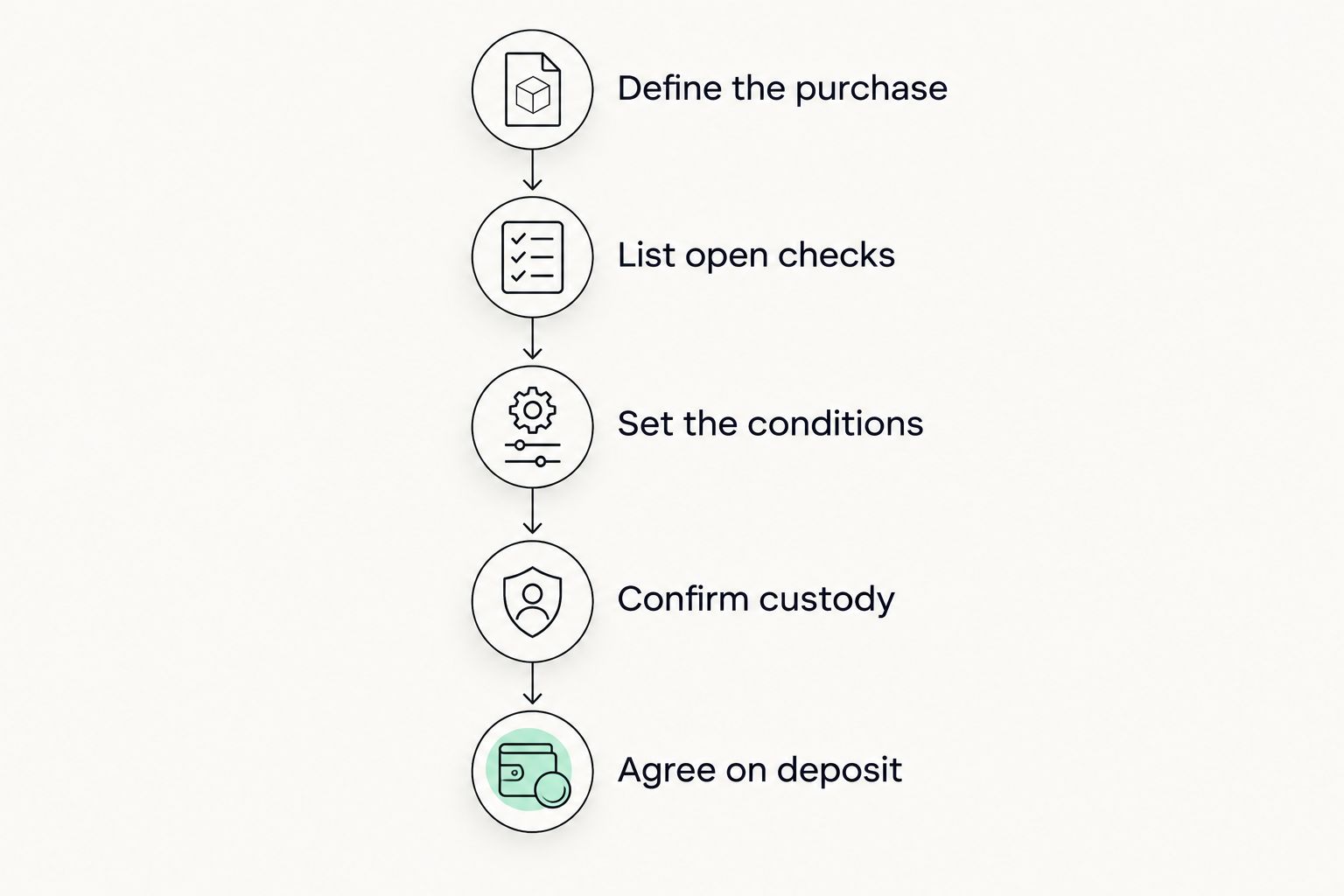
For a private purchase in 2026, use this sequence before agreeing to the amount:
- Define the purchase. Identify the car by VIN, confirm the agreed specification, and record the buyer and seller’s legal identities.
- List open checks. Identify the inspection, service-record review, title review, and financing decisions still outstanding.
- Set the conditions. Write down when the buyer can withdraw, when a refund is due, and what constitutes a failure to complete.
- Confirm custody. Identify the payment recipient, the account holder, and any agreed instructions for holding or releasing funds.
- Agree on the deposit. Negotiate the amount alongside the remaining obligations, then document how it applies at closing.
Ask the seller to explain what the deposit achieves. Does it establish a conditional purchase commitment? Does it change how the seller handles other inquiries? Does it become nonrefundable after an agreed event? Record the answer rather than assuming the payment creates a particular right.
The deposit receipt should connect the payment to the signed agreement and the identified vehicle. A transfer confirmation proves that money moved. It does not, by itself, explain the conditions under which you paid it.
Compare the payment structures before choosing
These structures describe different contractual arrangements, not standard packages. Their suitability depends on the agreement and applicable law.
| Structure | Best for | Benefit | Limitation |
|---|---|---|---|
| Conditional purchase deposit | Buyers with agreed checks outstanding | Connects commitment to specified inspection or document conditions | Vague conditions leave room for disagreement |
| Nonrefundable purchase deposit | Buyers ready to accept the stated commitment | Makes the agreed financial consequence of withdrawal explicit | Buyer withdrawal can put the deposit at risk under the agreement |
| Deposit held by an agreed third party | Parties seeking documented custody and release instructions | Separates holding the money from receiving the sale proceeds | Requires separate verification of the holder and its terms |
Choose the structure before negotiating the amount. None of these labels replaces the actual agreement. In particular, third-party custody does not establish that a car is correctly represented or that its title is clear.
Conditional deposits: define the exit conditions
A conditional deposit needs more than the word refundable. State which findings allow withdrawal, how the buyer must give notice, and what evidence supports the decision. Include the refund process and the responsible party.
For an inspection condition, decide whether the buyer can reject the car based on the report or whether only specified findings trigger that right. Those are different commitments. Avoid language that leaves the buyer and seller with different understandings of an acceptable inspection.
Document what happens if the inspection cannot take place as planned. An unavailable specialist, an inaccessible car, or missing records should have an agreed response rather than an improvised argument.
Review what a pre-purchase supercar inspection should cover before drafting the condition. The inspection scope and the deposit condition should address the same concerns.
Nonrefundable deposits: finish the checks first
Treat a nonrefundable deposit as money at risk, not as an administrative formality. Before accepting that commitment, understand the car, the seller’s authority, the documents, and the remaining closing requirements.
The word nonrefundable does not answer every legal question. Applicable law and the full agreement matter, particularly where a seller fails to perform or the vehicle differs from its description. Ask an attorney to review terms you do not understand before paying.
For sellers, separate buyer withdrawal from seller failure to complete. A deposit agreement should explain both. A label that addresses only the buyer’s obligations leaves the rest of the transaction unresolved.
Third-party-held deposits: check custody and release
If the parties propose an escrow arrangement or another third-party holder, verify the provider independently. Confirm the account identity, the written holding instructions, and the events that authorize release.
Ask what happens when the parties disagree. A holder’s process for disputed funds matters as much as its process for an uncomplicated closing. Do not assume either party can obtain a refund or release funds unilaterally.
An intermediary’s involvement is not a substitute for instructions. Establish whether the broker coordinates communication, receives money, represents a party, or performs another defined role. Those responsibilities should not be left implicit.
Why the deposit amount varies
The deposit conversation should reflect the actual transaction. For your 2026 purchase, discuss these factors together rather than treating the amount as an isolated negotiating point:
- Car specification. Confirm that the proposed car meets your agreed requirements before making a financial commitment.
- Outstanding due diligence. Inspection, history, and service-record questions need conditions that match the work still to be completed.
- Buyer readiness. Separate a confirmed purchasing plan from unresolved financing or other approval requirements.
- Seller obligations. Document what the seller agrees to do after receiving the deposit, including how other inquiries will be handled.
- Title and payoff work. Identify outstanding ownership documents or lender involvement before setting release instructions.
- Closing coordination. Align payment, documents, and handoff responsibilities, particularly when buyer and seller are in different states.
None of these factors creates an automatic formula. They identify what you are committing to and which uncertainties remain. If a party asks for a different deposit, ask which obligation or condition has changed.
Is a supercar deposit the same as a down payment?
A purchase deposit and a financing down payment are different commitments. A purchase deposit records an agreed commitment toward the vehicle transaction; a lender’s down payment forms part of the financing arrangement.
Do not assume the deposit automatically satisfies the lender’s requirements. Ask the lender how the payment must be documented and whether it counts toward the buyer’s contribution. Make sure the closing paperwork records any credit correctly.
Your 2026 buying budget should also separate the deposit from inspection, transport, registration, insurance, and ownership planning. Paying a deposit does not resolve those decisions. Keep sufficient funds available for the obligations you have agreed to accept.
Should I pay a deposit before the pre-purchase inspection?
Pay before inspection only if you accept the written conditions governing that payment. If your decision depends on the inspection, establish that condition before transferring funds. Do not rely on an assurance that the parties will resolve problems later.
Felipe Cimino, CEO and co-founder of SV Sourcing, has identified buyers skipping a pre-purchase inspection as a firsthand concern. His observations also include buyers purchasing internationally; that is a reason to examine the specific transaction, not to declare every overseas purchase unsafe.
For a remote purchase, confirm who selects the inspector, who authorizes access, and who receives the report. Keep inspection findings separate from sales assurances. If a material question remains unanswered, resolve the question before increasing your commitment.
What should a seller agree before accepting a deposit?
A seller should agree what the payment changes. Specify the buyer’s obligations, the seller’s obligations, the outstanding conditions, and the process if either party does not complete. Do not treat a deposit as a completed sale.
Clarify whether the seller will stop entertaining other offers and when that commitment ends. Identify who arranges inspection access and how the parties approve any revised terms. Put extensions and amendments in writing.
Keep personal information and vehicle documents limited to what the transaction requires. Verify the buyer and any intermediary without circulating unnecessary private details. Discretion should coexist with proper identification, not replace it.
SV Sourcing is suited to exotic- and collector-car buyers and sellers seeking private sourcing and deal coordination. The service is not a substitute for an independent inspection, legal advice, or the parties’ written deposit terms. Keep the coordinator’s role distinct from the responsibilities of the inspector, lender, and attorney.
What should I confirm immediately before sending funds?
Recheck the instructions against the signed agreement. Confirm the recipient’s identity and account details through an independently verified contact method, especially if payment instructions change. Do not use an unexpected message as the sole basis for a transfer.
Use this final check for a 2026 private purchase:
- The agreement identifies the correct buyer, seller, and vehicle.
- The deposit amount and its application at closing are recorded.
- Refund and withdrawal conditions match your understanding.
- The recipient and any third-party holding role are clear.
- The inspection and document-review obligations remain intact.
- The parties have agreed how to acknowledge receipt.
Pause if the instructions conflict with the agreement. Pressure to act is not a replacement for consistent documents. Resolve the conflict before money moves.
FAQ
What is a reasonable deposit amount for buying a supercar?
A reasonable deposit amount for buying a supercar is one you accept after reviewing the written purchase conditions and outstanding checks. Negotiate the amount together with refund rights, custody, and closing responsibilities rather than using an assumed standard percentage.
Can I get my supercar deposit back if the inspection finds a problem?
An inspection finding does not by itself establish a refund right; the agreement and applicable law determine the outcome. Before paying, specify which findings permit withdrawal and how to request a refund.
Should I send a deposit directly to a private seller?
Send a deposit to a private seller only after verifying identity, authority to sell, payment instructions, and the written terms. Direct payment leaves custody with the seller, so understand the agreed refund process before proceeding.
Does a deposit mean the seller must stop talking to other buyers?
A deposit should not be treated as an automatic promise that the seller will stop talking to other buyers. Put any restriction on other offers, its duration, and its conditions in the agreement.
Can a broker coordinate a deposit without holding the money?
A broker can coordinate communication and documents without acting as the deposit holder. Confirm the broker’s actual role, the payment recipient, and who authorizes any release or refund.
What if the seller asks me to increase the deposit?
Ask what changed in the proposed transaction before agreeing to increase the deposit. Document the revised amount and confirm whether the existing inspection, refund, and closing conditions remain unchanged.
One last thing
Negotiate the failed transaction before funding the intended one. Ask what happens if the inspection is unacceptable, a required document does not arrive, or either party cannot complete.
Clear answers do not guarantee a closing. They give both parties an agreed process when the deal changes. The right deposit is a documented commitment, not a test of how quickly you can send money.