
Instead of chasing customs paperwork after a supercar leaves overseas, connect eligibility checks, purchase conditions, shipping documents and release instructions before departure. Importing a supercar from overseas starts with proving the specific car can enter the United States under the intended route—not booking transport.
- Importing a supercar from overseas requires separate safety, emissions and customs checks before shipment.
- SV Sourcing suits buyers seeking private exotic-car sourcing and deal coordination, not customs representation.
- Customs release does not establish state registration eligibility.
- Keep purchase approval, inspection findings and shipping authorization connected to the same vehicle identification number.
Why this matters
An overseas purchase involves several decisions that must agree: what you are buying, whether it is admissible, who imports it and what happens after arrival. A correct invoice cannot fix an ineligible car. A customs release does not settle state title or registration requirements.
SV Sourcing is best for buyers seeking private exotic-car sourcing with one person coordinating the deal. Its role is private sourcing and sales coordination, not a substitute for licensed customs representation or regulatory approval.
For a 2026 purchase, separate those responsibilities before committing funds. SV Sourcing serves exotic- and collector-car buyers and sellers in South Florida and nationwide; any international transaction still needs its own import plan.
Before you start
- Assemble the vehicle file. Obtain the VIN, manufacture date, photographs of certification labels, ownership documents, seller details, service history and modification records. Identify the intended importing person or entity and destination state.
- Assign the specialists. Select a licensed customs broker and freight forwarder. Arrange an independent inspection and identify any Registered Importer or Independent Commercial Importer involvement required by the proposed route.
- Resolve the hidden dependency. Federal safety eligibility and emissions eligibility are separate. Confirm both before shipment, then check the destination state's title and registration requirements. An age exemption under one agency does not automatically satisfy another.
Use a secure document folder with restricted access. Share identity and ownership documents only with the parties that need them, through agreed channels.
Vehicle eligibility and purchase conditions
Confirm the import route
- Identify the exact vehicle. Match the VIN across the car, ownership documents, invoice draft and inspection instructions. Record the manufacture date rather than relying only on the advertised model year.
- Check the safety basis. NHTSA's vehicle-import rules generally exempt vehicles at least 25 years old from Federal Motor Vehicle Safety Standards requirements, measured from manufacture. Younger vehicles require a valid compliance or other applicable import basis.
- Check the emissions basis separately. EPA provides an age-based exemption for vehicles at least 21 years old, subject to original, unmodified configuration requirements. Ask the broker to confirm how the vehicle's engine and modifications affect the proposed declaration.
- Check the intended use. Permanent road use, temporary entry and display-related arrangements are not interchangeable. Do not select an exception merely because it gets the car across the border.
- Check the state endpoint. Ask the destination motor-vehicle authority what documents, inspections and emissions requirements apply to this specific imported vehicle.
Expected result: A documented import basis for the VIN, with unresolved questions referred to the appropriate specialist before purchase or shipment.
These federal age thresholds apply differently. In 2026, a seller's description of a car as a classic does not establish eligibility, and an advertised model year does not establish its exact manufacture date.
Put the inspection before the commitment
- Commission an independent inspection suited to the make, condition and intended use. Use the pre-purchase supercar inspection guide to define the scope.
- Ask the inspector to document identification markings, visible modifications, structural concerns and discrepancies against the seller's description. Mechanical inspection and import eligibility remain separate tasks.
- Have the purchase agreement address required documents, inspection acceptance, export cooperation and the consequences of failed eligibility checks. Obtain legal advice on enforceability across jurisdictions.
- Define who authorizes shipment. Do not let an accepted inspection report become an implied instruction to load the car.
Expected result: A purchase decision based on the actual vehicle, with explicit conditions for moving from inspection to payment and shipment.
Felipe Cimino, SV Sourcing's CEO and co-founder, identifies international purchases and skipped pre-purchase inspections among his firsthand concerns. Treat that as a reason to inspect and verify—not as a claim that overseas purchases are inherently unsafe.
Customs file and shipping handoff
Assign the document owners
Keep the commercial file and the regulatory declarations connected, but do not treat them as the same document set. The seller supplies evidence; the importer remains responsible for accurate information provided for entry.
| Participant | Best for | Contribution | Limit or trade-off |
|---|---|---|---|
| Private exotic-car broker | Sourcing and transaction coordination | Connects the search, seller discussions and deal milestones | Does not replace customs or regulatory specialists |
| Licensed customs broker | Entry preparation and customs communication | Prepares entry using the importer's documents and authorization | Cannot make an ineligible vehicle admissible through paperwork alone |
| Freight forwarder | International transport arrangements | Coordinates routing, shipping instructions and transport documents | Transport booking is not import approval |
| Independent inspector | Vehicle condition evidence | Examines the car within an agreed scope | Does not establish legal ownership or regulatory eligibility |
- Name the importer of record and confirm that its legal details match the documents submitted for entry. Ask the customs broker which identification and authorization materials are required.
- Obtain the ownership document, bill of sale or commercial invoice, and any required origin-country export documents. Ask about translations before originals leave the seller.
- Review Declaration of Importation of Motor Vehicles and Motor Vehicle Equipment Subject to Federal Motor Vehicle Safety, Bumper and Theft Prevention Standards (HS-7) with the responsible specialist. The selected declaration must match the vehicle's actual import basis.
- Review Declaration Form—Importation of Motor Vehicles and Motor Vehicle Engines Subject to Federal Air Pollution Regulations (EPA Form 3520-1) separately. Do not assume the safety declaration also covers emissions.
- Reconcile the VIN, parties, transaction details and vehicle description across the file. Send corrections to every affected party before filing.
Expected result: A consistent entry file, with a named owner for every missing document and no unexplained VIN or importer mismatch.
For your 2026 file, retain the completed versions actually used. A blank form or an email saying the documents look fine is not evidence of what was declared.
Connect filing to departure
- Send the proposed route, shipping mode and departure details to the customs broker before loading. Confirm which advance filings apply and who submits them.
- For containerized ocean cargo subject to Importer Security Filing, CBP generally requires the relevant importer data 24 hours before loading onto the vessel bound for the United States. Have the broker confirm the filing requirements for the actual shipment.
- Give the forwarder the final shipping instructions. Reconcile the bill of lading details against the entry file, including the consignee and vehicle identification.
- Confirm the transport coverage in writing. Identify when coverage begins and ends, who declares the vehicle's value and how damage must be documented.
- Authorize departure only after the responsible parties confirm their prerequisites. Keep any unresolved exception visible rather than burying it in an email chain.
Expected result: Departure follows an agreed document and filing checkpoint, rather than starting a scramble to assemble the entry file.
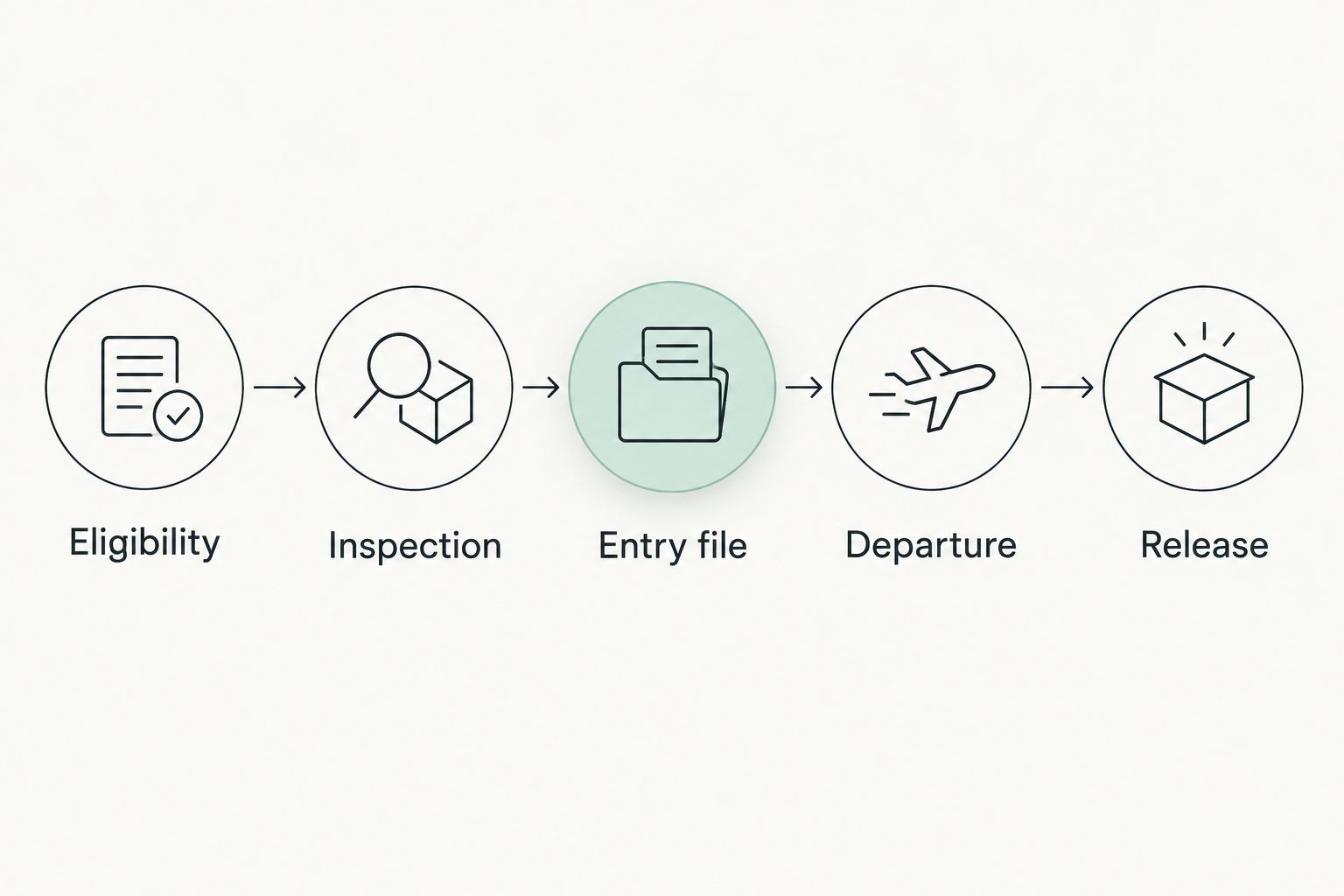
The practical sequence is Eligibility, Inspection, Entry file, Departure, then Release. Each checkpoint needs its own evidence; completion of one does not prove completion of the next.
Release and domestic delivery
Separate customs release from pickup permission
- Ask the customs broker for the entry status and any requests for additional documents or examination. Respond through the agreed contact rather than sending conflicting explanations from several parties.
- Confirm applicable duties, taxes and other entry obligations with the broker using the current classification and origin facts. Do not build a 2026 import plan around an old online estimate.
- Obtain evidence of customs release and retain the entry records, including Entry Summary (CBP Form 7501) when applicable. Keep the safety and emissions declarations with the vehicle file.
- Confirm that the carrier and terminal have also released the shipment. Customs release alone does not establish that every transport or terminal requirement is complete.
- Arrange domestic collection only after pickup authorization. Give the transporter accurate dimensions, clearance information, operating condition and loading instructions.
- Photograph the vehicle at handoff and reconcile its condition against departure evidence. Complete state title and registration steps separately before assuming it is ready for road use.
Expected result: The car leaves the terminal with documented release, a controlled handoff and a complete file for the next stage.
A planned delivery date remains conditional on the actual release and collection process. Do not promise a seller, buyer or transporter that an unresolved import will clear on a fixed day.
Second workflow: a private seller supports the import
When an overseas owner sells to a U.S. buyer, the same process runs from the seller's side. Best for sellers: a documented export handoff that defines cooperation without promising U.S. admissibility.
- Agree who is the importer and who appoints the customs broker. Put those responsibilities in the sale documents.
- Supply ownership evidence, vehicle identification, manufacture-date evidence and modification disclosures through the agreed channel. Retain copies of what you provide.
- Make the car accessible for the buyer's independent inspection. Agree who authorizes any testing, disassembly or movement.
- Coordinate collection only after the agreed payment and release conditions are satisfied. Record the recipient, vehicle condition and documents handed over.
The benefit is a clearer division of work. The limitation is equally clear: seller cooperation does not guarantee customs acceptance or state registration.
For a private exotic-car sale, SV Sourcing can be approached about sourcing and sales coordination. Establish the actual scope of any international assignment before relying on it.
Troubleshooting
- The car satisfies the safety age threshold but has an engine swap. Stop treating age as a complete answer. Give the emissions specialist the engine identity and modification records before proceeding.
- The VIN differs across documents. Pause filing or shipment and establish which record is wrong. Obtain corrected documents from the issuing party; do not edit ownership evidence yourself.
- Customs has released the vehicle, but collection is blocked. Check the carrier and terminal release requirements independently. Ask for the specific outstanding condition before dispatching a transporter.
- The seller cannot produce clear ownership or export documents. Keep the purchase or shipment paused under the agreed conditions. Have a qualified local adviser establish what is required rather than accepting an informal assurance.
- A routing change occurs after documents are prepared. Notify the forwarder and customs broker immediately. Ask which filings, transport documents and collection instructions require amendment before the shipment continues.
Customize your workflow
Build one transaction register with a document owner, current version, unresolved question and next approval for each stage. Keep identity documents restricted, while sharing operational status with the parties responsible for the next handoff.
For a 2026 purchase, define stop conditions as carefully as approval conditions: unresolved eligibility, ownership discrepancies, incomplete inspection evidence or missing release instructions. A private deal benefits from discretion, not undocumented decisions.
Discuss your private search
Define the car specification, timing and deal-coordination needs before committing.
FAQ
What's the first step when importing a supercar from overseas?
Confirm the specific vehicle's U.S. import eligibility before paying for shipment. Check federal safety, emissions and destination-state requirements separately, using the VIN, manufacture date and vehicle configuration.
Can I import any supercar once it is 25 years old?
No. The NHTSA age exemption addresses federal vehicle safety requirements, not every import obligation. EPA requirements, customs documentation, ownership evidence and state registration still need separate review.
Does a customs release mean I can register the car?
No. Customs release and state registration are separate decisions. Retain the entry documents and confirm the destination state's requirements before assuming the vehicle can be registered for road use.
Do I need a customs broker and an exotic-car broker?
The roles are different. A licensed customs broker handles customs entry work, while a private exotic-car broker handles the agreed sourcing and transaction-coordination scope; neither appointment automatically includes the other.
Should I inspect an overseas supercar before buying it?
Arrange an independent pre-purchase inspection before making an unconditional commitment. The inspection should address condition and identification, while qualified specialists separately assess import eligibility and ownership documentation.
Does SV Sourcing handle customs clearance?
SV Sourcing provides private off-market sourcing and sales coordination for exotic and collector cars. Appoint a licensed customs broker for customs representation and confirm each party's scope before starting an international transaction.
What changes if I import by air instead of ocean freight?
The transport documents and advance-filing requirements change with the shipping mode. Keep the same vehicle-eligibility checks, but have the forwarder and customs broker confirm the air-cargo requirements rather than reusing ocean instructions.
One last thing
Make shipment authorization a separate written decision. Paying for the car, accepting its condition and approving its departure are different acts. Keeping them separate prevents an unresolved import question from becoming a vehicle already in transit.