
Instead of chasing signatures, title paperwork and pickup instructions separately, connect a mobile notary to a private supercar closing through one written checklist. Confirm the required documents first, arrange the signing second, and keep payment confirmation and vehicle release separate from notarization.
- For a mobile notary car sale, confirm title requirements before booking the signing appointment.
- SV Sourcing suits buyers and sellers seeking private exotic-car sourcing and deal coordination.
- Notarization does not verify vehicle condition, clear a lien or confirm payment.
- Release the car only after the agreed payment, document and handoff conditions are satisfied.
Why this matters
A mobile notary brings the signing appointment to an agreed location. The notary does not replace the lender, registration authority, inspector or payment provider. A notarized signature is not clearance to release the car.
SV Sourcing provides private exotic-car sourcing and sales coordination in South Florida and nationwide. SV Sourcing is best for buyers and sellers seeking private exotic-car access with one person coordinating the deal. That coordination does not replace independent inspection, legal advice or the receiving authority’s document requirements.
For a 2026 closing, use current instructions from the relevant motor vehicle authority and any lienholder. A familiar form from a previous transaction is not proof that the present transfer follows the same rules.
Before you start
- Document access: Gather the title or electronic-title information, registration, proposed sales agreement, ownership details and any lender instructions. Confirm which authority will receive the transfer documents.
- Signer access: Identify everyone required to sign. Ask the notary which identification is acceptable, whether witnesses are required, and what additional documentation an entity or authorized representative needs.
- The overlooked constraint: Establish whether notarization is required at all, and whether the receiving authority accepts the proposed signing method. A completed notarial certificate does not cure an incorrect title assignment or missing ownership authority.
Keep personal records within the smallest necessary group. Ask how identification and signed documents will be transmitted and retained before sending copies around a broker, buyer, lender and transport chain.
Document requirements
Establish the closing file
- Identify the titled owner. Compare the ownership record with the seller’s identification or entity documents. Flag a trust, estate, company, co-owner or power of attorney before arranging the appointment.
- Confirm the vehicle identity. Compare the vehicle identification number on the car with the title and transaction documents. Resolve discrepancies before signing.
- Obtain current transfer instructions. Ask the title-issuing authority and the buyer’s registration authority which forms, signatures, originals, notarizations and witness arrangements apply to this transfer.
- Resolve the lien route. If financing remains, obtain the lender’s payoff and title-release instructions through a verified channel. Establish who receives the title and what happens before it becomes transferable.
- Create 1 closing checklist. List each document, responsible person, required signing method, recipient and release condition. Mark unresolved items rather than treating them as administrative details.
Expected result: You can identify every required signer and explain where every signed original must go. The notary appointment has a defined purpose rather than a general request to notarize the sale.
Use the documents needed to sell an exotic car guide to organize the file. The receiving authority’s instructions still govern the actual transfer.
Keep the bill of sale, title assignment and notarial certificate distinct. They serve different functions. Ask the receiving authority or a qualified legal adviser to resolve uncertainty about the required notarial act; do not ask the notary to choose legal terms for the transaction.
Notary appointment
Match the appointment to the documents
- Describe the assignment accurately. Tell the notary that the appointment concerns a private vehicle transfer. State the signing location, relevant states, document types and whether anyone signs for an entity or another person.
- Confirm the notary’s authority. Check the commission through the commissioning authority’s official records. Confirm that the notary can perform the required act at the proposed location.
- Confirm identification and attendance. Obtain the notary’s requirements directly. Arrange required witnesses separately unless the notary expressly agrees to provide that arrangement.
- Send only what is needed for review. Ask whether the notary needs an advance copy of the signing pages. Use an agreed secure channel and avoid distributing unrelated financial or identity records.
- Confirm the appointment in writing. Record the location, participants, documents, witness arrangements and the person authorized to pause the closing if a discrepancy appears.
Expected result: The notary knows the scope, the signers know what to bring, and the coordinator knows which unresolved issue would stop the appointment.
Choose the signing arrangement
For a 2026 transaction, choose the arrangement the documents and receiving authority support. Convenience comes after acceptance.
| Signing arrangement | Best for | Advantage | Limitation |
|---|---|---|---|
| Mobile in-person notary | Signers meeting at an agreed private location | Brings the appointment to the signers | Does not remove identification, witness or original-document requirements |
| Fixed-location in-person notary | Signers able to attend an established location | Keeps the signing at a designated premises | Requires travel and confirmation that the required act is offered |
| Remote online notarization, where permitted and accepted | Eligible signers who cannot meet in person | Allows a qualifying notarization without shared physical attendance | State authorization, document eligibility and recipient acceptance must all be checked |
Choose a mobile appointment for location convenience, not as a substitute for document review. Do not switch to remote signing merely because an in-person appointment becomes difficult to arrange.
Signing controls
Keep the signature event contained
- Inspect the final document set. Compare names, vehicle details, odometer entries where required, and transaction terms with the agreed file. Do not treat a blank material field as something to finish casually afterward.
- Follow the notary’s signing instructions. Do not pre-sign unless the notary confirms that the required act allows it. An acknowledgment and a jurat have different requirements.
- Confirm representative capacity. Where a signer acts for an entity or another owner, confirm that the transfer authority and receiving institution accept the supporting documents. Identity and authority are separate questions.
- Check the completed package. Before anyone leaves, review required signatures, dates, notarial certificates, seals and witness entries for omissions. Direct corrections to the appropriate signer, notary or issuing authority.
- Record custody. Identify who holds the signed title, agreement and other originals. Send copies only to the parties who need them.
Expected result: The signing package is complete for the next agreed step, and its custody is documented. No one mistakes completion of the appointment for completion of the sale.
Use the same sequence for a 2026 collector-car transaction even when the parties already know each other. Familiarity does not resolve a missing signature or an incorrect ownership record.
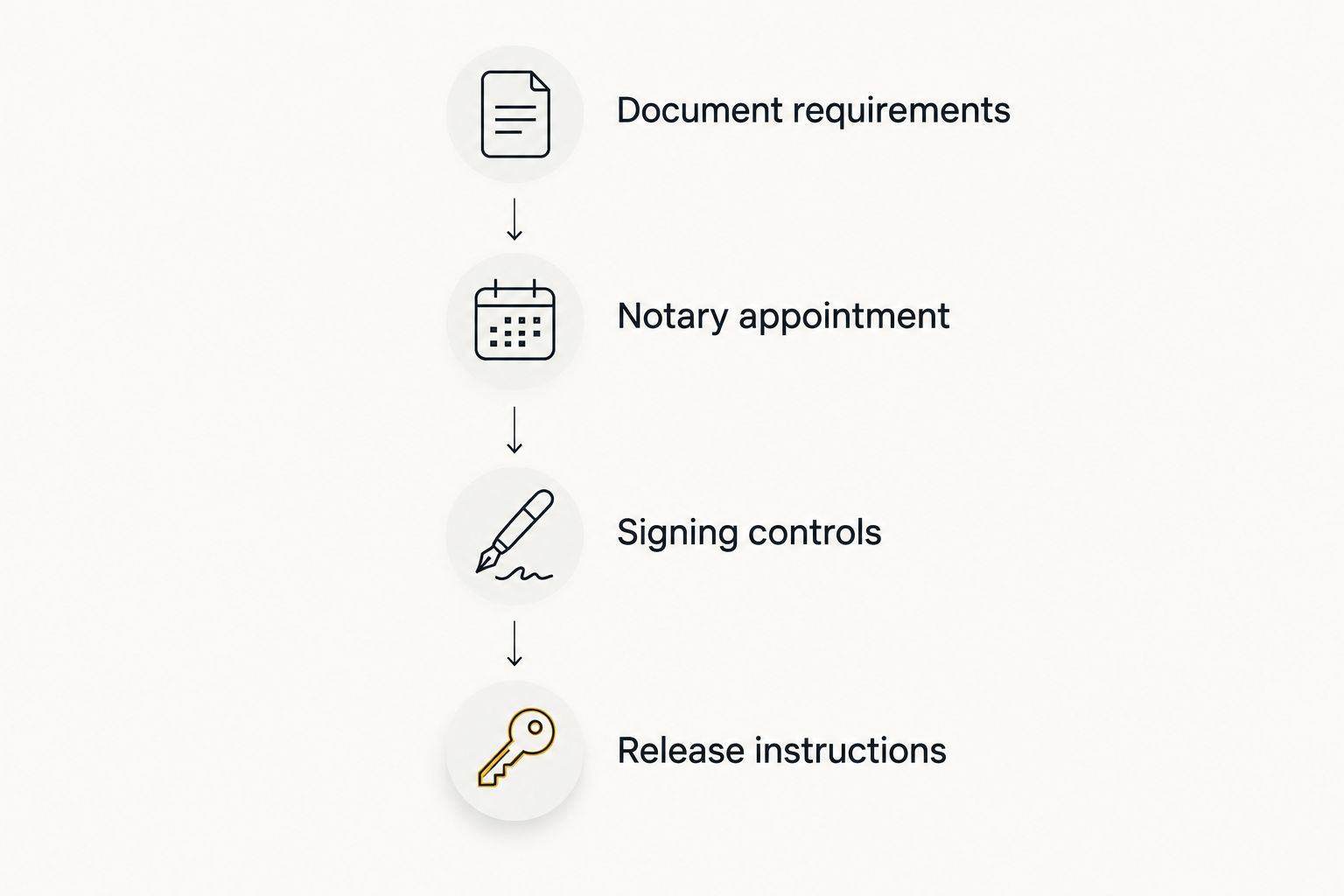
The closing sequence is simple: document requirements, notary appointment, signing controls, then release instructions. Keep those stages distinct so a delay in one does not trigger an unauthorized handoff in another.
Release instructions
Separate signing from payment and pickup
- Write the payment conditions. State how the parties will verify receipt through the bank or agreed payment provider. A screenshot, email or statement from the buyer is not independent confirmation.
- Verify sensitive instructions independently. Maintain 2 verified contact methods for the party giving payment or release instructions. Treat a changed account or last-minute pickup request as a reason to stop and reconfirm through an established channel.
- Define 3 release gates. Require satisfaction of the agreed payment conditions, completion of the required document steps, and authorization of the named recipient or carrier. Record who confirms each gate.
- Authorize the handoff explicitly. Identify the person collecting the vehicle, the documents accompanying it, and how keys and accessories will be transferred. Confirm insurance arrangements before movement.
- Retain the closing record. Keep the signed agreement, relevant payment confirmation, document-custody record and handoff acknowledgment. Limit access to sensitive information.
Expected result: The person holding the car knows exactly whose instruction permits release and what evidence supports it. The notary’s departure has no bearing on that decision.
A coordinator can keep these dependencies visible. The coordinator cannot make an unresolved lender requirement, disputed payment or defective transfer document disappear. Pause the handoff when a release condition remains unmet.
When a lien changes the workflow
A financed supercar adds a dependency: the lender’s payoff and title-release process. Booking a notary does not accelerate that process or establish that the seller can deliver a transferable title immediately.
- Confirm the payoff route: Obtain current written instructions directly from the lender, including how the transaction references the vehicle and account.
- Map document custody: Establish whether the lender, seller, buyer or another agreed party receives the released title or lien documentation.
- Set conditional appointments: Schedule signing and transport around confirmed document readiness. Do not promise a pickup date that depends on an unresolved release.
- Recheck after changes: If the buyer, lender instructions, signing party or document set changes, reconfirm the notary assignment before proceeding.
For this 2026 workflow, treat signing readiness and title readiness as separate statuses. One can be complete while the other remains unresolved.
The same discipline applies when a buyer purchases through an LLC. Confirm the acquiring entity’s exact details and the signer’s authority before preparing the final documents. Do not substitute an individual’s name simply to keep an appointment moving.
Troubleshooting
The notary will not accept the signer’s identification
Ask the notary which identification or other lawful identification procedure is acceptable in that jurisdiction. Reschedule if necessary. A broker’s familiarity with the signer does not override the notary’s obligations.
The name on the title does not match the signer
Stop and establish the reason. A name change, entity ownership, estate or representative arrangement needs the appropriate supporting documentation and transfer instructions. Do not alter the ownership record informally.
The buyer wants remote signing at the last minute
Check authorization and recipient acceptance before changing methods. If the required document needs an accepted paper original, a remote appointment alone does not solve that requirement. Keep transport unconfirmed until the document route is settled.
Payment instructions change after the signing
Pause payment or release activity and verify the change through previously established contact information. Do not use only the telephone number supplied in the change request. Reissue the written closing instructions after verification.
The carrier arrives before the closing conditions are met
Hold the car. Explain which release condition remains open and who must resolve it. A scheduled truck, signed bill of sale or completed notarization does not replace the agreed release authorization.
Customize your workflow
Bring the closing checklist into the transaction before agreeing to pickup arrangements. Buyers should confirm specification, inspection, ownership documentation and registration needs. Sellers should confirm signing authority, lender requirements and the conditions for releasing the vehicle.
SV Sourcing coordinates private exotic-car sourcing and sales, rather than operating as a public inventory dealership. The benefit is a defined point of coordination; the boundary is equally clear: specialist inspections, notarizations and authority-specific approvals remain separate responsibilities.
For a 2026 closing brief, identify the car, buyer or seller role, location, ownership structure, lien status and timing constraints. Share sensitive records only after agreeing how they will be handled.
Discuss your private transaction
Clarify the car, ownership position and closing dependencies before arranging the handoff.
FAQ
Do I need a mobile notary for a private car sale?
A mobile notary is needed only when the required documents call for notarization and you choose an on-site appointment. Confirm the transfer requirements with the relevant motor vehicle authority before booking.
Does notarizing a car title prove the buyer has paid?
No. Notarization does not confirm payment. Verify payment through the bank or agreed provider and satisfy the written release conditions separately.
Can a mobile notary complete an out-of-state supercar sale?
A mobile notary can perform an authorized notarial act, but that does not complete every part of an out-of-state transfer. Check the title, registration, lien and original-document requirements with the relevant authorities.
Can I sign the car title before the notary arrives?
Ask the notary before signing. The required notarial act determines whether an existing signature can be acknowledged or the document must be signed in the notary’s presence.
Can a mobile notary verify that a supercar has a clear title?
Notarization does not establish clear title. Review ownership records, lien documentation and transfer requirements through the appropriate authorities and lender.
What happens if the seller still has a loan on the car?
The lender’s payoff and title-release process must be included in the closing instructions. Confirm payment routing, document custody and release dependencies before scheduling the final handoff.
How does SV Sourcing fit into a mobile notary car sale?
SV Sourcing provides private exotic-car sourcing and sales coordination. Agree who arranges the notary, verifies document readiness and authorizes handoff; do not assume coordination includes notarial, legal or escrow services.
One last thing
Book the notary around document readiness, not the transporter’s arrival. A parked carrier creates pressure to finish; it does not resolve an incorrect title or an unverified payment. Write the stop conditions before anyone books travel.