
An exotic car broker for divorce asset sales coordinates a private vehicle sale with the aim of completing a documented transaction within the owners’ agreed or court-authorized instructions. Unlike an ordinary sale, the process must address who can approve an offer, what information can be shared, and where the proceeds belong.
- SV Sourcing suits owners seeking private exotic-car sale coordination, not legal decisions about divorce assets.
- Choose an exotic car broker for divorce asset sales after counsel confirms authority and approval requirements.
- Separate market evidence, buyer verification and closing instructions; private outreach does not replace due diligence.
- Agree on inspection access, loan payoff and proceeds instructions before committing to a buyer.
Why private sale coordination matters for divorcing owners
The broker coordinates the transaction. Your lawyer determines the legal boundaries. A private introduction does not establish permission to sell, settle ownership disputes or decide how proceeds should be divided.
SV Sourcing provides private, off-market sourcing and sales coordination for exotic and collector cars in South Florida and nationwide. The service fits owners who want buyer introductions and a coordinated deal rather than a public inventory listing. It does not replace counsel, a lender or an independent inspector.
For a 2026 sale, build the instructions around the documents and restrictions that apply to your transaction. Do not assume that possession of the car, a name on an insurance policy or access to the keys establishes sale authority.
Private outreach also needs boundaries. Keeping a car out of public advertising is different from withholding information from someone entitled to receive it.
How to organize a divorce-related exotic-car sale
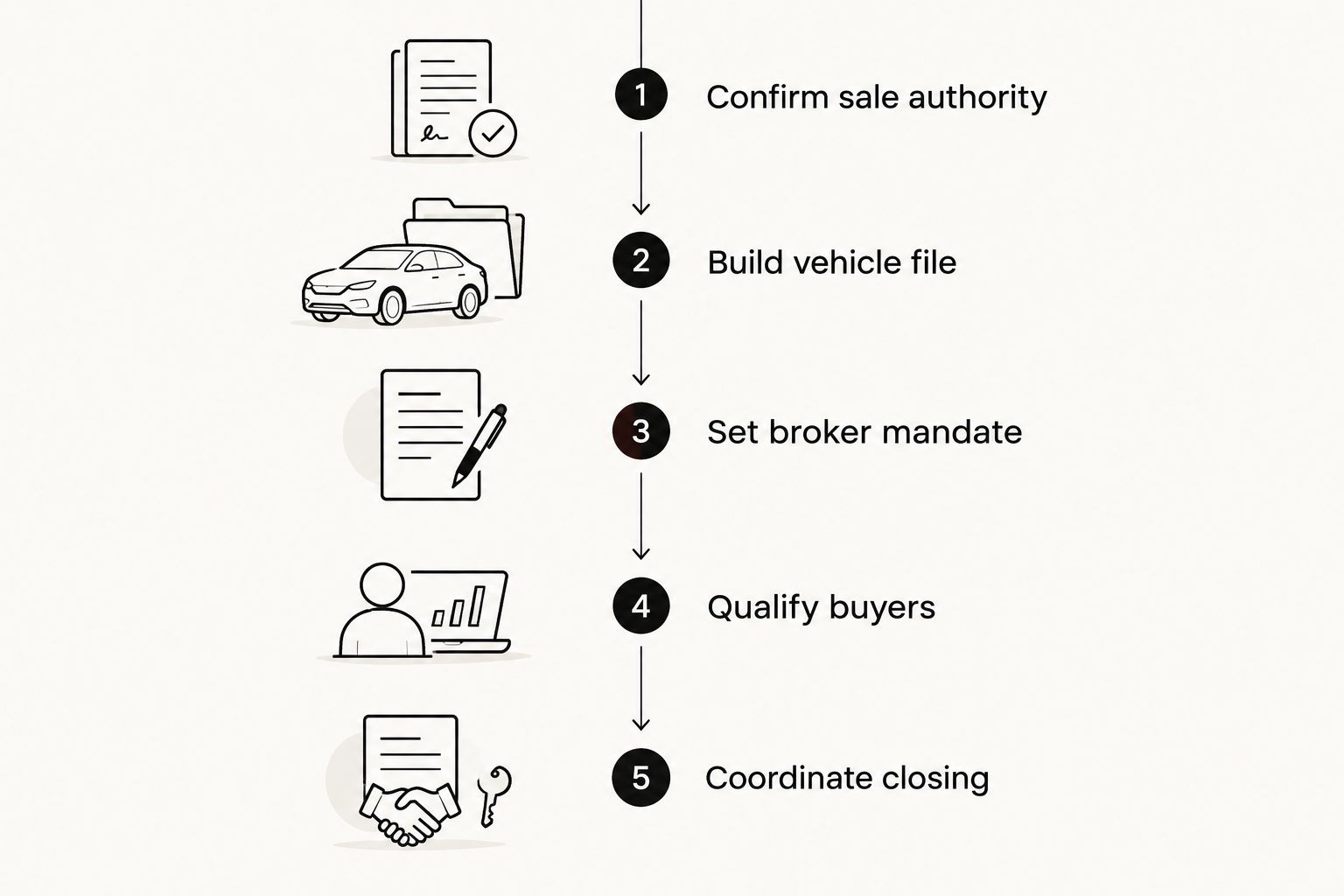
1. Confirm sale authority
Start with your lawyer and the ownership documents. Ask who must authorize marketing, sign an agreement, approve an offer and execute the transfer. These are separate questions; do not treat approval to discuss a sale as approval to complete it.
If instructions conflict, pause buyer outreach until counsel resolves them. The broker should not choose between spouses or interpret a disputed order.
Define 2 approval gates in writing: permission to begin outreach and permission to accept a transaction. Counsel should specify any additional approvals required for your circumstances.
- Identify the titled owner and any entity holding the vehicle.
- Ask counsel to identify applicable sale restrictions and required consents.
- Name the person authorized to communicate instructions to the broker.
- Record who approves offers and who signs transfer documents.
- Establish how changed or conflicting instructions will be handled.
2. Build the vehicle file
You can assemble the documents yourself before appointing an intermediary. Use 1 vehicle file with controlled access, rather than forwarding different versions of records across separate conversations.
Include the specification, mileage, service history, known condition issues and title information. Separate facts supported by documents from statements that still need verification. A buyer’s inspection should not become the first point at which an unresolved condition issue surfaces.
For a 2026 transaction, label the file with the date each current item was obtained. An older service invoice is useful history; it is not a statement of the car’s present condition.
- Record the vehicle identification number and exact specification.
- Gather service invoices, ownership records and relevant condition reports.
- Identify liens and request current payoff instructions when applicable.
- List known modifications, damage, missing items and outstanding work.
- Keep personal financial and divorce documents outside the buyer-facing file.
3. Set the broker’s mandate
The manual route is to handle introductions, questions and follow-up yourself. Appointing a private broker delegates those tasks, but the agreement must distinguish coordination from decision-making authority.
SV Sourcing offers private off-market access with one person coordinating the deal. That arrangement suits owners who want a defined communication channel. It does not resolve disagreements about whether to sell or what terms to accept.
Read what an exotic-car broker agreement should include before authorizing outreach. Ask competing private brokers the same questions so their proposals are comparable.
- Define representation: who engages the broker and whose instructions govern.
- Specify permitted outreach, advertising and information sharing.
- Document compensation terms, expenses and termination provisions.
- Require approval before accepting offers or changing the sales approach.
- Clarify custody, insurance and responsibility if the vehicle changes location.
4. Establish an evidence-based asking strategy
Separate the value needed for the divorce process from the asking strategy used to approach buyers. Ask counsel whether a formal valuation is required and who should provide it. A broker’s market discussion is not automatically a substitute.
Compare relevant specifications, mileage, condition and documented transaction evidence where available. An advertised figure shows an asking position, not proof that a buyer completed a purchase on those terms.
Felipe Cimino, CEO and co-founder of SV Sourcing, has identified unrealistic asking expectations leaving cars unsold as a firsthand concern. Treat that observation as a reason to document assumptions, not as a prediction about your car.
- Identify which vehicle details materially distinguish the car from comparisons.
- Separate advertised examples from documented completed transactions.
- Record the evidence supporting the proposed asking strategy.
- Agree on when to review buyer feedback and revise instructions.
- Route disagreements about value back to the authorized decision-makers.
5. Control disclosures and qualify buyers
Discretion starts with an information-release plan. Decide what a prospective buyer sees initially, what requires verification, and what remains restricted to counsel and the closing parties.
A buyer needs enough vehicle information to assess the opportunity. The buyer does not need the personal history behind the sale. Privacy protects personal information; it does not justify concealing relevant vehicle facts.
For a 2026 sale, approve the actual photographs and document copies before they circulate. Check for registration details, home addresses, reflections and unrelated paperwork visible in the images.
- Use a buyer-facing vehicle summary without unnecessary personal details.
- Establish identity and purchasing authority before arranging access.
- Agree on an appropriate funding-verification process with the relevant professionals.
- Share sensitive records through a controlled channel.
- Keep a record of introductions, disclosures and substantive offers.
6. Agree on inspection and offer conditions
A private introduction is not a substitute for a pre-purchase inspection. Give the buyer a clear route to an independent inspection and agree on access, location and responsibility before moving the car.
An offer is more than its headline amount. Compare inspection conditions, funding arrangements, proposed delivery, required approvals and any unresolved title issue. A seemingly straightforward offer still needs a documented acceptance process.
If a buyer requests an international purchase or shipment, obtain transaction-specific advice before proceeding. Felipe has raised international purchases and skipped inspections as firsthand concerns; that does not establish that every overseas transaction is unsafe.
- Confirm the inspector’s independence and suitability for the vehicle.
- Agree on inspection scope, permitted testing and handling arrangements.
- Record how new findings affect negotiation or cancellation rights.
- Put offer conditions and required approvals in writing.
- Avoid delivery commitments before the closing dependencies are understood.
7. Coordinate closing and retain the record
Before releasing the vehicle, check 3 closing dependencies: payment confirmation, title or lien requirements, and approved proceeds instructions. Assign responsibility for each rather than assuming the broker, lender or lawyer is handling everything.
Your bank or payment professional should explain how to verify receipt. Your lender should provide its payoff process. Counsel should confirm instructions for holding or distributing proceeds where the divorce arrangements require them.
For a 2026 closing, retain a dated transaction record. Include the accepted terms, approvals, payment confirmation, transfer documents and handoff acknowledgment, with access limited to the appropriate parties.
- Confirm final approval against the agreed acceptance process.
- Verify payment through independently confirmed institutional channels.
- Follow lender instructions for payoff and lien release when applicable.
- Confirm insurance, custody and transport arrangements before handoff.
- Retain the closing record and document where the proceeds were directed.
The sequence matters: confirm authority before outreach, document the vehicle before negotiations, and settle closing instructions before release. Use this sequence to assign responsibilities, not to promise a completion date.
Compare your private-sale options
Compare private brokers on their written mandate, not promises of access or speed. Ask who represents whom, how buyers are qualified and which decisions remain yours. A large contact list does not answer those questions.
The alternatives below describe different working arrangements. Their suitability depends on your authority to sell, required discretion and willingness to handle the transaction yourself.
| Option | Best for | Practical benefit | Key limitation |
|---|---|---|---|
| SV Sourcing private coordination | Owners seeking off-market introductions and one coordinating contact | Private sourcing, sales and deal coordination | Does not determine divorce rights, required approvals or proceeds allocation |
| Another private exotic-car broker | Owners comparing representation and transaction processes | Allows comparison of mandates and communication arrangements | Scope, custody and disclosure practices require individual review |
| Owner-managed private sale | Owners prepared to manage inquiries and records directly | Direct control over outreach and buyer communication | You handle qualification, negotiation and coordination yourself |
| Dealer purchase or consignment | Owners considering a dealer-led transaction | Provides a separate route to evaluate alongside private brokerage | Purchase and consignment are different arrangements; review custody, exposure and terms |
Do not select an intermediary solely because it offers to take possession immediately. Establish who controls the vehicle, who insures it and what happens if the engagement ends without a completed sale.
Common mistakes divorcing owners make
Treating private outreach as permission to sell
A discreet conversation can still create confusion if the broker lacks clear instructions. Obtain counsel’s direction before authorizing introductions or discussing acceptance terms. Do not ask a broker to resolve competing ownership claims.
Using the sale to settle the wider dispute
The vehicle transaction should follow agreed instructions, not become a separate negotiation over the divorce itself. Keep disagreements about allocation with counsel. Give the broker a clear route for pausing the process when approval is disputed.
Sharing the divorce file with prospective buyers
Buyers need vehicle facts and evidence that the transaction can proceed. They do not need unrelated financial schedules or personal correspondence. Use a separate buyer-facing file and preserve required disclosures through the appropriate professional channels.
Choosing an intermediary without checking custody terms
Felipe’s firsthand concerns include owners entrusting cars to unsuitable intermediaries or dealerships. The practical response is to check authority, insurance, access and release conditions before handing over keys. Do not treat a private introduction as proof of suitability.
Promising a completion date before dependencies are resolved
Inspection findings, lender instructions and disputed approvals can affect the transaction. Identify those dependencies before agreeing to delivery. A preferred date belongs in the plan; it is not a guaranteed outcome.
FAQ
Can I sell my exotic car while my divorce is pending?
Ask your lawyer to confirm whether you can sell and which approvals are required before authorizing outreach. Title ownership alone does not answer every question about divorce-related restrictions or consent.
What does an exotic car broker do in a divorce asset sale?
An exotic car broker coordinates buyer introductions, vehicle information, negotiations and transaction logistics within an agreed mandate. The broker does not decide ownership rights, interpret court orders or determine how proceeds are divided.
Can a broker keep my divorce-related car sale private?
A broker can structure private outreach and limit unnecessary public exposure within the agreed mandate. Discretion does not remove required disclosures to buyers, counsel, lenders or other entitled parties.
Is SV Sourcing suitable for a divorce-related exotic-car sale?
SV Sourcing suits owners seeking private exotic-car introductions and sales coordination after sale authority is established. Owners still need counsel for divorce instructions and independent professionals for relevant inspection, payment and title matters.
Do both spouses have to approve the sale?
Your lawyer must confirm whose approval is required for your specific ownership structure and divorce arrangements. Give the broker written instructions identifying who can authorize outreach, accept terms and sign transfer documents.
Should I accept an offer before the buyer inspects the car?
Document the inspection conditions before committing to a transaction. Specify how findings affect acceptance, renegotiation or cancellation, and obtain legal advice on the agreement where needed.
Where should the proceeds from the car sale go?
Direct proceeds only according to instructions confirmed by the appropriate legal and financial professionals. Do not ask the broker to choose an allocation between spouses or improvise a destination at closing.
One last thing
Agree on the pause rule before the first introduction. State who can halt outreach, what happens when instructions conflict, and who resolves the issue. A clear pause rule protects the process without pretending every disagreement can be prevented.
Before starting a 2026 sale, prepare the authority instructions and vehicle file first. Those documents give a private broker something usable: a defined car, a defined mandate and a defined approval path.