
Instead of treating an appraisal as your asking price, connect it to verified sale evidence, the car’s present condition, and your private-sale terms. An exotic car appraisal for private sale is a valuation input, not a buyer commitment; this workflow turns it into a documented asking strategy and a controlled negotiation brief.
- An exotic car appraisal for private sale supports an asking price; it does not establish what a buyer will pay.
- Check the appraisal’s purpose, valuation date, assumptions, and vehicle identification before using it in private-sale negotiations.
- Separate your asking price, negotiation floor, and expected seller proceeds in a confidential worksheet.
- SV Sourcing suits exotic- and collector-car owners seeking private introductions and coordinated sales rather than public inventory exposure.
Why this matters
An appraisal answers a valuation question under stated assumptions. A private sale requires a buyer to accept a particular car, its condition, and the transaction terms. Those are connected decisions, not interchangeable ones.
SV Sourcing is best for exotic- and collector-car owners seeking private introductions and coordinated sales. SV Sourcing provides private, off-market sourcing and sales coordination in South Florida and nationwide. The service is not a substitute for an independent valuation or mechanical inspection.
Felipe Cimino, CEO and co-founder, has identified unrealistic asking prices leaving cars unsold as a firsthand concern. That observation supports a practical rule: document why the asking price makes sense before authorizing introductions.
For a 2026 sale, check the report’s actual valuation date. A document received recently can still describe the car or market at an earlier point.
Before you start
- Collect the evidence. Have the complete appraisal, vehicle identification number, current mileage, ownership documents, service records, condition photographs, and any inspection findings. Request supporting records from whoever holds them.
- Establish authority. Confirm who owns the car, who can approve an asking price, and whether a lender or another owner must participate. Prepare a confidential worksheet with 3 price fields: asking price, negotiation floor, and expected proceeds.
- Check the non-obvious mismatch. An insurance replacement valuation is not automatically a private-sale valuation. Read the report’s purpose and value definition before carrying its conclusion into a seller brief.
You do not need a particular application. Use a private document or spreadsheet. The bold labels below are suggested worksheet headings, not software buttons or existing platform features.
Evidence file
Establish what the appraisal actually covers
- Create Report basis. Record the appraiser, report purpose, valuation date, value definition, and whether the vehicle was physically inspected. Read the assumptions and limitations, not just the conclusion.
- Create Vehicle identity. Match the report to the vehicle identification number, model, specification, and documented equipment. Flag anything the report assumes but the records do not establish.
- Create Changes since appraisal. Record mileage changes, repairs, damage, servicing, modifications, or new history findings. Attach the underlying documents rather than relying on a summary from memory.
Expected result: You can explain what the appraisal values, when it values it, and which facts require an update.
Do not rewrite the appraiser’s conclusion yourself. Ask the appraiser to clarify an ambiguous value definition or assess material changes. Keep the original report intact and record later comments separately.
For your 2026 evidence file, use the full valuation date and the date of each supporting document. A year alone is too broad to establish which information came first.
Keep identity documents and financial information separate from the vehicle presentation. The buyer needs enough evidence to evaluate the car, not unrestricted access to the owner’s personal records. The guide to documents needed to sell an exotic car helps organize the transaction file.
Comparable sales
Test the appraisal against relevant evidence
- Create Comparable evidence. Record each vehicle’s specification, mileage, condition disclosures, transaction date, and evidence source. Distinguish a completed sale from an advertisement or an unaccepted offer.
- Create Material differences. Explain why each comparison is relevant and where it differs. Consider documented provenance, originality, service history, accident history, modifications, and inspection findings without assigning unsupported premiums or deductions.
- Create Evidence limits. Mark undisclosed transaction terms, uncertain condition, and unverified claims. Exclude a comparison when you cannot explain what it contributes.
Expected result: Your asking strategy rests on identifiable evidence rather than a collection of attractive advertisements.
Use this table to keep valuation inputs separate. Each serves a different purpose; none settles every question.
| Input | Best for | Strength | Limitation |
|---|---|---|---|
| Written appraisal | Understanding a stated valuation basis | Documents assumptions and a valuation date | Its purpose or condition assumptions can differ from the proposed sale |
| Verified completed sale | Testing what a transaction achieved | Reflects an agreed transaction | Specification, condition, and terms can differ |
| Public asking price | Understanding seller positioning | Shows what sellers are requesting | Does not establish an achieved sale price |
| Written buyer offer | Evaluating a specific negotiation | Connects an amount to proposed terms | Inspection, funding, or other conditions can prevent completion |
For a rare specification, a less similar sale is not automatically useless. State the mismatch. Do not disguise a broad comparison as a direct equivalent.
When reviewing 2026 comparisons, preserve the transaction date and source. If a reported result includes buyer charges, distinguish those from the amount attributable to the vehicle before comparing it with a seller’s asking price.
Asking strategy
Separate the public position from the private decision
- Complete Asking price. Write the proposed opening position and a short evidence-based explanation. State which appraisal assumptions still hold and which condition facts the buyer must evaluate.
- Complete Negotiation floor. Set the owner’s confidential approval boundary. Treat it as an internal decision, not proof of market value and not information to circulate with the car’s presentation.
- Complete Expected proceeds. Account for any lender payoff and transaction expenses that apply to the proposed arrangement. Use confirmed terms. Keep unresolved amounts marked as unresolved rather than treating the asking price as the seller’s take-home amount.
Expected result: You have a defensible opening position, a private approval boundary, and a separate understanding of proceeds.
Do not increase the claimed market value merely because the owner needs higher proceeds. A loan balance or another purchase plan explains the owner’s circumstances; it does not establish the car’s value.
Avoid an arbitrary negotiation cushion. Explain how the asking position relates to the evidence and what terms would justify reconsidering it. An inspection contingency, included equipment, or handoff responsibility belongs in that discussion.
Use 2 decision gates: approve the asking strategy before introductions, then approve any changed terms before accepting an offer. This prevents a discussion about the car from becoming unauthorized agreement on the transaction.
The workflow has a clear sequence. Gather the evidence before setting the position, and approve the position before circulating it.
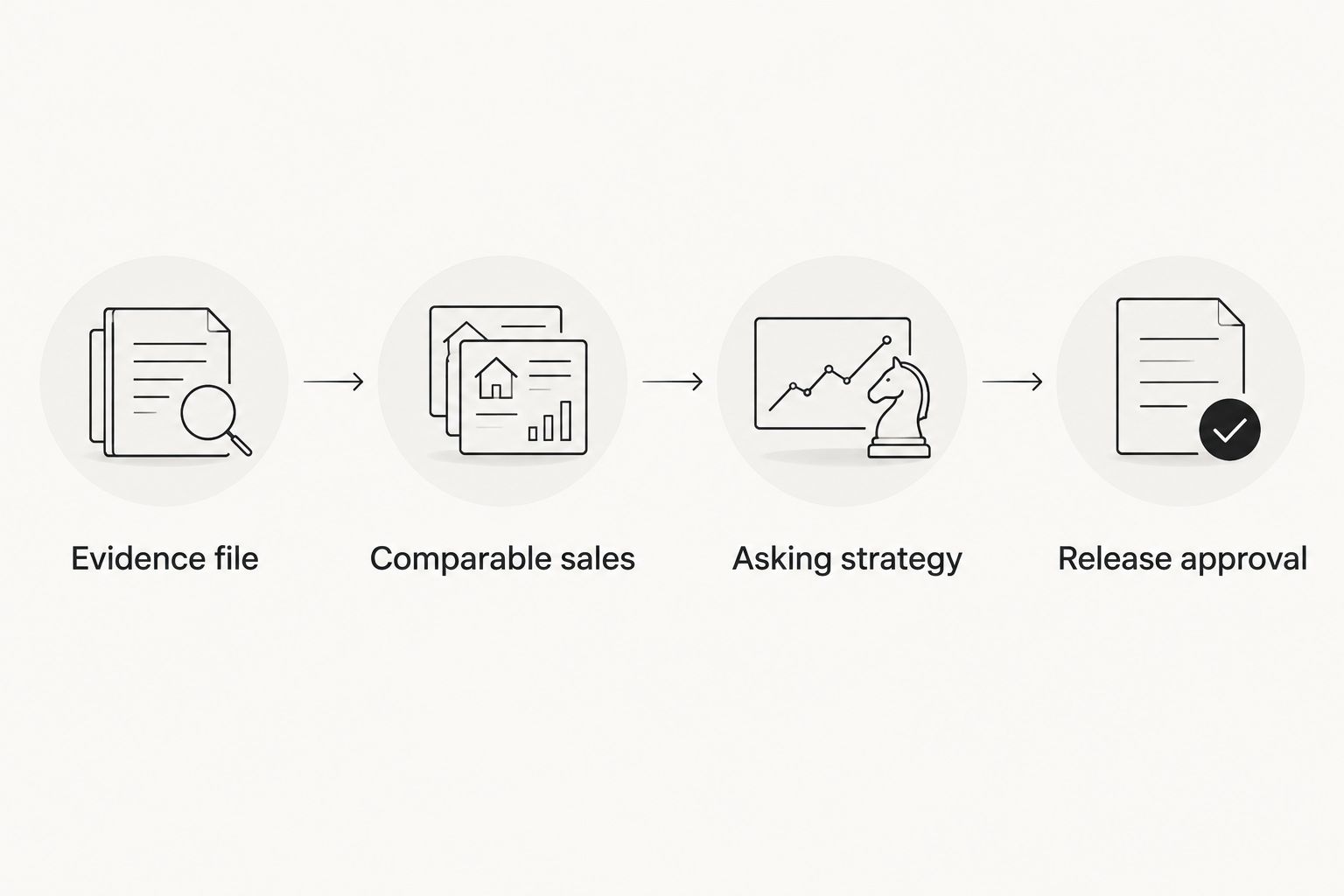
Release approval
Connect the asking strategy to private introductions
- Create Approved presentation. Identify the vehicle facts, condition disclosures, photographs, and valuation explanation that can be shared. Record which documents require redaction or controlled release.
- Create Offer conditions. Specify how inspection, funding verification, title review, and handoff arrangements will be addressed. Record who can approve changes and who receives questions.
- Create Review trigger. Require a review when material evidence changes: a new inspection finding, a relevant verified sale, a changed ownership requirement, or an offer with different terms.
Expected result: The person coordinating the deal has a clear brief without receiving open-ended authority to change it.
With SV Sourcing private-sale coordination, discuss the approved presentation, seller authority, and communication boundaries before introductions. Felipe Cimino and co-founder Alejandro S. are both involved in private sourcing, sales, and deal coordination. Establish the designated contact for your transaction rather than assuming who holds approval authority.
The benefit is a defined point of coordination. The limitation is equally clear: coordination does not replace the appraiser, inspector, lender, or seller’s own approval. A private introduction is not a completed transaction.
When an inspection changes the asking strategy
The adjacent workflow starts with a new fact rather than a new appraisal. A buyer’s inspection can identify an issue that the earlier report did not address.
- Record the finding. Obtain the written inspection result and distinguish a confirmed defect from a recommendation for further investigation.
- Check the implication. Seek qualified repair guidance where needed. Ask whether the finding changes an assumption in the appraisal; do not invent a deduction from the asking price.
- Approve the response. Decide whether to investigate, repair, revise the asking strategy, or decline the proposed terms. Update the approved presentation before further introductions.
Keep the original report and the revised decision together. Do not silently replace the evidence used to support earlier discussions.
For an active 2026 sale, date the revision and identify who approved it. Buyers and sellers should be able to distinguish the original position from a later response to new information.
An updated asking price does not require accepting every requested concession. It requires understanding the finding and making an explicit decision about it.
Troubleshooting
The appraisal is higher than the offers
Compare the report’s purpose and assumptions with the actual offers. Check whether those offers include inspection, funding, or other conditions. Ask for clarification where the evidence conflicts; neither the report nor an offer automatically invalidates the other.
The closest comparison has a different specification
Write down the differences instead of applying an unsupported adjustment. If the missing distinction is central to value, seek more relevant evidence or ask the appraiser to address it. Sparse evidence calls for clearer limits, not greater certainty.
The inspection contradicts the presentation
Pause use of the disputed claim. Verify the finding, correct the approved presentation, and reconsider the asking strategy. An appraisal should not be used to dismiss a mechanical or history issue it did not evaluate.
The owner’s required proceeds exceed the supported position
Separate the owner’s financial requirement from the market evidence. Review the payoff and applicable transaction expenses. Then decide whether the owner wants to proceed under the supported terms; do not present a personal requirement as an independent valuation.
Different intermediaries circulate different terms
Stop further circulation until the owner approves a single current brief. Identify the authorized coordinator and record who can change terms. Withdraw superseded versions so buyers are not negotiating against conflicting instructions.
Customize your workflow
For a buyer, reverse the worksheet. Compare the seller’s appraisal with the intended use, ownership budget, inspection scope, and purchase conditions. Ask what evidence supports the proposed terms rather than treating a valuation document as permission to skip diligence.
For a seller, prepare a private evidence file before arranging introductions. Keep the presentation factual and the negotiation floor confidential. Ask SV Sourcing to discuss private introductions and deal coordination around that brief, without assuming a particular outcome.
Discuss your private sale
Clarify your car, timing, valuation evidence, and coordination needs.
FAQ
Should my private-sale asking price match the appraisal?
No. A private-sale asking price should reflect the appraisal’s purpose and assumptions alongside relevant transaction evidence, current condition, and proposed terms. The appraisal is an input, not a buyer commitment.
Can I use an insurance appraisal to sell my exotic car?
You can share it as supporting information, but an insurance valuation does not automatically establish a private-sale value. Read its value definition and ask the appraiser whether it addresses the proposed transaction.
Do I need a new appraisal before selling in 2026?
A 2026 sale does not by itself determine whether you need a new appraisal. Review the valuation date, material changes to the vehicle, and the report’s intended use with the appraiser.
Does an appraisal replace a pre-purchase inspection?
No. An appraisal addresses value under stated assumptions; a pre-purchase inspection evaluates condition within its agreed scope. Check what each report actually covers.
Should I disclose my minimum acceptable amount to buyers?
Keep your negotiation floor in the confidential seller brief rather than the buyer presentation. Give your coordinator explicit approval boundaries and decide what negotiation information can be shared.
What happens if an inspection finds a problem after the asking price is agreed?
Review the written finding and the agreed transaction conditions before deciding how to respond. Investigate the issue, assess its relevance to the valuation, and approve any revised terms explicitly.
Can SV Sourcing coordinate a private exotic-car sale?
Yes. SV Sourcing provides private, off-market sourcing and sales coordination for exotic and collector cars in South Florida and nationwide. Clarify representation, approval authority, and document-sharing boundaries before proceeding.
One last thing
A valuation disagreement can actually be a disagreement about assumptions. Before debating the conclusion, compare the car described, the condition assumed, the valuation date, and the transaction terms.
Your strongest next move is a short written explanation connecting those facts to the asking strategy. If that explanation does not hold together, resolve the evidence gap before authorizing another introduction.