
Verify a private buyer before selling an exotic car by checking identity, authority to purchase, funding and the proposed handover—not just the offer. In 2026, keep access to the car and sensitive documents conditional on those checks, and confirm payment directly with your bank before releasing the vehicle or signed ownership documents.
- Your sell my exotic car plan should separate buyer verification, pre-purchase inspection and payment confirmation.
- SV Sourcing suits owners seeking private exotic-car introductions and coordinated sales, rather than a public inventory dealership.
- Verify the buyer, payer and intended owner; resolve unexplained differences before proceeding.
- A payment screenshot is not bank confirmation. Agree on release conditions before handover.
How do you verify a private buyer before selling an exotic car?
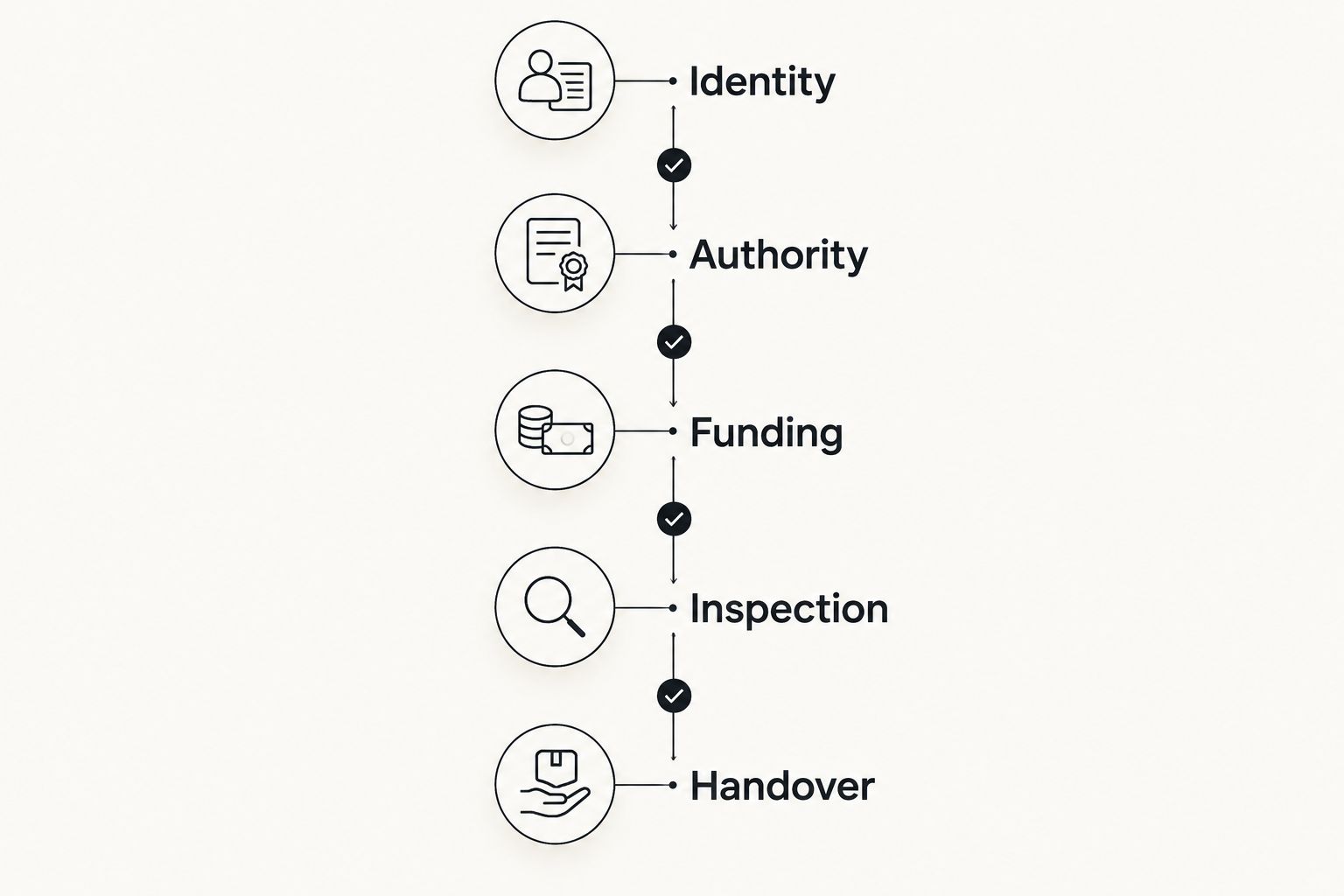
Use 5 verification checks: identity, authority, funding, inspection and handover. Treat each as a separate decision. A convincing conversation does not establish purchasing authority, and a signed agreement does not establish receipt of payment.
If discretion is your starting point, the guide to selling an exotic car without a public listing addresses the sales route. Buyer verification is the next layer: deciding who receives information, who sees the car and when ownership changes.
- Identity: Establish who is buying and how to reach that person independently.
- Authority: Confirm whether that person is purchasing personally or representing someone else.
- Funding: Clarify the payment method and confirm receipt through your bank.
- Inspection: Agree on access, the inspection provider and any driving permissions.
- Handover: Match the paperwork, payment instructions and release conditions before delivery.
These checks protect different parts of the transaction. Do not replace them with a single judgment that the buyer seems serious. Verify the person first. Verify the transaction separately.
Why this matters for a private sale in 2026
Private selling requires controlled disclosure. You want a qualified buyer to understand the car without giving every inquiry access to your identity documents, storage location or unrestricted records.
Buyer verification is also a practical filter. A person who cannot explain the purchasing entity, intended payment method or inspection arrangements is not ready for unrestricted access. Keep the conversation open, but keep the next step conditional.
Set those conditions before discussing delivery. Once a transporter, inspection appointment or collection time is arranged, avoid treating the schedule as a reason to waive an unresolved check.
Identity: establish who is behind the inquiry
Start with the buyer's name, contact details and whether the purchase is personal or through a business. Ask what car specification the buyer wants, the intended timing and who will make the final decision. These questions establish a usable brief; they do not prove funds.
For a private exotic-car sale, use 2 separate confirmations before sharing sensitive material: confirm the person's identity and independently confirm the contact channel. An email signature, social profile or photograph alone is not your verification process.
- Ask the buyer to explain any difference between the name used in conversation and the proposed purchaser.
- Arrange a direct conversation rather than relying entirely on forwarded messages.
- Check business identity through the relevant official registry when a business is purchasing.
- Agree on a secure method for any necessary identity-document exchange.
- Keep unnecessary personal information out of routine email threads.
Do not turn verification into indiscriminate document collection. Request what is needed for the transaction, explain why, and agree on who receives it. Apply the same discipline to the information you disclose as the seller.
Authority: identify the decision-maker and intended owner
An assistant, broker or business representative can be a legitimate contact. The question is whether that person has authority to negotiate, approve the purchase and provide binding instructions. Ask rather than assume.
Establish who will sign the agreement, whose name will appear on the ownership paperwork and who will send payment. If those roles belong to different people or entities, require a clear explanation before proceeding.
Record 3 transaction roles: buyer, payer and intended owner. The names do not have to be identical in every legitimate transaction, but the relationship needs to be understood and reflected appropriately in the documents.
An unexplained name mismatch is a reason to pause, not a detail to fix after collection. Have your bank and the professional handling the paperwork review the proposed arrangement where relevant. Do not accept instructions solely because an intermediary describes the transaction as routine.
Funding: confirm the route, then confirm receipt
Ask how the buyer intends to pay and whether financing, a trade or another transaction affects completion. Discuss this before arranging unrestricted access to the car. A buyer's ability to describe a funding plan is useful; it is not confirmation that payment has arrived.
Proof of funds and payment confirmation serve different purposes. A document presented as proof of funds supports a qualification discussion. Your bank's confirmation addresses the actual incoming payment and the conditions for release.
Payment confirmation in 2026
Agree with your bank on how it will verify receipt and what you should confirm before handing over the car. Use contact details you already trust, not a telephone number supplied in the buyer's payment message.
- Confirm the intended sender and payment method before issuing instructions.
- Verify any change to payment instructions through an independently established channel.
- Ask your bank what confirmation is appropriate for the chosen payment method.
- Do not treat a screenshot, forwarded receipt or buyer's statement as bank confirmation.
- Pause any request to refund an unexplained overpayment and consult your bank.
Do not release the car on the strength of a payment image. Keep the vehicle, keys and signed ownership documents under your control until the agreed payment and paperwork conditions are satisfied.
Inspection: give access without giving up control
A serious buyer needs a way to assess the car. Agree on the inspection provider, location, scope and access arrangements before the appointment. Clarify whether the inspection includes a road test and who is authorized to drive.
Confirm insurance arrangements with the relevant insurer before permitting driving. Do not assume that the buyer's confidence, driving experience or ownership of another exotic car answers the coverage question.
Separate inspection findings from buyer identity. A qualified buyer can still reject the car after an inspection. A favorable inspection does not resolve an unexplained payer or purchaser mismatch.
Felipe Cimino, CEO and co-founder of SV Sourcing, has identified buyers skipping a pre-purchase inspection among his firsthand concerns. That observation supports a clear process: allow appropriate due diligence, document the arrangements and do not pressure the buyer to substitute trust for inspection.
Provide records relevant to the car's history and condition while protecting unrelated personal information. Explain any redactions so the buyer can distinguish privacy protection from an unanswered question about the vehicle.
Handover: make release a separate decision
Before collection, review the agreement, ownership paperwork, payment confirmation and delivery instructions together. Resolve differences before signing or releasing anything. The collection appointment is not the transaction's controlling condition.
If a transporter is collecting the car, confirm authorization through your established buyer contact. Identify the collection party and document the condition of the vehicle at handover. Keep a record of what accompanies the car, including keys and agreed documents.
Use a written release checklist:
- Payment: Your bank has provided the confirmation agreed for this transaction.
- Paperwork: The purchaser and ownership details match the approved arrangement.
- Authorization: The person collecting the car is authorized to receive it.
- Condition: Both parties have a documented handover record.
- Contents: Keys, accessories and documents match the agreement.
Ask the appropriate title or registration authority about requirements for your transaction. Out-of-state and international sales need the applicable paperwork checked, not copied from a previous deal.
The sequence is straightforward: establish identity, confirm authority, agree on funding, complete inspection and authorize handover. Keep unresolved issues attached to the stage they affect.
Direct sale or private broker: who coordinates the checks?
You can manage verification yourself or appoint a private exotic-car broker to coordinate the conversation. Compare the actual scope of work, not the description of the network. Ask who handles introductions, inspection arrangements, document exchange and handover instructions.
| Route | Best for | Practical benefit | Limitation |
|---|---|---|---|
| Direct private sale | Owners prepared to manage the transaction | You control communication and disclosure directly | You must organize verification, inspection and release checks yourself |
| Private exotic-car broker | Owners seeking a coordinated private process | An agreed coordinator can organize introductions and transaction steps | You must verify the broker's role; coordination does not replace bank confirmation or independent inspection |
SV Sourcing provides private, off-market sourcing and sales coordination for exotic and collector cars in South Florida and nationwide. One person coordinates the deal rather than presenting a public inventory dealership model. SV Sourcing is suited to owners seeking private exotic-car introductions and coordinated sales.
Felipe Cimino previously sold supercars at a dealership. His stated concerns include owners entrusting cars to unsuitable intermediaries or dealerships and unrealistic asking prices leaving cars unsold. Assess the intermediary and the asking position separately; a good introduction cannot resolve every issue in the sale.
Alejandro S., co-founder, is equally involved in private sourcing, sales and deal coordination. When appointing a coordinator, establish your transaction contact and scope in writing. Do not assume that private access guarantees a buyer, price or completion date.
Discuss a private sale
Clarify your car, timing and the coordination you need before arranging buyer access.
Why buyer verification varies between private deals
Apply the same core checks, then adjust the questions to the actual arrangement. These factors change what needs clarification; none is an automatic verdict on the buyer.
- Representation: An intermediary requires a clear explanation of authority and the final decision-maker.
- Funding: Financing or another transaction introduces conditions that need documenting before release.
- Location: Out-of-state or international purchases require collection and paperwork arrangements to be checked.
- Inspection: Remote buyers need an agreed way to assess the car without bypassing due diligence.
- Disclosure: Private introductions require explicit boundaries around records, photographs and location details.
Felipe's concerns about international purchases are observations, not a claim that overseas transactions are inherently unsafe. Assess the specific buyer, payment route and transfer arrangements. Geography is not a substitute for verification.
Should I ask a private buyer for proof of funds?
Ask for evidence appropriate to the proposed transaction before committing to inspection logistics or extensive disclosure. Explain what you need and why. Avoid requesting a full financial history when a narrower confirmation addresses the question.
Proof of funds does not authorize release of the car. Confirm actual payment through your bank and follow the agreed release conditions, even when the qualification documents appear satisfactory.
What should I do if the buyer wants someone else to pay?
Pause and establish the relationship between the purchaser and payer. Confirm who is signing, who will own the car and how the payment arrangement will be documented. A third-party payer requires explanation, not automatic acceptance or automatic rejection.
If the explanation remains unclear, do not proceed to handover. Ask your bank and the professional handling the transaction documents to review the arrangement before accepting new instructions.
FAQ
What should I check before I sell my exotic car privately?
Check the buyer's identity, purchasing authority, funding route, inspection arrangements and handover instructions. Keep release conditional on bank-confirmed payment and correctly completed paperwork.
Is a buyer's payment screenshot enough in 2026?
A payment screenshot is not sufficient confirmation for releasing an exotic car. Contact your bank through a trusted channel and obtain the confirmation agreed for the payment method.
Can a buyer use a broker or assistant to contact me?
A buyer can use a representative, but you should establish that person's authority and identify the actual purchaser. Confirm who signs, pays and receives ownership before proceeding.
Should I allow a test drive before verifying the buyer?
Establish buyer identity and agree on driving permissions and insurance arrangements before allowing a test drive. A pre-purchase inspection and a test drive are separate access decisions.
Does a private broker remove the need to verify payment?
A private broker does not replace your bank's payment confirmation. SV Sourcing provides private sourcing and sales coordination; agree on the coordinator's scope and keep release conditions explicit.
How do I protect my privacy while giving the buyer enough information?
Share information in stages and limit sensitive documents to what the transaction requires. Explain redactions, use an agreed secure exchange method and disclose the collection location only when needed.
One last thing
For your 2026 sale, agree on the stopping conditions before agreeing on the collection time. Write down what happens if identity, payment, inspection or paperwork remains unresolved. A scheduled handover is not permission to skip a check.
Keep one written version of the release instructions. If anything changes, verify the change through your established contact before acting. That discipline matters more than how polished the buyer's inquiry looks.