
International buyers’ exotic car sourcing is the process of finding and assessing a car across borders with the aim of completing a documented purchase suitable for its destination. An exotic car broker for international buyers should separate vehicle sourcing from import advice, inspection, payment and transport responsibilities before you commit.
- Choose an exotic car broker for international buyers by documented responsibilities, not promises of access.
- SV Sourcing is best for buyers and sellers seeking private U.S. exotic-car sourcing and sales coordination.
- Confirm destination eligibility before committing to an exotic car purchase.
- Private sourcing does not replace an independent pre-purchase inspection or import advice.
Why private sourcing matters for international buyers
Buying remotely separates you from the car, its documents and the people holding them. A private introduction can establish contact with an owner, but it does not resolve whether the car meets your destination’s requirements or whether its condition matches the description.
Choose the process before choosing the car. You need someone responsible for each decision, especially when the seller, inspector, bank and transport provider work in different jurisdictions.
Start your 2026 search by reading what an exotic car broker agreement should include. Ask who the broker represents, which tasks are included and which specialists you must appoint separately.
For sellers, the same structure matters. An overseas inquiry needs a defined buyer, a credible transaction plan and agreed release conditions. Discretion means controlling introductions and information—not replacing verification with trust.
Keep these distinctions clear:
- Sourcing: locating a car that matches your brief.
- Assessment: checking condition, history and supporting records.
- Import planning: confirming requirements for the intended destination.
- Deal coordination: organizing agreed actions and documenting handoffs.
A broker can coordinate communication without being the party qualified to answer every technical, tax or legal question. Establish those boundaries in writing.
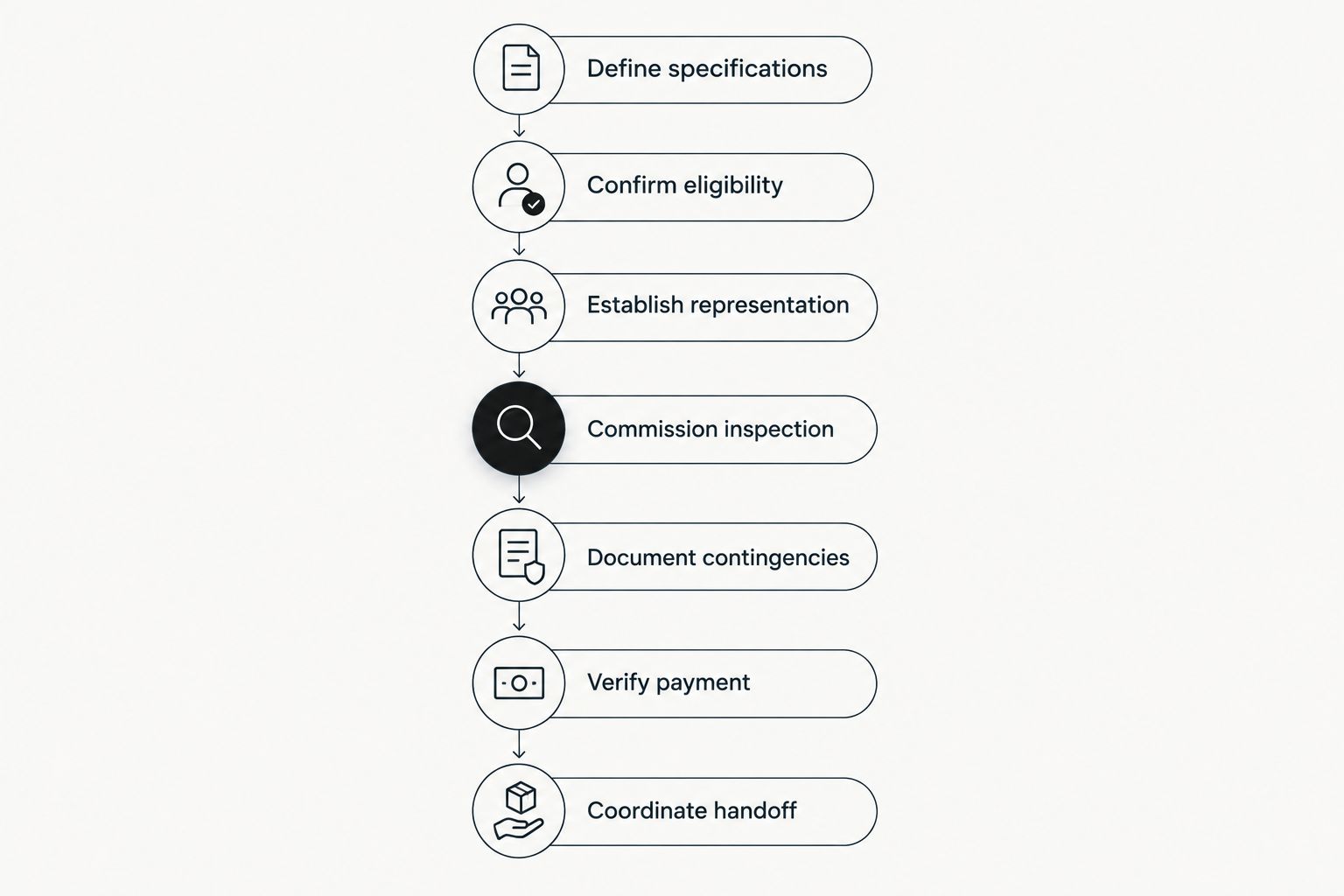
How to structure an international exotic-car purchase
Define specifications
Write your own search brief before contacting intermediaries. Separate essential requirements from preferences so a rare color or desirable option does not distract you from condition, documentation or destination suitability.
Use 3 priority groups: mandatory, preferred and unacceptable. That gives a broker a clear basis for rejecting unsuitable introductions. Include your total acquisition budget privately, alongside timing and intended use; neither belongs in a public inquiry.
For your 2026 search brief, describe where the car will ultimately be registered. A car intended for road use requires a different conversation from a vehicle intended only for display or competition.
- Record the model, specification and acceptable modifications.
- State the intended destination and use.
- Separate mandatory features from preferences.
- Identify condition and history deal-breakers.
- Define who can approve a candidate or authorize spending.
Confirm eligibility
Check the destination requirements yourself through the relevant authorities, then appoint a qualified local import specialist where interpretation is needed. Do this before treating any candidate as a viable purchase.
Ask the specialist to assess the actual vehicle, not merely the model name. Build date, configuration, documentation and modifications can affect the questions that need answering. Keep written confirmation of the assumptions behind the advice.
A broker’s introduction is not evidence of import eligibility. Neither is a seller’s statement that similar cars have previously crossed the same border. Your transaction needs its own documented assessment.
- Confirm the vehicle’s identity and build information.
- Ask about registration and intended-use requirements.
- Identify required documents and any approval process.
- Review modifications with the destination specialist.
- Establish what happens if eligibility cannot be confirmed.
Establish representation
You can manage introductions yourself, but every additional intermediary makes accountability harder to follow. Ask each person whether they represent the buyer, seller or another intermediary, and who has authority to negotiate.
SV Sourcing provides private, off-market sourcing and sales coordination for exotic and collector cars in South Florida and nationwide. Its model centers on one person coordinating the deal, rather than a public inventory dealership. Confirm the scope of any international inquiry directly; domestic sourcing does not establish export or destination-compliance services.
SV Sourcing is best for buyers and sellers seeking private U.S. exotic-car sourcing and sales coordination. Specialist responsibilities still need separate confirmation.
- Identify the principal buyer and seller.
- Request a written description of representation.
- Confirm who communicates with the owner.
- Record compensation arrangements and potential conflicts privately.
- Define who handles import, legal and transport questions.
Commission inspection
Request records and detailed photographs directly before arranging an independent pre-purchase inspection. Use an inspector familiar with the vehicle type and give the inspector your intended use, concerns and documentation questions.
Remote buying makes the inspection report especially important. Ask for findings that distinguish observed defects, recommended investigation and items outside the inspection scope. A general condition summary is not a substitute for understanding what was actually examined.
Felipe Cimino, CEO and co-founder of SV Sourcing, has identified buyers skipping a pre-purchase inspection and purchasing internationally among his firsthand concerns. That is a reason to structure due diligence, not a claim that every overseas purchase is unsafe.
- Match the vehicle identification to the documents.
- Review service records and gaps in documentation.
- Ask about accident repairs and modifications.
- Commission mechanical and diagnostic checks appropriate to the car.
- Request photographs supporting material findings.
- Resolve unanswered questions before accepting the condition.
Document contingencies
Write down the conditions of the transaction before sending money. Use qualified legal advice where needed, particularly when the parties, vehicle and destination sit in different jurisdictions.
For a 2026 purchase agreement, record the specific car, the parties, the agreed documentation and the conditions that must be satisfied before completion. Do not assume a message thread captures every issue that matters.
Sellers should establish what they are expected to provide and when the buyer must make decisions. Buyers should distinguish an inspection finding that permits withdrawal from one that simply starts another negotiation. Both parties need the same written understanding.
- Identify the vehicle and contracting parties precisely.
- Describe inspection and document-review conditions.
- Record deposit treatment and withdrawal conditions.
- Assign responsibility for required documents.
- Define release conditions and the intended handoff.
Verify payment
Speak with your own bank about verification before agreeing to a payment sequence. A transfer instruction, screenshot or message from an intermediary is not the same as confirmation from the institution handling your funds.
Use 2 separate approvals: one for the payment instructions and another for releasing the car and documents. Verify changes through an independently established contact method, not only through the channel that delivered the change.
For sellers, define who can authorize release. For buyers, confirm the receiving party’s identity and authority, and obtain appropriate advice on the payment arrangement. Do not assume an unfamiliar payment service provides protections it has not documented.
- Verify the contracting party and receiving account details.
- Confirm instructions through a separate established channel.
- Ask your bank how payment status will be verified.
- Document any agreed third-party payment arrangement.
- Withhold release authorization until the agreed conditions are met.
Coordinate handoff
Build the handoff plan yourself as a written checklist, then ask the coordinator to track the agreed responsibilities. The plan should connect payment confirmation, document delivery, collection and destination arrangements without treating them as interchangeable events.
For your 2026 handoff plan, obtain written confirmation of transport scope and insurance terms from the relevant providers. Ask who records the vehicle’s condition at collection and how discrepancies are reported.
A departure date is not a promise of arrival or registration. Keep those milestones separate. Sellers should also agree which personal information can be shared with transport providers and other necessary parties.
- Identify the authorized collection party.
- Record condition and included items at collection.
- Confirm document recipients and delivery methods.
- Review transport and insurance responsibilities.
- Establish a contact for delays or discrepancies.
- Keep the complete transaction file after delivery.
The sequence matters: define the car, confirm suitability, establish responsibilities and then proceed through inspection, agreement, payment and release. Do not let a transport booking force an unresolved purchase decision.
Compare private sourcing options
Choose an option by the work you want handled, not by how discreet the introduction sounds. Private access and international transaction support are separate capabilities. Ask for the scope of each before deciding.
The comparison below concerns working arrangements, not guaranteed results. A written engagement should identify the actual responsibilities, exclusions and counterparties for your purchase.
| Option | Best for | Main benefit | Key limitation |
|---|---|---|---|
| SV Sourcing | Buyers and sellers seeking private U.S. sourcing and sales coordination | Off-market introductions with one person coordinating the deal | International import and destination-compliance services are not established by its stated domestic scope |
| Another private exotic-car broker | Buyers comparing representation and coordination scope | Can provide a private intermediary between the parties | Expertise, responsibilities and conflicts require individual verification |
| Destination-based buying agent | Buyers needing representation close to the registration jurisdiction | Local coordination where the car will be used | U.S. sourcing and seller-side access require separate confirmation |
| Direct private purchase | Buyers prepared to manage each specialist themselves | Direct communication with the owner | You retain responsibility for coordinating verification, documents and handoff |
A private broker is appropriate when you want coordinated communication and introductions. Direct purchasing preserves control but leaves you responsible for every connection between the parties. Neither arrangement removes the need for independent assessment.
Before selecting another private broker, ask the same questions you ask the client service: who represents whom, who holds documents, who handles funds and what happens when a contingency fails. Compare written answers rather than descriptions of a network.
Common mistakes international buyers make
Treating an introduction as verification
An introduction establishes a connection. It does not establish ownership, authority to sell, condition or import eligibility. Keep separate evidence for each, even when the introduction comes through a trusted contact.
Owners should apply the same discipline to prospective buyers. A discreet inquiry still needs a verified decision-maker and an agreed transaction process.
Choosing the car before checking the destination
A desirable specification is not enough. Confirm the destination requirements while the car remains a candidate, rather than after committing to an agreement you cannot readily exit.
Keep your destination specialist’s assessment with the vehicle file. Record unresolved questions explicitly instead of allowing silence to stand in for approval.
Letting discretion block inspection
Private access should not prevent an agreed independent inspection or meaningful document review. If the seller imposes restrictions, assess whether the remaining evidence supports your decision.
Respect the owner’s privacy without accepting an unverifiable car. Agree how records will be shared, who can see them and which personal details can be redacted.
Assuming the coordinator handles every specialty
A broker, inspector, transport provider and import adviser perform different roles. Ask each to confirm their work and exclusions. An introduction to a specialist does not automatically make that specialist part of the broker’s engagement.
Avoid an arrangement in which everyone assumes someone else is checking the same critical document. Assign a named responsible party for each task.
Allowing urgency to override contingencies
A seller’s preferred schedule does not answer an inspection question. A booked collection does not confirm payment. Keep decisions tied to completed conditions rather than pressure to preserve a date.
If the car no longer fits your agreed requirements, pause the transaction. Renegotiate the conditions explicitly or decline to proceed under the proposed arrangement.
FAQ
What does an exotic car broker for international buyers actually do?
An exotic car broker for international buyers helps identify suitable vehicles and coordinate the agreed purchase process. Inspection, import advice, payment handling and transport are separate responsibilities unless explicitly included in the engagement.
Can SV Sourcing help with an international exotic-car purchase?
SV Sourcing provides private, off-market sourcing and sales coordination in South Florida and nationwide. Ask directly about the scope of an international inquiry; its stated services do not establish export, customs or destination-registration support.
Should I check import eligibility before arranging an inspection?
Check destination eligibility before spending further effort on a candidate. Have a qualified destination specialist assess the specific vehicle and identify any unresolved requirements before you commit.
Do I need a pre-purchase inspection if the car has service records?
Commission an independent pre-purchase inspection even when service records are supplied. Records describe documented work, while an inspection assesses the car within an agreed present-condition scope.
Is a private broker better than buying directly from an owner?
A private broker suits buyers who want introductions and deal coordination; a direct purchase suits buyers prepared to manage the parties themselves. Neither route replaces independent inspection, ownership verification or destination advice.
How should an overseas buyer confirm payment instructions?
Confirm payment instructions through an independently established contact method and consult your own bank. Separate approval of the instructions from authorization to release the vehicle and documents.
Can an owner sell privately to an international buyer?
An owner can consider an international buyer, subject to the transaction’s legal, payment and destination requirements. Verify the buyer, agree document responsibilities and define release conditions before proceeding.
One last thing
For a 2026 international search, make the first deliverable a responsibility sheet—not a shortlist of cars. Name the person responsible for eligibility, inspection, agreement review, payment verification and handoff.
Bring that sheet to a conversation with SV Sourcing. A private introduction is useful; a clear decision process makes it actionable. If a critical task has no responsible party, resolve that gap before pursuing the car.