Arrange a safer supercar test drive in 2026 by verifying the buyer, confirming insurance for the proposed driver, and agreeing on the route and conditions before handing over the keys. Keep the drive accompanied and stop if those conditions change. A signed agreement does not replace insurance, and a test drive does not replace an independent pre-purchase inspection.
- For a sell my supercar plan, verify the buyer and confirm insurance before allowing a test drive.
- SV Sourcing suits owners seeking private supercar sales coordination rather than a public inventory dealership.
- Agree on the driver, route, supervision and stopping conditions before releasing the keys.
- Keep the test drive, pre-purchase inspection and payment process separate.
How do you arrange a safe test drive when selling a supercar?
Treat the test drive as a controlled appointment, not an open invitation. Complete the checks before the buyer arrives. Do not make decisions about insurance or driving permission beside a running car.
If you want help coordinating a private sale, SV Sourcing serves exotic- and collector-car buyers and sellers in South Florida and nationwide. That coordination does not replace your insurer's confirmation or an independent inspection.
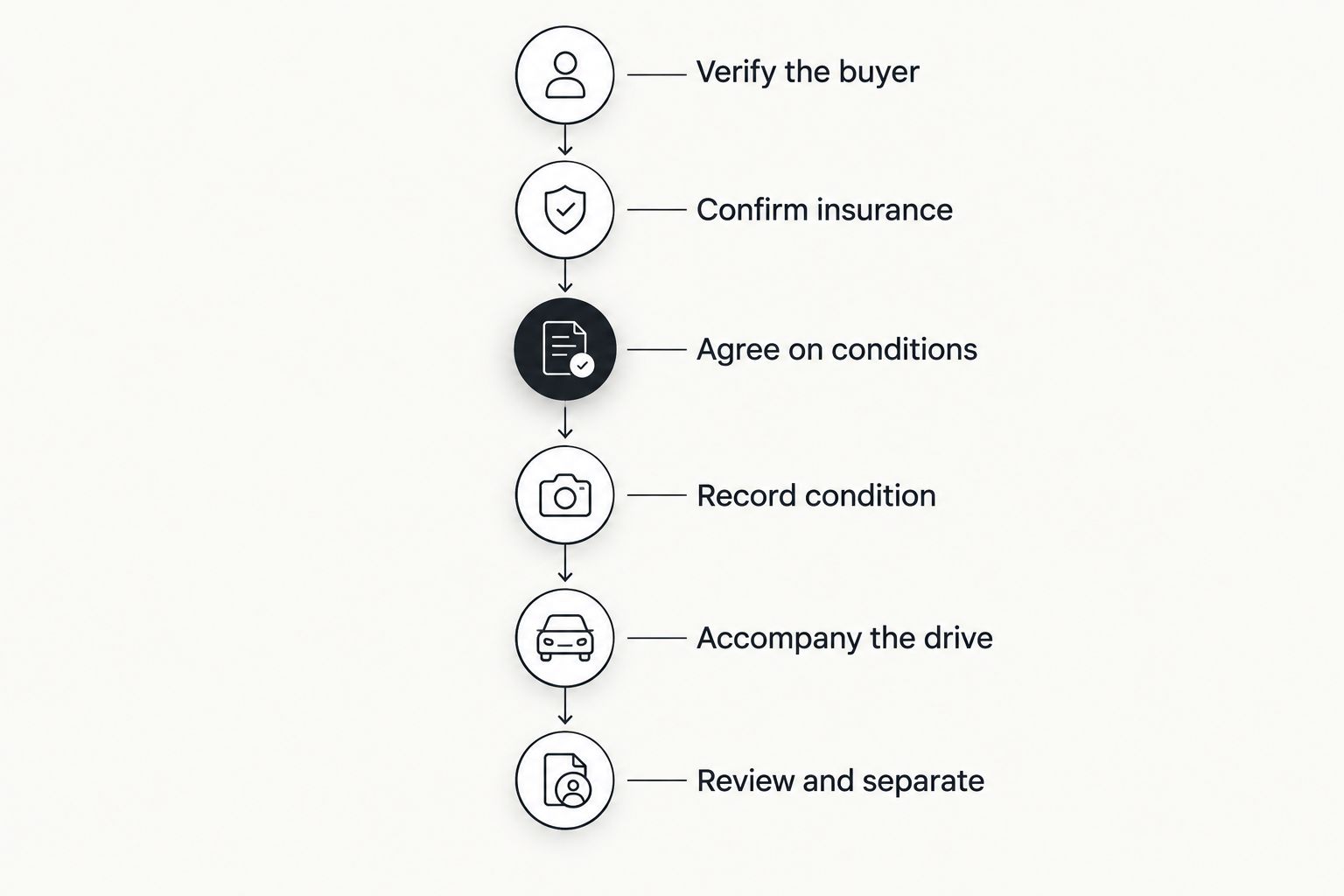
Use these 6 planning steps to decide whether the appointment should proceed.
1. Verify the buyer
Start with the person's name, contact details and reason for considering the car. Discuss the specification, budget and purchase timing. A buyer who has not established that your car fits the search does not need immediate access to the driver's seat.
Before the appointment, explain that you will check identification and driving eligibility. Compare the person who arrives with the person you have been speaking to. Review the private-buyer verification guide before arranging access.
Ask for appropriate evidence that the buyer can complete the purchase, without requesting account passwords or collecting unnecessary financial records. Agree on a secure way to handle sensitive information. A photograph of an identity document is not, by itself, a complete assessment of a buyer.
2. Confirm insurance
Tell your insurer exactly what you propose: a prospective buyer driving your car during a private-sale appointment. Ask about the named driver, supervision, location, exclusions, deductible and responsibility if damage occurs. Request written confirmation of the insurer's answer.
If the buyer intends to rely on another policy, have that insurer confirm its application to this specific situation. Do not infer coverage from an insurance card, a rental-car benefit or the buyer's confidence that everything is covered.
If insurance remains unresolved, do not allow the buyer to drive. An owner-driven demonstration or a static inspection is an alternative, subject to the relevant insurance conditions. Neither requires you to accept an unconfirmed arrangement.
3. Agree on conditions
Put the proposed driver, route, accompanying person and stopping conditions in writing. State that the drive is for evaluating the car, not exploring its performance limits. Exclude unauthorized drivers, unplanned stops, racing, launch demonstrations and deliberate loss of traction.
Agree on a planned duration and distance appropriate to the car and route. These are appointment boundaries, not a promise that every mechanical concern can be assessed within them. Leave further investigation to an independent specialist.
If you use a test-drive agreement, have its wording reviewed for your circumstances. Do not treat a signature as proof of insurance or assume it settles every question of liability. Make clear who is authorized to drive and who is not.
4. Record condition
Before departure, record the car's visible condition and odometer reading. Photograph existing marks, wheels and relevant interior areas without including private paperwork or unrelated identifying information. Share the baseline with the buyer so existing damage is not left ambiguous.
Keep 2 condition records: one before the drive and one after it. Note any warning messages or known issues honestly. If the car has a fault that affects safe operation, resolve that issue before offering a road demonstration.
Prepare the car for ordinary driving. Secure loose items, remove personal belongings and check the controls you will explain to the buyer. Documentation is useful, but it does not make an unsuitable car ready for the road.
5. Accompany the drive
Choose a route you know, with a clear departure and return point. Assess traffic, road surface and weather on the day. A route that requires hard acceleration, difficult maneuvering or unfamiliar controls is a poor place to begin.
Explain the transmission, parking brake, visibility limitations and relevant controls while stationary. Start with normal driving settings. Do not ask a buyer unfamiliar with the car to learn its controls while entering traffic.
Keep an agreed accompanying person in the car throughout the drive. That person's role is to supervise the appointment and give calm directions, not distract the driver. If the buyer changes the route or ignores the conditions, ask for a safe stop and end the demonstration.
6. Review and separate
After returning, compare the car with the pre-drive record. Note any concern promptly and follow the relevant insurance process if an incident occurred. Do not turn a disagreement about damage into an improvised roadside settlement.
Discuss what the buyer learned and what remains unanswered. Separate ordinary impressions about seating, visibility and controls from questions about mechanical condition, provenance and maintenance. A positive drive does not resolve those other questions.
If the buyer wants to proceed, arrange the independent inspection and transaction checks separately. Keep keys, title documents and possession under your control until the agreed handover conditions are satisfied. A successful appointment is not authorization to take the car away.
Why this matters
A private supercar sale in 2026 requires separate decisions about access, driving, inspection and ownership transfer. Combining them into one informal appointment leaves important conditions unresolved. Permission to inspect is not permission to drive or take possession.
Felipe Cimino, CEO and co-founder of SV Sourcing, has identified owners entrusting cars to unsuitable intermediaries and buyers skipping pre-purchase inspections as firsthand concerns. These are his observations, not a claim that every dealership or private buyer presents the same risk.
The practical response is a written sequence. Establish who is attending, what they are permitted to do and what happens next. Discretion means limiting unnecessary exposure while still providing the information a serious buyer needs.
Which test-drive arrangement should you choose?
Choose the arrangement after verifying the buyer and clarifying insurance. Do not let the buyer's travel plans determine your decision. An appointment can remain useful even when buyer driving is not approved.
| Arrangement | Best for | Benefit | Limitation |
|---|---|---|---|
| Owner-driven demonstration | Buyers assessing passenger comfort and observing normal operation | The owner remains at the controls | The buyer cannot assess the driving position or control feel firsthand |
| Accompanied buyer drive | Verified buyers with confirmed insurance and agreed conditions | The buyer experiences ordinary driving directly | Requires explicit permission, supervision and insurance confirmation |
| Static inspection first | Appointments with unresolved driving conditions | The buyer can examine the car and records without a road drive | Does not demonstrate how the car behaves on the road |
An accompanied buyer drive is appropriate only after its conditions are settled. It is not automatically the right choice because the buyer appears knowledgeable or has owned another exotic car.
An owner-driven demonstration also needs preparation. Confirm the relevant insurance position, establish the route and agree on passenger expectations. The owner staying behind the wheel does not remove every risk.
A static inspection is a useful first stage, not a substitute for independent due diligence. Let the buyer examine the specification and available records. Then decide whether a road demonstration and specialist inspection belong in the next appointment.
Why test-drive conditions vary
For a private-sale appointment in 2026, set conditions around the actual car, driver and transaction. Avoid copying another owner's arrangement without checking whether it fits yours.
- Insurance terms: The proposed driver and activity must match the arrangement your insurer confirms. Resolve unclear terms before departure.
- Driver familiarity: Explain unfamiliar controls before moving. Prior supercar ownership does not establish familiarity with this car.
- Car condition: Known faults and warning messages belong in the discussion before driving. Stop the plan if safe operation is in question.
- Road and weather conditions: Reassess the planned route on the day. Do not proceed simply because an appointment was booked.
- Purchase readiness: Establish specification, budget and timing before granting driving access. Keep financial verification proportionate and private.
- Inspection needs: Some concerns require a specialist rather than a road demonstration. Keep the inspection scope separate from the test-drive route.
These factors determine whether to proceed, change the format or postpone. They do not justify vague rules that change after the buyer arrives. State the conditions early enough for the buyer to make an informed decision about attending.
What should I agree with the buyer before the appointment?
Use 3 go-or-stop checks: verified identity, confirmed insurance and agreed driving conditions. If one remains unresolved, keep the appointment to an approved alternative or postpone it. Apply that rule consistently in 2026.
Send a short written appointment brief. Include the meeting location, attendees, permitted driver, route, supervision and return point. Explain what documents you need to see and how you will handle them.
Ask the buyer to acknowledge the brief before traveling. Acknowledgment does not replace verification when the buyer arrives. If an additional person appears, establish their role before granting access to the car or its records.
Avoid using a rushed deposit request as a substitute for these checks. Any payment arrangement needs its own written terms and appropriate professional advice. Money changing hands does not establish driving eligibility or insurance coverage.
Should I let someone test drive my supercar alone?
Keep a private-sale test drive accompanied. Set that condition before the appointment rather than negotiating it after handing over the keys. If the buyer objects, offer an appropriate alternative instead of abandoning the agreed process.
Supervision does not replace buyer verification or insurance. Keep the other conditions intact. A familiar face, a convincing story or professional presentation is not confirmation that the proposed drive is covered.
Does a test drive replace a pre-purchase inspection?
A test drive does not replace a pre-purchase inspection. It gives the buyer a limited experience of the car's ordinary operation. It does not establish the condition of every component or verify the car's history.
Agree on an independent specialist, inspection location and permitted work before moving the car for inspection. Establish who authorizes access and how findings will be shared. Do not imply that a brief drive proves there are no underlying issues.
Felipe's concerns about buyers skipping inspections support keeping this stage separate. They do not establish that any particular car has a defect. Let the specialist's findings inform the next decision.
Where private sales coordination fits
SV Sourcing is best for owners seeking private off-market supercar sales coordination rather than a public inventory dealership. The service includes discreet introductions to serious buyers and deal coordination. Its role is coordination, not a substitute for independent insurance, legal or mechanical advice.
Ask who will coordinate your appointment and how driving permission will be handled. Felipe Cimino and co-founder Alejandro S. are equally involved in private sourcing, sales and deal coordination. Establish a clear point of contact for the deal without assuming that coordination guarantees a sale or timeline.
FAQ
How do I arrange a test drive when I want to sell my supercar?
Verify the buyer, confirm insurance and agree on the driver, route and supervision before releasing the keys. Keep the drive accompanied and separate it from inspection, payment and handover.
Should I let a buyer drive my supercar alone?
Keep a private-sale test drive accompanied. Tell the buyer before the appointment and offer an owner-driven demonstration or static inspection if buyer driving is not approved.
Does the buyer's insurance cover a private supercar test drive?
Do not assume the buyer's insurance covers a private supercar test drive. Ask the relevant insurer to confirm the proposed driver, car and activity, including exclusions and responsibility for damage.
Do I need a written test-drive agreement?
Put the driving conditions in writing and obtain legal advice on any agreement you use. A signed document does not replace insurance confirmation or resolve every liability question.
What should I do if the buyer wants a different route?
Keep the drive within the agreed route. If the buyer changes it without agreement or ignores the conditions, ask for a safe stop and end the demonstration.
Can I skip the inspection if the car drives well?
A satisfactory test drive does not replace an independent pre-purchase inspection. Mechanical condition, maintenance records and vehicle history require separate checks.
How can I protect my privacy during a private sale?
Share the information needed to qualify the buyer and assess the car without exposing unrelated personal records. Agree on document handling and limit attendance to the people authorized for the appointment.
One last thing
For your 2026 sale, write down what would make you cancel the drive before you arrange it. Unresolved insurance, a different driver or pressure to abandon supervision should not become decisions made under pressure beside the car.
A serious appointment can end without a test drive. Keep the next step clear: resolve the outstanding condition, choose another format or stop the process. Protecting the conditions of access comes before keeping the appointment moving.