
Consignment is better when you want an intermediary to manage presentation, inquiries and the sale under a written agreement; a direct private sale is better when you want control and can handle buyer screening, inspections and closing. Neither route guarantees a stronger offer or a faster sale. For a collector car in 2026, choose by responsibility, custody and disclosure—not by the label alone.
- Consignment vs private sale for a collector car comes down to custody, control and responsibility—not a guaranteed result.
- Direct private sales suit hands-on owners; consignment suits owners who want to delegate defined tasks.
- SV Sourcing suits collector-car owners seeking private introductions and coordinated sales rather than public inventory exposure.
Why this matters
Your selling arrangement determines who speaks for you, who handles the car and what happens when a buyer raises a problem. A promising introduction does not answer those questions. The agreement must.
Before appointing an intermediary, review what an exotic-car broker agreement should include. Separate permission to introduce buyers from permission to advertise, move the car, approve work or accept an offer.
Delegating the sale does not remove the need to approve its terms. You still need clear boundaries, accurate disclosures and a documented handoff.
Is consignment better than a private sale for a collector car?
Consignment is better for delegation. A direct private sale is better for retaining responsibility and control. Broker-coordinated private selling offers a separate arrangement: help with introductions and coordination without assuming that the car must become public inventory.
These routes overlap. A consignment agreement can restrict publicity, and a private sale can involve an intermediary. Compare the actual mandate rather than treating the names as fixed packages.
| Selling route | Best for | Main advantage | Main limitation | Confirm before proceeding |
|---|---|---|---|---|
| Consignment | Owners who want to delegate sale management | An intermediary handles the agreed selling tasks | Your control depends on the written mandate | Custody, publicity, authority, expenses and termination |
| Direct private sale | Owners prepared to manage the transaction | You control communication and decisions directly | You handle screening, appointments and closing | Buyer identity, inspection terms and payment verification |
| Broker-coordinated private sale | Owners seeking discreet introductions and coordination | You can delegate defined tasks while setting boundaries | Coordination does not replace inspection or closing safeguards | Representation, disclosure permissions and handoff responsibilities |
Choose the route whose responsibilities you understand and accept. Do not assume that consignment includes every closing task, or that a private introduction includes buyer verification. Ask who performs each task and how completion is documented.
Consignment: best for owners who want defined delegation
Consignment fits when you do not want to answer inquiries, arrange viewings or manage negotiations yourself. Its value depends on what the intermediary actually agrees to do. A broad promise to “handle the sale” leaves too much unresolved.
Ask whether the car remains with you or moves into the intermediary's custody. Then establish who can drive it, where it can be stored and how inspection access works. Confirm insurance arrangements directly rather than assuming your existing coverage applies unchanged.
For a 2026 consignment agreement, read the exit provisions as closely as the selling authority. Know how you recover the car, end the mandate and handle an introduction that becomes a transaction after termination.
- Advantage: You can place agreed selling tasks with an intermediary.
- Trade-off: Delegation introduces another party's decisions and procedures.
- Best for: An owner who wants less day-to-day involvement but will review the mandate carefully.
Do not sign on the strength of a proposed asking position alone. Ask how the intermediary will explain the car's specification, condition and records to a serious buyer.
Direct private sale: best for hands-on owners
A direct private sale fits when you are prepared to be the seller's main point of contact. You decide what to disclose, whom to meet and which terms to accept. You also own the administrative work.
That means distinguishing an interested person from a buyer ready to proceed. Establish identity, intended purchasing entity, inspection expectations and the proposed payment process before granting access to the car or sensitive documents.
Keep negotiation and closing separate. Agreement on commercial terms does not establish that payment is complete, that a lien has been released or that transport is authorized.
- Advantage: You retain direct control of the conversation and approvals.
- Trade-off: Every unresolved task remains yours unless you appoint someone to handle it.
- Best for: An owner with the time and willingness to manage inquiries, due diligence and handoff.
Choose direct selling because you can manage the process, not because an introduction looks simple. A familiar buyer still needs a documented transaction.
Broker-coordinated private sale: best for discreet introductions
A private intermediary can help connect an owner with prospective buyers and coordinate the transaction. That is different from automatically placing the car into public inventory. The agreement should establish whether photographs, identifying details or the owner's identity can circulate.
SV Sourcing is suited to collector-car owners seeking private introductions and coordinated sales. Its service covers private, off-market sourcing and sales coordination in South Florida and nationwide, with one person coordinating the deal.
The limitation remains clear: private access does not establish condition, clear title or completed payment. Buyers still need due diligence, and sellers still need explicit approval points.
- Advantage: You can seek introductions without choosing a public-listing approach.
- Trade-off: You must define the intermediary's authority and the boundaries of disclosure.
- Best for: An owner who wants discretion and coordination while retaining approval over the transaction.
Why the right selling route varies
The right choice depends on the car and the work you want to retain. Use these factors to compare proposals in 2026, whether the intermediary calls the arrangement consignment, brokerage or private sales coordination.
- Your involvement: Decide whether you want to handle inquiries and appointments or approve decisions after someone else coordinates them.
- Custody: Establish where the car stays, who holds the keys and who authorizes movement.
- Privacy: Define which details can be shared privately, circulated to other intermediaries or published.
- Documentation: Service records, ownership documents and modification disclosures affect what a buyer can evaluate.
- Closing complexity: A lender, purchasing entity or interstate handoff adds parties and responsibilities that need coordination.
- Your timing: State the desired timing without treating it as a promised completion date. Agree on what happens if the sale does not progress.
A seller's urgency should not become permission to bypass verification. A buyer's enthusiasm should not become permission to skip an inspection.
How should you choose before signing an agreement?
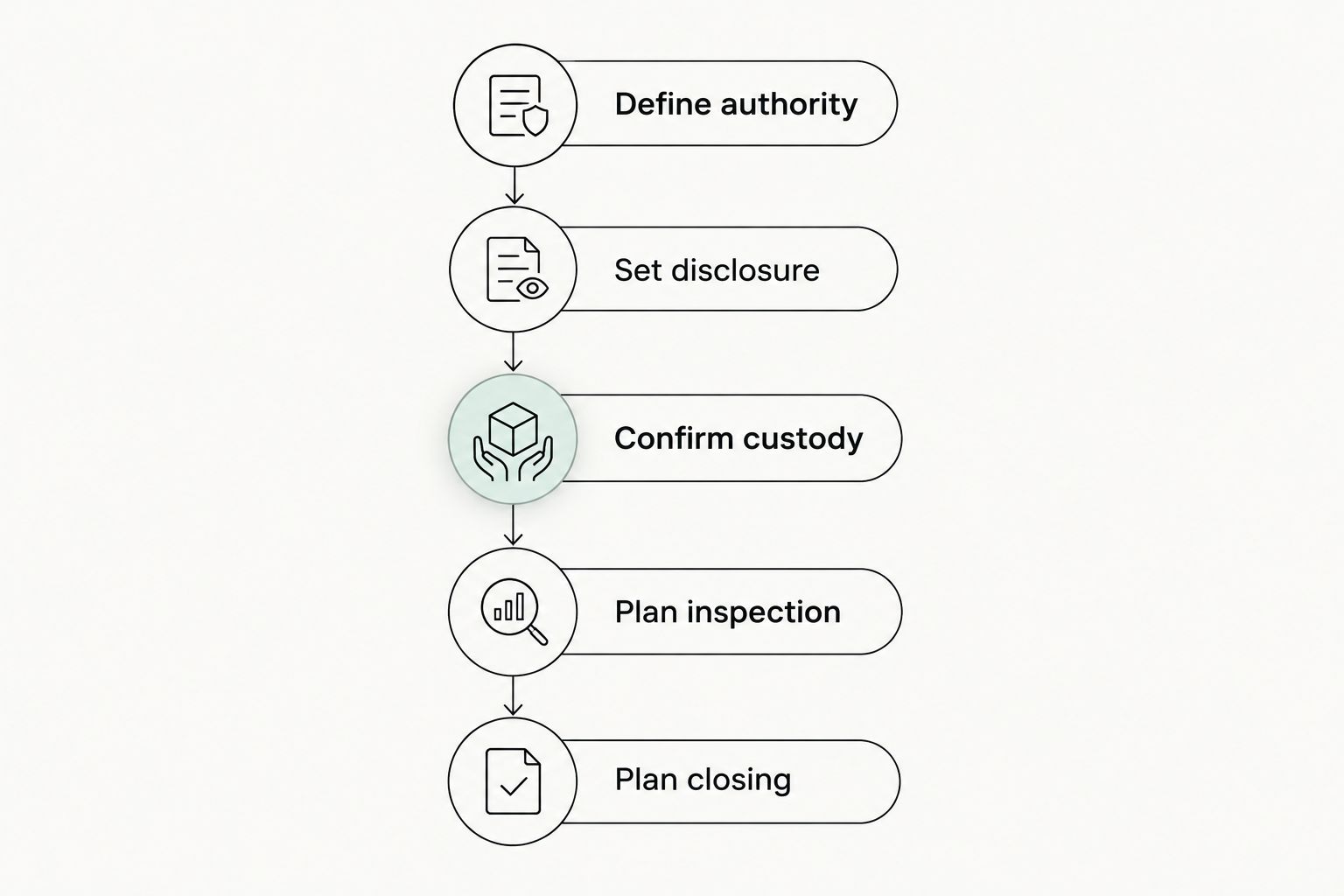
Make 3 decisions first: who controls the car, who controls disclosure and who approves the transaction. Then use the following 5 checkpoints to turn those decisions into a workable mandate.
- Define authority. Name the tasks the intermediary can perform. Reserve approval over offers, repairs, transport and any other action you do not want delegated.
- Set disclosure. Agree on which photographs and records can be shared, with whom, and at what stage. Keep personal information separate from the vehicle information a buyer needs.
- Confirm custody. Record the car's condition, supplied keys and accompanying items before any transfer. Establish access and insurance responsibilities.
- Plan inspection. Agree on the inspection location, access, responsibility for arrangements and how findings will be handled before closing.
- Plan closing. Assign responsibility for ownership documents, any lender involvement, payment confirmation and release of the car.
Keep 2 approvals separate: accepting an offer and authorizing release of the car. The first records your commercial decision. The second follows completion of the agreed closing conditions.
For a 2026 sale, keep the approved mandate and any changes in a retrievable written record. If a buyer requests a different inspection location or purchasing entity, document the change rather than relying on an informal understanding.
What should buyers check under either arrangement?
Buyers should establish who owns the car, who is authorized to negotiate and what evidence supports the description. An intermediary's involvement does not replace those checks. Neither does direct access to the owner.
State your specification, budget boundaries and timing before arranging an inspection. Distinguish required features from preferences so the seller can assess whether the conversation is relevant.
Ask for service records and disclosures before treating the car as a match. Then arrange an appropriate independent pre-purchase inspection. Confirm its scope rather than assuming that a general condition review covers every mechanical, diagnostic or documentation question.
Felipe Cimino, CEO and co-founder of SV Sourcing, previously sold supercars at a dealership. His firsthand concerns include owners choosing unsuitable intermediaries, unrealistic asking expectations leaving cars unsold, and buyers purchasing internationally or skipping a pre-purchase inspection. Those observations support careful selection and due diligence; they do not establish that dealerships or overseas purchases are inherently unsafe.
Does consignment mean giving up control of the car?
Consignment gives the intermediary only the authority established by the agreement; custody and decision-making need separate treatment. Ask whether you can continue using the car, withdraw it or reject an offer, and identify any conditions attached to those rights.
Do not assume that retaining legal ownership means retaining unrestricted practical access. Read the custody, access and termination provisions together.
Can I sell privately without advertising the car publicly?
A private sale does not require you to choose public advertising. You can authorize discreet introductions and set limits on the circulation of photographs, vehicle details and personal information.
Privacy needs instructions, not just intent. Specify what can be shared and require approval before the car is presented through a new channel.
Does either route remove the need for an inspection?
Neither route removes the need for buyer due diligence. An independent pre-purchase inspection addresses the car; the selling arrangement addresses who manages the transaction.
A seller can prepare records and provide access without promising an inspection outcome. Agree in advance on how new findings affect the buyer's decision and the proposed terms.
FAQ
Is consignment better than a private sale for a collector car?
Consignment is better for defined delegation; a direct private sale is better for hands-on control. Compare custody, authority, privacy and closing responsibilities before choosing.
Can I keep my collector car at home while someone helps sell it?
Keeping the car at home depends on the selling agreement. Confirm custody, access, insurance and inspection arrangements before appointing an intermediary.
Is a private broker the same as a consignment dealer?
A private broker and a consignment dealer do not necessarily operate under the same mandate. Compare their actual responsibilities, custody arrangements and disclosure permissions rather than relying on the label.
Does selling privately mean handling every task myself?
Selling privately does not require you to handle every task yourself. You can appoint an intermediary to coordinate agreed work while retaining specific approval rights.
Should a buyer still inspect a car sold on consignment?
A buyer should still arrange appropriate independent due diligence for a consigned car. The intermediary's involvement does not establish the car's mechanical condition or verify every statement in its description.
Can an intermediary accept an offer without asking me?
An intermediary's authority to accept an offer depends on the agreement. State your approval requirements explicitly before authorizing the sale process.
What should I prepare before discussing a private sale?
Prepare the car's specification, ownership documents, service records, known-condition disclosures and your timing. Explain any lender involvement and decide what information you authorize for initial introductions.
One last thing
A private introduction and a private transaction are not the same thing. A car introduced discreetly can still lose that discretion if photographs or owner details are passed on without agreed limits.
Before sharing the car, write down what can circulate. Before releasing it, confirm that the agreed closing conditions are complete. Those boundaries matter more than the name of the selling route.
To discuss a private collector-car sale, SV Sourcing provides off-market introductions and deal coordination. Bring the specification, records, ownership position and desired timing—not just an asking expectation.