
Title transfer for a private exotic car sale starts with verifying the seller’s ownership and any lien, then completing the title assignment and the buyer’s application under the applicable state rules. Payment, lien release and vehicle delivery need an agreed closing sequence; signing the title alone does not finish the buyer’s state paperwork. For an interstate sale, confirm both the selling state’s document requirements and the buyer’s state requirements before releasing funds or the car.
- Title transfer for a private exotic car sale requires ownership checks, correct signatures and the buyer’s state application.
- Resolve any lender payoff and lien-release process before committing to a vehicle handoff.
- A bill of sale supports the transaction; it does not replace required title documents.
- SV Sourcing provides private exotic-car sourcing and sales coordination, not a substitute for state title approval.
Why this matters
A car can be ready for transport while its ownership documents are not ready for transfer. Treat those as separate closing conditions. A signed agreement, a payment confirmation and a transferable title each answer a different question.
Start with the documents needed to sell an exotic car. Then confirm which documents the receiving motor vehicle agency requires for your particular transaction.
For a 2026 closing, use current state instructions rather than a form saved from a previous sale. The car’s value does not replace ordinary ownership requirements, and a private introduction does not remove them.
How does title transfer work for a private exotic car sale?
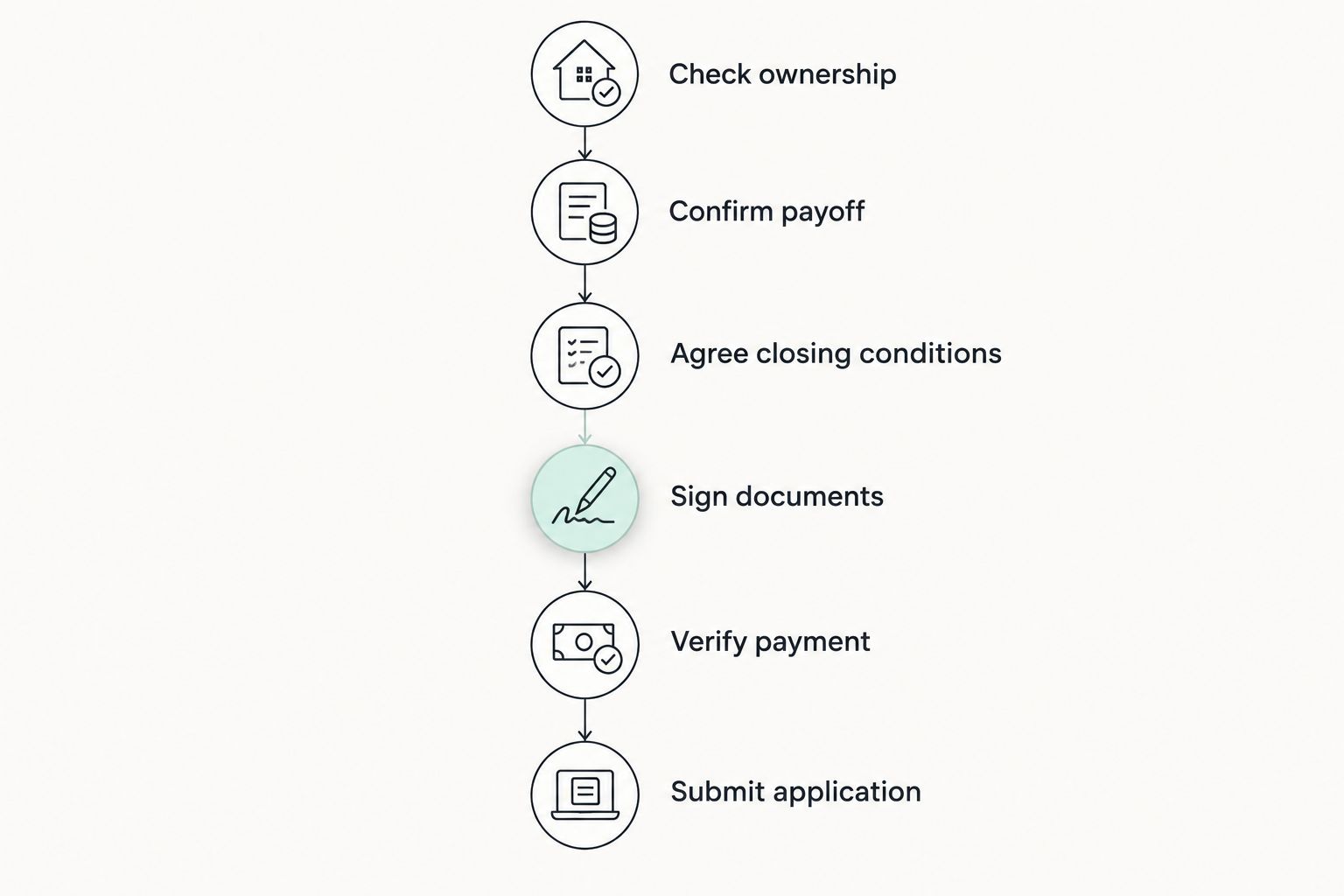
Follow this sequence before arranging the final handoff. Each step should have a responsible person and a clear completion condition.
1. Check ownership
Match the seller’s identification to the owner shown on the title or official ownership record. Compare the vehicle identification number on the documents with the car itself. Modern standardized VINs contain 17 characters; older collector cars require checks appropriate to their identification format.
If an LLC, trust or estate owns the car, verify who has authority to sign. Possessing the keys or managing the sale does not establish that authority. Resolve additional owners and required signatures before scheduling the closing.
Do not accept an unexplained ownership mismatch. Ask for the supporting documents and confirm the signing requirements with the relevant state agency.
2. Confirm payoff
Determine whether a lender holds a lien and whether the title is paper or electronic. If money remains owed, obtain the lender’s payoff instructions and confirm how the lien release and title will reach the appropriate party.
A loan payment and a lien release are separate events. Ask the lender what happens after payment, who receives the release, and whether further action is necessary to obtain a transferable title.
Do not build the closing around an assumed release date. Put the lender’s actual process into the agreement, including what happens if the documents arrive later than expected.
3. Agree closing conditions
Record the parties’ legal names, the VIN, the agreed transaction terms and any inspection conditions in the sales agreement. Specify who handles the payoff, documents, transport and state application. Keep the instructions consistent across the agreement and closing correspondence.
Decide what must happen before the car leaves the seller’s control. That includes payment verification, required signatures and the agreed route for delivering the title. If escrow is involved, confirm its written release conditions rather than assuming it checks every document.
A delivery appointment is not a reason to waive an unresolved closing condition. Change the appointment instead.
4. Sign documents
Complete the title assignment exactly as the issuing state requires. Check buyer and seller names, signatures, dates and required odometer disclosures. Verify whether notarization or another supporting form applies before signing.
Do not leave the buyer’s identity blank or sign forms you do not understand. Avoid erasures and informal corrections; ask the title agency how to fix an error before altering an ownership document.
A bill of sale records the transaction terms. It does not replace a required title assignment, lien release or state application.
5. Verify payment
Use independently verified bank or escrow contact details to confirm payment status. A screenshot, forwarded email or buyer’s assurance is not independent confirmation. Ask the financial institution what the payment status means before authorizing the agreed release.
Follow the written sequence for funds, documents and possession. Where a lender or escrow provider controls part of that sequence, confirm its instructions directly. Do not improvise new payment destinations during the closing.
6. Submit application
The buyer completes the title application and any registration steps required by the destination state. The seller completes any separate sale notice, plate or registration obligations required by the seller’s state. Keep copies of the signed documents and submission records.
Confirm the applicable deadlines directly with the state agency for the 2026 transaction. They are not uniform nationwide. Handing over a signed title does not mean the buyer has completed the state application.
Which title situation are you dealing with?
Identify the title situation before choosing a closing date. These are document conditions, not interchangeable ways to bypass state requirements.
| Title situation | What it means for closing | Useful preparation | Main constraint |
|---|---|---|---|
| Paper title, no recorded lien | Review the original and required assignment fields | Best for: owners preparing an ordinary documented private transfer | Errors or missing signatures still interrupt the application |
| Active lender lien | Coordinate payoff, release and title delivery | Best for: financed-car sellers planning with their lender | The lender’s document process controls part of the sequence |
| Electronic title | Confirm how the state permits the private transfer | Best for: owners checking the issuing state’s electronic-title procedure | Do not assume a paper assignment is immediately available |
| Missing or damaged title | Establish the state’s replacement or correction route | Best for: sellers resolving documents before accepting a closing date | A bill of sale alone does not resolve the missing-title issue |
| Entity or estate ownership | Establish the signer’s legal authority | Best for: authorized representatives assembling supporting records | Personal identification alone does not establish authority to sell |
Paper title without a lien
Inspect the original before signing. Check the owner information, VIN, brands or other notations, and every assignment field that applies. The buyer should know what original documents will accompany the application.
A clean-looking document is not enough. Confirm the title’s status through the relevant state process, and investigate discrepancies before payment or delivery.
Financed car or electronic title
A financed car needs a payoff plan that connects the money to the release of the lender’s interest. An electronic title needs the issuing state’s approved transfer procedure. These conditions sometimes overlap, but neither should be treated as a routine paper-title handoff.
Ask who controls each document at every stage. Then identify what evidence each party receives before taking the next step. That is more useful than a general assurance that the title will follow.
Out-of-state buyer
An interstate sale involves 2 state systems: the state associated with the existing title and the buyer’s destination state. Confirm the assignment requirements and the documents needed for the buyer’s application before signing.
Do not assume the seller’s plates, registration or insurance authorize the buyer’s trip home. Resolve lawful transport or temporary operating arrangements separately from title transfer. Shipping the car does not complete registration.
Why title-transfer requirements vary
The correct process depends on the records and jurisdictions involved. For a 2026 transaction, check these factors against current agency instructions:
- Issuing state. The existing title’s assignment requirements determine how the seller completes the document.
- Destination state. The buyer’s state determines its application requirements and supporting paperwork.
- Lien status. An active lien adds lender instructions, release evidence and document-routing decisions.
- Ownership structure. Multiple owners, an LLC, a trust or an estate changes whose signatures and authority need verification.
- Vehicle history and documents. An import, title brand, missing title or inconsistent identification calls for additional review before closing.
Exotic-car status alone does not create a separate national title-transfer system. Focus on the actual vehicle record, not assumptions about how a valuable car should be handled.
Can you transfer the title before the loan is paid off?
An active lien requires the lender’s involvement in the closing plan. Whether the transaction can proceed through a particular sequence depends on the lender’s instructions and applicable state procedures; a seller’s signature does not independently remove the lien.
Get the payoff instructions, release method and document recipient confirmed before proceeding. If those answers are unresolved, the title portion of the closing is unresolved too.
Does the title need to be notarized?
Notarization depends on the applicable state requirements and documents. Check before signing: a notary verifies the required identity and signing formalities, not the car’s mechanical condition or the buyer’s payment.
For a remote closing in 2026, confirm which notarization methods the receiving agency accepts. Do not assume an online appointment produces an acceptable document for every jurisdiction.
Is a pre-purchase inspection part of title transfer?
A pre-purchase inspection does not transfer ownership. It addresses a different question: whether the car’s condition meets the buyer’s expectations before the buyer commits under the agreement.
Felipe Cimino, CEO and co-founder of SV Sourcing, identifies buyers skipping a pre-purchase inspection as a firsthand concern. Keep mechanical due diligence and ownership due diligence separate. Passing either check does not replace the other.
Where private sales coordination fits
SV Sourcing is for exotic- and collector-car buyers and sellers seeking private access and a coordinated deal. The service covers private, off-market sourcing and sales coordination in South Florida and nationwide, rather than a public-inventory dealership model.
For the buyer, prepare the specification, budget, timing and due-diligence requirements. For the seller, prepare the ownership records, lien information and conditions for discreet introductions. A defined brief gives the coordinator something concrete to work with.
SV Sourcing presents one person coordinating the deal. That gives the conversation a clear point of contact; it does not replace the lender, inspector, motor vehicle agency or qualified legal adviser. Title approval remains with the relevant authority, and no closing date should depend on an unconfirmed document promise.
Discuss your private sale
Clarify ownership records, buyer requirements and the conditions for a coordinated private deal.
FAQ
Can I sell my exotic car if the bank holds the title?
A lender-held title requires a coordinated payoff and release process. Confirm the lender’s instructions and the applicable state requirements before agreeing to the vehicle handoff.
Is a bill of sale enough to transfer an exotic car?
A bill of sale does not replace required title documents. Check the issuing state’s assignment requirements and the buyer’s state application requirements.
Who submits the title paperwork in a private car sale?
The buyer generally submits the application for a title in the buyer’s name. The seller must also complete any separate sale-reporting or other obligations required by the seller’s state.
Can I leave the buyer’s name blank on the title?
Do not leave the buyer’s identity blank on the title assignment. Complete the required fields under the issuing state’s instructions and resolve errors through its approved correction process.
Does an exotic-car broker approve the title transfer?
An exotic-car broker does not replace the state authority that processes the title application. A coordinator can help organize the transaction, but required signatures, lender releases and state approval remain separate responsibilities.
Can the buyer drive the car home after signing the title?
Signing the title alone does not establish permission to drive the car home. Confirm insurance, registration, plate and temporary operating requirements before the trip.
What should I do if the title has the wrong VIN?
Stop the closing and resolve the VIN discrepancy before proceeding. Compare the vehicle and ownership records, then obtain correction instructions from the appropriate title authority.
One last thing
Keep 3 checkpoints separate: the agreement is signed, payment is verified, and the ownership documents are acceptable for the intended transfer. None proves the others. Add a separate confirmation for vehicle release so the transporter does not become the person deciding whether the closing is complete.
Before your 2026 closing, ask one final question: who holds the money, the title and the car at each stage? If the parties cannot give the same answer, settle the sequence before the handoff. This guide explains preparation; transaction-specific legal and tax questions belong with qualified advisers.