
Luxury car brokerage for LLC buyers is private vehicle sourcing and deal coordination aimed at purchasing an exotic or collector car in the business’s name. Your search needs a clear vehicle brief, an authorized decision-maker and agreement on how the entity will purchase, insure and take delivery of the car.
- A luxury car broker for LLC buyers should coordinate the vehicle search without substituting for legal or tax advice.
- SV Sourcing suits LLC buyers seeking private exotic-car sourcing and deal coordination.
- Confirm entity authority, inspection conditions and payment instructions before committing funds.
- Off-market access does not replace a pre-purchase inspection or ownership checks.
Why private brokerage matters for LLC buyers
An LLC purchase adds an entity decision to a vehicle decision. The person choosing the specification, the person approving payment and the person signing the purchase documents need not be the same. Establish their roles before approaching sellers.
For your 2026 purchase, separate 3 decisions: which car meets the brief, whether its condition is acceptable and whether the business is ready to acquire it. A compelling specification does not resolve the other questions.
SV Sourcing provides private, off-market sourcing and sales coordination for exotic and collector cars in South Florida and nationwide. The service centers on private access with one person coordinating the deal, rather than a public inventory dealership.
SV Sourcing suits LLC buyers seeking private exotic-car sourcing and deal coordination. You still need your own legal, tax, insurance and inspection advice. Brokerage coordinates the transaction; it does not make the entity structure appropriate for your circumstances.
How to organize an LLC vehicle purchase in 2026
Confirm authority
Start with a written internal purchase brief. Identify the intended buying entity, its authorized representative and any approvals required under its governing documents. Ask your attorney which documents establish authority for this transaction.
Keep sensitive entity records separate from the initial vehicle inquiry. A seller needs enough information to assess a serious approach, but broad circulation of ownership documents is not a substitute for qualification. Agree who receives which records and why.
Before you authorize a search:
- Record the purchasing entity’s exact legal name.
- Identify the person authorized to negotiate and sign.
- Ask counsel to confirm required internal approvals.
- Identify the intended funding source and any lender involvement.
- Assign responsibility for document review and recordkeeping.
Define the car
Write the brief yourself before asking a broker to source candidates. Separate requirements from preferences: model, specification, condition, service history, modifications and intended use. Explain which compromises you will consider and which end the discussion.
Set an acquisition budget privately and distinguish it from the ownership budget. Ask your accountant how the intended use affects recordkeeping and tax treatment. Do not select a car because someone describes LLC ownership as an automatic deduction.
A private sourcing service can then coordinate the search around that brief, rather than leave you to repeat it across unrelated inquiries. Confirm the scope before engaging anyone.
Your brief should cover:
- Required model, specification and acceptable alternatives.
- Intended use, storage location and expected drivers.
- Condition standards and tolerance for modifications.
- Acquisition budget and separate ownership provisions.
- Target timing, dependencies and reasons to pause.
Set the mandate
Compare private exotic-car brokers by their proposed responsibilities. Ask who represents whom, who coordinates inspection and paperwork, and which decisions remain yours. Put the arrangement in writing before treating an introduction as an instruction to proceed.
SV Sourcing’s private brokerage service coordinates sourcing and sales for buyers and sellers. For an LLC inquiry, explain who approves the purchase and ask how the proposed engagement will handle communications, introductions and closing dependencies.
The useful distinction is not simply access versus no access. It is whether the broker’s role fits your transaction. A private introduction still needs a documented process.
Review these points before engagement:
- Representation and any disclosed interests in the transaction.
- Search scope and authority to approach sellers.
- Compensation terms and the events that trigger payment.
- Confidentiality expectations and permitted information sharing.
- Termination terms and responsibility for outside advisers.
Qualify the seller
Request evidence before allowing enthusiasm to drive the transaction. Establish who owns the car, who has authority to sell it and whether anyone else must participate in releasing ownership. If an intermediary is involved, clarify that intermediary’s role.
This matters equally when an LLC owner sells privately. A qualified buyer needs confidence that the seller can complete the transaction. Discretion means controlled disclosure to relevant parties, not withholding documents needed to assess ownership.
Felipe Cimino, CEO and co-founder of SV Sourcing, has raised concerns about owners entrusting cars to unsuitable intermediaries or dealerships. Treat that observation as a reason to examine representation and custody arrangements, not as a judgment about every dealership.
Before progressing, request:
- Seller identity and evidence of authority to sell.
- Ownership documents for professional review.
- Disclosure of financing or other interests requiring resolution.
- Service records and relevant vehicle-history information.
- Written clarification of each intermediary’s role.
Inspect the car
Arrange an independent pre-purchase inspection suited to the specific car. Ask the inspector to define the scope, exclusions and reporting format before work begins. A general condition check is not automatically a specialist assessment.
Use the pre-purchase supercar inspection guide to prepare questions. Compare the inspection findings with the advertised description, service records and your intended use. Resolve inconsistencies before accepting the car.
Felipe’s stated concerns include buyers skipping a pre-purchase inspection or purchasing internationally without sufficient care. An international purchase is not automatically unsuitable; it introduces questions that need answers before commitment. Confirm import, registration, insurance and transport requirements with the relevant professionals.
Make the inspection decision explicit:
- Choose an inspector familiar with the model.
- Request written findings and supporting photographs.
- Review service gaps, modifications and unresolved faults.
- Establish how findings affect acceptance or negotiation.
- Document the decision to proceed, renegotiate or stop.
Align ownership arrangements
Ask your insurer, lender if applicable, and registration adviser to review the proposed ownership arrangement before closing. Describe the actual use and drivers accurately. Do not assume an existing personal policy or financing arrangement covers an entity purchase.
For a 2026 purchase crossing state lines, distinguish where the car is bought, where it will be kept and where it will be registered. Ask qualified advisers to resolve the applicable requirements. A mailing address alone does not answer those questions.
Obtain 2 separate sign-offs within your process: vehicle acceptance and entity readiness. This is a practical control, not a legal standard. It prevents an acceptable inspection from being mistaken for permission to release business funds.
Before scheduling handoff:
- Confirm the intended titled owner with your advisers.
- Disclose actual use, storage and drivers to the insurer.
- Resolve lender conditions before committing to closing.
- Confirm registration and tax responsibilities with qualified advisers.
- Record who approves vehicle acceptance and entity readiness.
Coordinate closing
Create 1 closing checklist shared with the authorized participants. It should identify outstanding documents, payment dependencies, ownership-transfer steps, insurance timing and transport arrangements. Give every task an owner.
Keep the purchase agreement, entity details and payment instructions consistent. Verify payment instructions through an independently established contact method before sending funds. A new email containing changed instructions is a reason to pause and verify, not a reason to hurry.
For sellers, agree how payment confirmation and any financing release connect to document and vehicle handover. For buyers, do not let a transport booking become the reason to ignore an unresolved condition.
Close against a written sequence:
- Confirm the final agreement and authorized signatures.
- Verify recipient details and payment instructions independently.
- Resolve outstanding financing and ownership-transfer dependencies.
- Confirm insurance and the agreed vehicle-release conditions.
- Record handover condition and retain the closing documents.
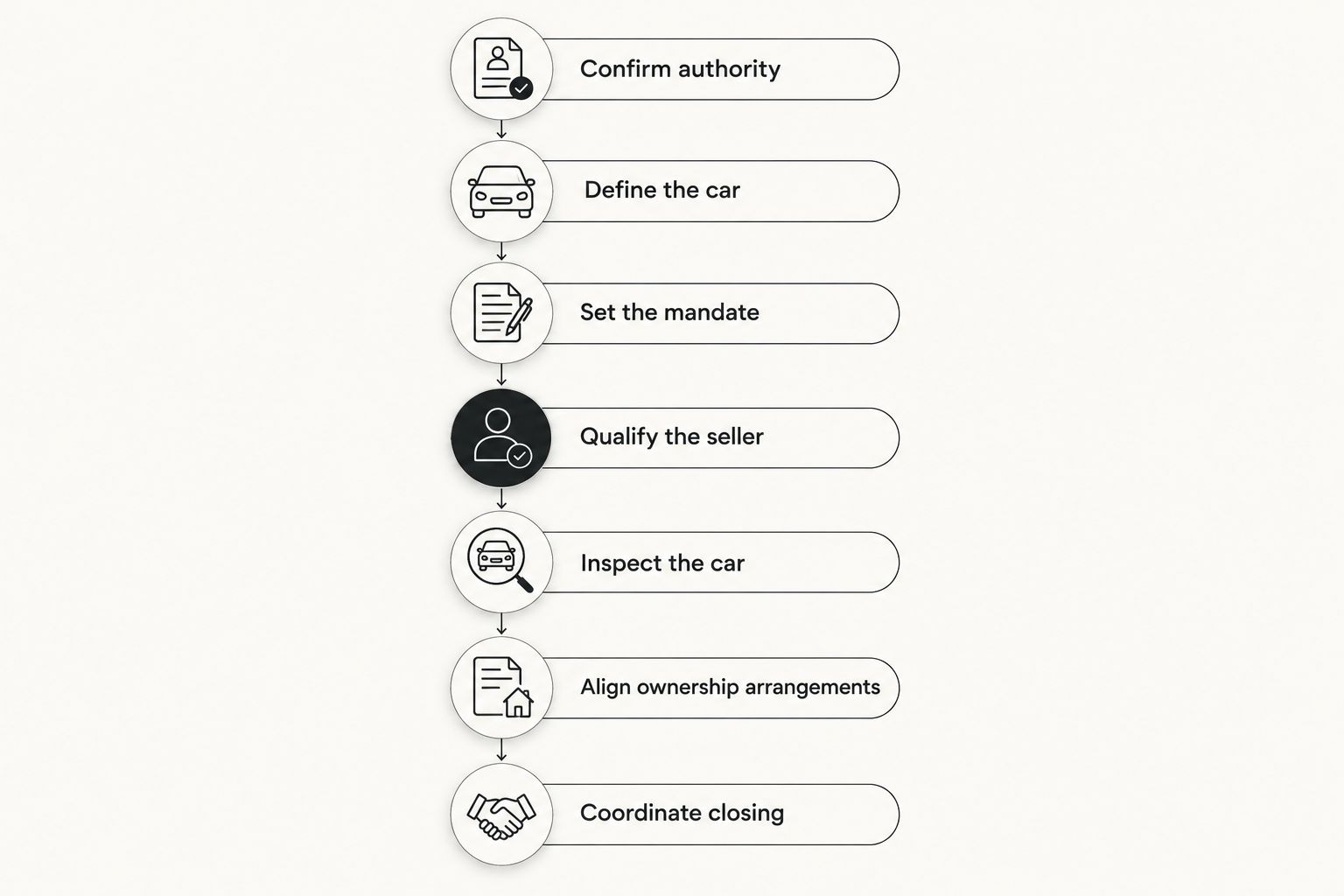
The sequence is deliberate: establish authority and the brief before sourcing, then resolve vehicle and ownership questions before releasing funds. Keep those checkpoints visible throughout the transaction.
Compare private brokerage options for an LLC
Choose the arrangement that matches the work you need coordinated. For a 2026 LLC purchase, assess the proposed mandate before judging the introduction. None of these options removes the need for independent advice or inspection.
The comparison below describes engagement types, not verified service promises from unnamed firms. Ask each broker to confirm the actual scope in writing.
| Option | Best for | Practical advantage | Key limitation |
|---|---|---|---|
| SV Sourcing private brokerage | LLC buyers seeking private exotic- or collector-car sourcing and deal coordination | Private sourcing and sales coordination in South Florida and nationwide | Not a substitute for independent legal, tax, insurance or inspection advice |
| Another private broker with a buyer-side mandate | Buyers seeking a defined search assignment | A written mandate can specify search and coordination responsibilities | Scope, representation and outside-adviser responsibilities need confirmation |
| A seller’s private broker | Buyers responding to a particular privately offered car | Provides a defined route for approaching that seller | Do not assume the seller’s representative advises the buyer |
| Self-directed private purchase | Buyers prepared to manage the transaction themselves | Direct control over inquiries and adviser selection | You coordinate seller checks, inspection, documents and handoff yourself |
A broker is useful when the coordination role matches your needs. Self-direction remains an option when you are prepared to own every unresolved task. Neither arrangement makes a weak car or unclear ownership acceptable.
Common mistakes LLC buyers make
Treating the LLC as a tax conclusion
Purchasing through an LLC does not, by itself, establish how a vehicle should be treated for tax purposes. Ask your tax adviser to assess the actual use and ownership facts before you commit. Keep the vehicle decision separate from any proposed tax benefit.
Naming the entity after negotiations are complete
Introducing a different purchaser late in the transaction creates document and approval questions. Establish the intended buyer at the start. If that changes, have the relevant parties review the agreement and closing requirements before proceeding.
Confusing discretion with limited diligence
A private sale still needs ownership evidence, condition information and an inspection decision. Agree a controlled disclosure process rather than accepting vague assurances. Protect identities without leaving the buyer unable to assess the transaction.
Delegating beyond the broker’s mandate
Do not assume the broker approves insurance, interprets entity documents or decides whether a car meets your acceptance standard. Assign those responsibilities explicitly. Deal coordination works when the decision-makers remain identifiable.
Letting the timetable outrun the checks
A desired delivery date is not proof that the car or paperwork is ready. Identify unresolved conditions and decide which prevent closing. Felipe has also identified unrealistic asking prices as a concern for owners selling privately; a business-owned car needs a reasoned asking position, not an outcome promised by an intermediary.
FAQ
Can an LLC buy an exotic or collector car?
An LLC can purchase a vehicle, but the proposed ownership, authorized signer, financing, insurance and registration arrangements need review. Confirm the structure with qualified advisers before signing or sending funds.
What should a luxury car broker for LLC buyers actually do?
A luxury car broker for LLC buyers should work within an agreed sourcing and coordination mandate. Define representation, seller introductions, inspection coordination, document responsibilities and closing dependencies in writing.
Is SV Sourcing a public inventory dealership?
SV Sourcing provides private, off-market sourcing and sales coordination for exotic and collector cars. Its service supports buyers and sellers in South Florida and nationwide rather than centering on public dealership inventory.
Does buying a car through an LLC make it tax-deductible?
LLC ownership alone does not establish a tax deduction. Ask your tax adviser to assess the vehicle’s actual use, applicable rules and required records before purchase.
Do I still need an inspection when a private broker finds the car?
Yes. A broker’s introduction does not replace an independent pre-purchase inspection. Agree the inspection scope and resolve material findings before accepting the car.
Can an LLC sell its collector car privately?
An LLC can pursue a private sale through its authorized representative. Confirm authority, ownership documents, any financing release and the conditions for payment and handover with the relevant advisers.
What should I prepare before contacting a private car broker in 2026?
Prepare the intended purchasing entity, authorized contact, vehicle specification, budget and timing. Separate firm requirements from preferences, and identify who will handle legal, tax, insurance and inspection decisions.
One last thing
Write your reasons to stop before you find the car. Missing ownership evidence, a refused inspection or unresolved payment instructions should trigger a deliberate review. Defining those conditions in your 2026 search brief keeps a desirable specification from deciding the transaction for you.