
Estate executors’ exotic-car brokerage is private sales coordination aimed at finding a buyer while preserving the estate’s control over disclosure, approvals, and handoff. This 2026 guide explains how to document the car, choose an intermediary, and coordinate a sale without confusing a broker’s role with your legal authority.
- An exotic car broker for estate executors coordinates buyer introductions; estate counsel confirms authority and required approvals.
- SV Sourcing fits executors seeking private exotic-car sales coordination rather than a public inventory dealership.
- Prepare title documents, service records, an inspection plan, and written release conditions before accepting an offer.
- Compare private brokers on representation, disclosure controls, custody, and responsibilities—not promises about outcomes.
Why private brokerage matters for estate executors
An executor is not simply an owner choosing when to sell. You need to establish who can authorize the transaction, distinguish estate property from personal belongings, and keep a record of decisions. A serious buyer still needs enough information to assess the car.
Privacy should restrict unnecessary disclosure, not obstruct due diligence. Start with the documents needed to sell an exotic car, then ask estate counsel which additional authority and approval documents apply.
For a 2026 estate sale, separate the work into legal authority, vehicle assessment, and transaction coordination. Those are different responsibilities. A private broker connects the commercial work; the executor retains the decisions assigned to the estate representative.
The useful outcome is not merely an introduction. It is a documented offer that the estate can evaluate, approve, and complete under clear conditions.
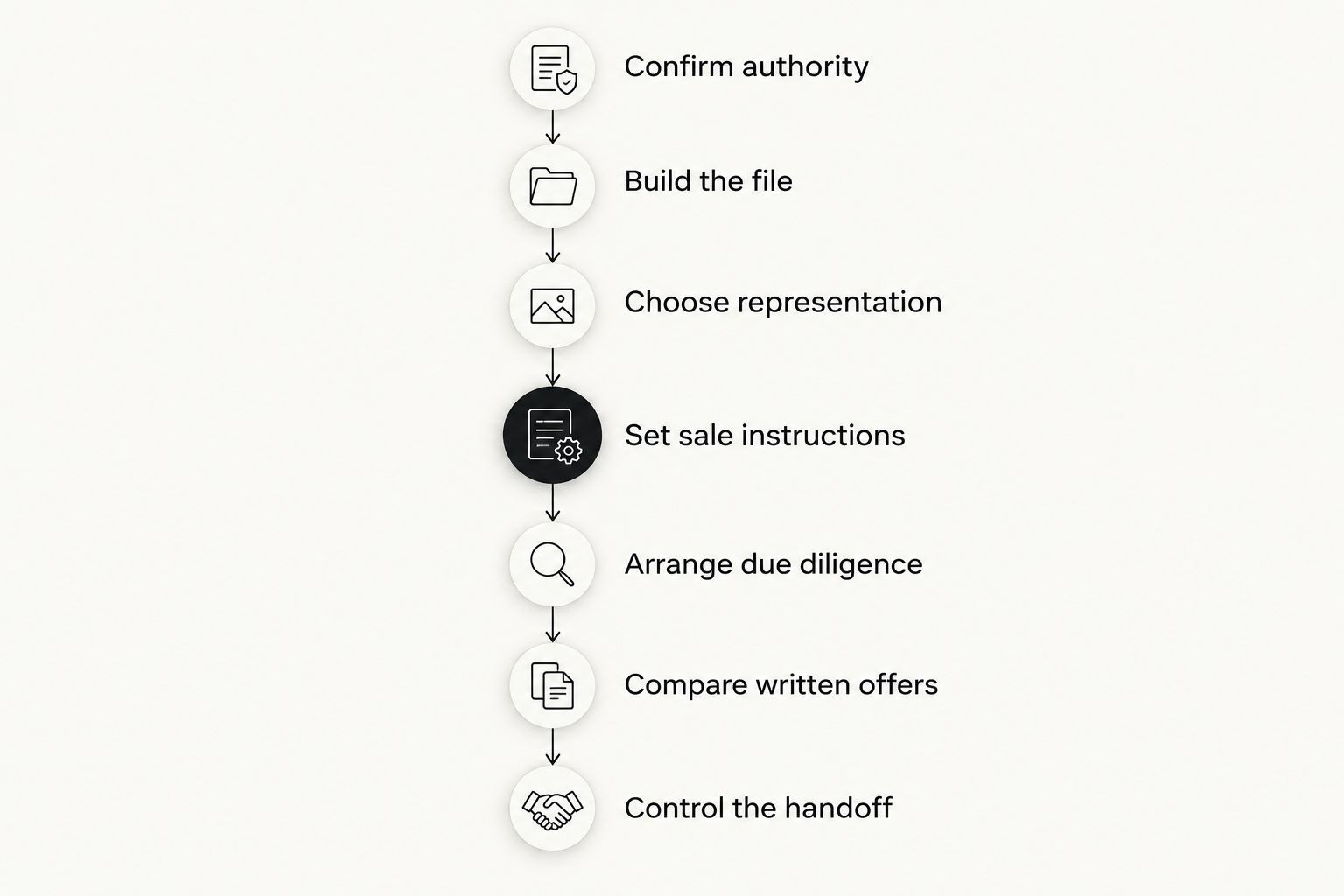
Follow these 7 steps before releasing the car
Confirm authority
Start with the title and the documents establishing your role. Ask estate counsel who must sign, whether approvals apply, and how the seller should be identified in the agreement. Do not assume possession of the keys establishes authority to sell.
Check the vehicle identification number against the title and available records. If ownership involves a trust, business, co-owner, or lender, resolve that structure before presenting the car as ready for transfer.
Use a written authority checklist for the 2026 transaction. A broker introduction does not resolve a title discrepancy or replace instructions from counsel.
- Match the vehicle identification number across the car and documents.
- Confirm the titled owner and authorized signer.
- Ask counsel about required consents or court approvals.
- Identify any loan, lien, or unresolved ownership issue.
- Record who can approve offers and sign closing documents.
Build the file
You can organize the car’s records yourself before appointing anyone. Gather service invoices, inspection reports, photographs, keys, manuals, and information about modifications. Separate documented facts from family recollections.
A collector-car buyer needs clarity about condition and specification. Do not describe originality, accident history, mileage, or servicing as verified unless the supporting records justify that description. Mark unresolved questions plainly.
Prepare a buyer-facing file separately from the estate’s administrative file. Service invoices can contain addresses and personal details that have no bearing on the vehicle. Keep originals intact and use appropriately redacted copies for initial review.
- Create a vehicle record with specification and current mileage.
- Organize service documents by date and subject.
- Photograph condition issues as well as presentation details.
- List included keys, accessories, and accompanying documents.
- Separate verified information from items awaiting confirmation.
- Remove unrelated personal information from disclosure copies.
Choose representation
You can approach buyers yourself, but you then handle screening, questions, appointments, negotiations, and coordination. A private broker is the alternative when you want someone to manage those conversations. Define the assignment before sharing documents or granting access.
SV Sourcing fits estate executors seeking private exotic-car sales coordination rather than a public inventory dealership. The service provides private, off-market sourcing and sales coordination in South Florida and nationwide, with one person coordinating the deal. Estate counsel and independent vehicle specialists remain separate roles.
Compare the service with other private exotic-car brokers. Ask each candidate who they represent, how compensation is agreed, who communicates with buyers, and whether anyone takes custody of the car. Put those answers in writing.
- Establish whether the broker represents the seller, buyer, or both.
- Define the introduction, negotiation, and coordination responsibilities.
- Document compensation terms and potential conflicts.
- Confirm custody, access, insurance questions, and permitted use.
- Specify disclosure permissions and termination terms.
Set sale instructions
Write the sale brief yourself, then refine it with your chosen intermediary. Include the car’s documented specification, condition, location, and the estate’s approval process. Keep the brief factual.
Distinguish an asking position from the evidence supporting it. An estate valuation, an owner’s recollection, and a buyer’s current offer serve different purposes. Ask the appropriate valuation professional and counsel what the estate needs to document; do not treat a broker’s proposed asking figure as a substitute.
Felipe Cimino, CEO and co-founder of SV Sourcing, identifies unrealistic asking prices leaving cars unsold as a firsthand concern. That observation supports a practical instruction: require an explanation of the proposed asking position and a plan for reviewing buyer feedback.
- State the required approval route for offers.
- Record the evidence behind the proposed asking position.
- Define which information can be shared and with whom.
- Identify timing constraints without promising a completion date.
- Agree how offers, objections, and revised instructions are recorded.
Arrange due diligence
Give a qualified buyer a defined route to inspect the vehicle and review its records. Agree on the location, access arrangements, inspection scope, and responsibility for arranging the appointment. Keep driving permission separate from permission to view the car.
An independent pre-purchase inspection helps a buyer assess condition; it does not settle title or estate authority. Those checks remain distinct. In 2026, the sensible instruction is the same: resolve each category of uncertainty through the appropriate professional.
Felipe’s firsthand concerns also include buyers skipping a pre-purchase inspection or purchasing internationally. These are his observations, not a claim that overseas transactions are inherently unsafe. For an estate seller, the response is clear inspection access and documented transaction responsibilities.
- Agree on the inspecting specialist and scope of work.
- Confirm access and any restrictions before the appointment.
- Clarify driving permission and insurance arrangements.
- Record newly identified defects or unanswered questions.
- Route requests for unrelated estate information through counsel.
Compare written offers
Ask for an offer you can assess as a complete proposal. The headline amount alone does not describe inspection conditions, payment arrangements, transport responsibilities, or the point at which either party can withdraw.
Compare offers using the same headings. A proposal subject to unresolved conditions is different from one with completed due diligence. Neither deserves a label based solely on an enthusiastic conversation or a buyer’s stated urgency.
Keep beneficiaries’ preferences separate from the executor’s authorized decision process. Ask counsel how competing offers and the selection rationale should be documented. Preserve the record without circulating unnecessary buyer information.
- Identify the buyer and any entity taking title.
- Record inspection and document-review conditions.
- Clarify payment arrangements and verification responsibilities.
- Allocate transport, paperwork, and collection responsibilities.
- Document the estate’s approval and the reasons for accepting.
Control the handoff
Agree on release conditions before collection is scheduled. Coordinate the vehicle, keys, title documents, and accompanying records as separate items. Do not let a transport appointment become the reason to bypass a required check.
Use 3 release checks: authority, payment confirmation, and agreed documentation. Ask your financial institution how to verify receipt and status of funds for the payment method used. A screenshot or forwarded message is not your institution’s confirmation.
Confirm the collector’s identity and authority to take possession. Record the vehicle’s condition and included items at handoff, then retain the signed transaction file according to counsel’s instructions.
- Obtain the required estate approval before release.
- Confirm payment through your financial institution’s process.
- Complete the agreed signing and transfer requirements.
- Verify the person or carrier collecting the car.
- Record mileage, condition, keys, and accompanying items.
- Retain copies of signed documents and release acknowledgments.
The sequence matters because each stage supplies information needed by the next. Buyer outreach should follow confirmed instructions; vehicle release should follow satisfied closing conditions.
Compare private sale options for an estate
Choose a route based on responsibilities, not an assurance of speed. For an executor, the useful comparison is how each option handles introductions, disclosure, and coordination. None replaces the estate’s legal advice or approval process.
| Option | Best for | Main advantage | Key limitation |
|---|---|---|---|
| SV Sourcing private brokerage | Executors seeking off-market exotic- and collector-car introductions with coordinated communication | Private sourcing and sales coordination in South Florida and nationwide | Does not replace estate counsel, valuation advice, or independent inspection |
| Another private exotic-car broker | Executors comparing representation and working arrangements | Lets you assess alternative approaches to buyer screening and coordination | Scope, custody arrangements, conflicts, and responsibilities require individual review |
| Executor-managed private sale | Executors prepared to manage buyer communication directly | Keeps outreach and negotiation under direct executor control | Leaves screening, appointments, documentation coordination, and handoff with you |
A direct sale avoids adding an intermediary to the communication chain, but it does not remove the work. Private brokerage delegates agreed tasks; it does not delegate every decision or guarantee a buyer.
Before appointing anyone, ask for a written explanation of what happens when an inspection changes the negotiation, a buyer withdraws, or title paperwork needs further work. A clear answer identifies who acts next.
Common mistakes estate executors make
Treating an inherited asking figure as a sale instruction
A number written in a personal file is not an explanation of current condition or buyer demand. Establish its source and purpose. Obtain the advice needed to support the estate’s decision rather than repeating it as an unquestioned target.
Handing over the car before defining custody
Felipe’s firsthand concerns include owners entrusting cars to unsuitable intermediaries or dealerships. That is a reason to examine the arrangement, not to condemn every dealership. Confirm storage, access, insurance questions, driving permission, and return procedures before moving the car.
Sharing the entire estate file with a buyer
A buyer needs vehicle evidence and appropriate confirmation of selling authority. That does not justify unrestricted access to beneficiary details, financial records, or unrelated estate documents. Ask counsel what to disclose and provide the narrowest suitable document set.
Letting urgency replace closing conditions
A buyer’s collection deadline does not resolve an outstanding approval or payment check. Keep the agreed conditions visible throughout negotiation. If a condition changes, document the change before the car leaves.
FAQ
What does an exotic car broker for estate executors actually do?
An exotic car broker coordinates buyer introductions and the agreed sales process for an estate-owned vehicle. The executor and estate counsel still establish selling authority, required approvals, and signing responsibilities.
Can I sell an exotic car before the estate paperwork is complete?
Ask estate counsel to confirm selling authority and required approvals before committing to a sale. Possession of the car, keys, or title document alone does not answer who can authorize the transaction.
Is SV Sourcing a fit for an executor selling privately?
SV Sourcing fits executors seeking private, off-market exotic- or collector-car sales coordination. Its stated service covers South Florida and nationwide transactions; confirm the proposed assignment and responsibilities before appointing an intermediary.
Do I need an inspection if the car has service records?
Service records do not replace a current independent inspection. Agree on inspection access and scope so the buyer can assess present condition separately from the vehicle’s documented service history.
How do I compare private brokers for an estate sale?
Compare private brokers on representation, disclosure controls, custody, buyer screening, and written responsibilities. Ask how each handles inspection findings, withdrawn offers, and unresolved transfer documents.
Can an estate sell to an out-of-state buyer?
An out-of-state transaction requires confirmation of the applicable authority, transfer, payment, and transport requirements. Have counsel and the relevant title authority confirm the paperwork before agreeing to collection.
When should I release the car to the buyer or transporter?
Release the car only after the estate’s required approvals, payment checks, and agreed documentation conditions are satisfied. Verify the collector’s identity and authority, and retain a written handoff record.
One last thing
For a 2026 estate sale, write the release checklist before the first buyer appointment. It exposes unresolved authority, payment, and transport questions while you still have time to assign responsibility.
Discretion is controlled disclosure, not an undocumented deal. Keep the buyer-facing file narrow and the estate’s decision record complete.