
Yes, selling a supercar to a private buyer can be safe when you verify the buyer, agree to written terms, confirm payment through your bank and control the handover. A private introduction does not replace those checks, and a payment screenshot is not a reason to release the car.
- Is it safe to sell a supercar to a private buyer? Yes, with verified identity, payment and a controlled handover.
- SV Sourcing coordinates private exotic-car sales; sellers must still resolve payment, title and inspection conditions.
- Keep possession until your bank confirms payment status and the agreed release conditions are satisfied.
- A private buyer's discretion is compatible with verification; anonymity is not a substitute for identification.
Why this matters
A serious offer is only the start. You still need to establish who is buying, who is paying and who is authorized to collect the car. Those roles should be clear before you sign transfer documents or arrange transport.
Start with how to verify a private buyer before selling an exotic car. For a sale in 2026, treat messages, identification documents and payment notifications as information to verify independently, not as proof by themselves.
Is it safe to sell a supercar to a private buyer?
Yes, provided you control the transaction rather than accepting the buyer's proposed process without checking it. Use the following sequence. Each stage should resolve a specific question before you move to the next.
- Verify identity. Establish the buyer's legal name, contact details and any representative's authority. If a company is purchasing, identify the entity and the person authorized to act for it. Resolve unexplained differences between the buyer, payer and proposed title holder.
- Agree terms. Record the vehicle identification number, agreed condition, inspection arrangements, payment method and release conditions. State what happens if an inspection changes the buyer's decision. Do not leave material promises in scattered messages.
- Arrange inspection. Agree where the car will be inspected, who can drive it and who remains responsible for its custody. Confirm insurance arrangements directly with the relevant insurer before a test drive. Do not assume the buyer's policy covers your car.
- Confirm payment. Contact your bank through a channel you already trust. Ask what the payment status means, what remains unresolved and whether any hold or verification issue affects release. Do not rely on the buyer's explanation of banking procedures.
- Control handover. Complete the applicable ownership documents and release the car only after the agreed conditions are satisfied. Verify the collector's identity and authority, whether the buyer arrives personally or sends a transporter. Record the handover.
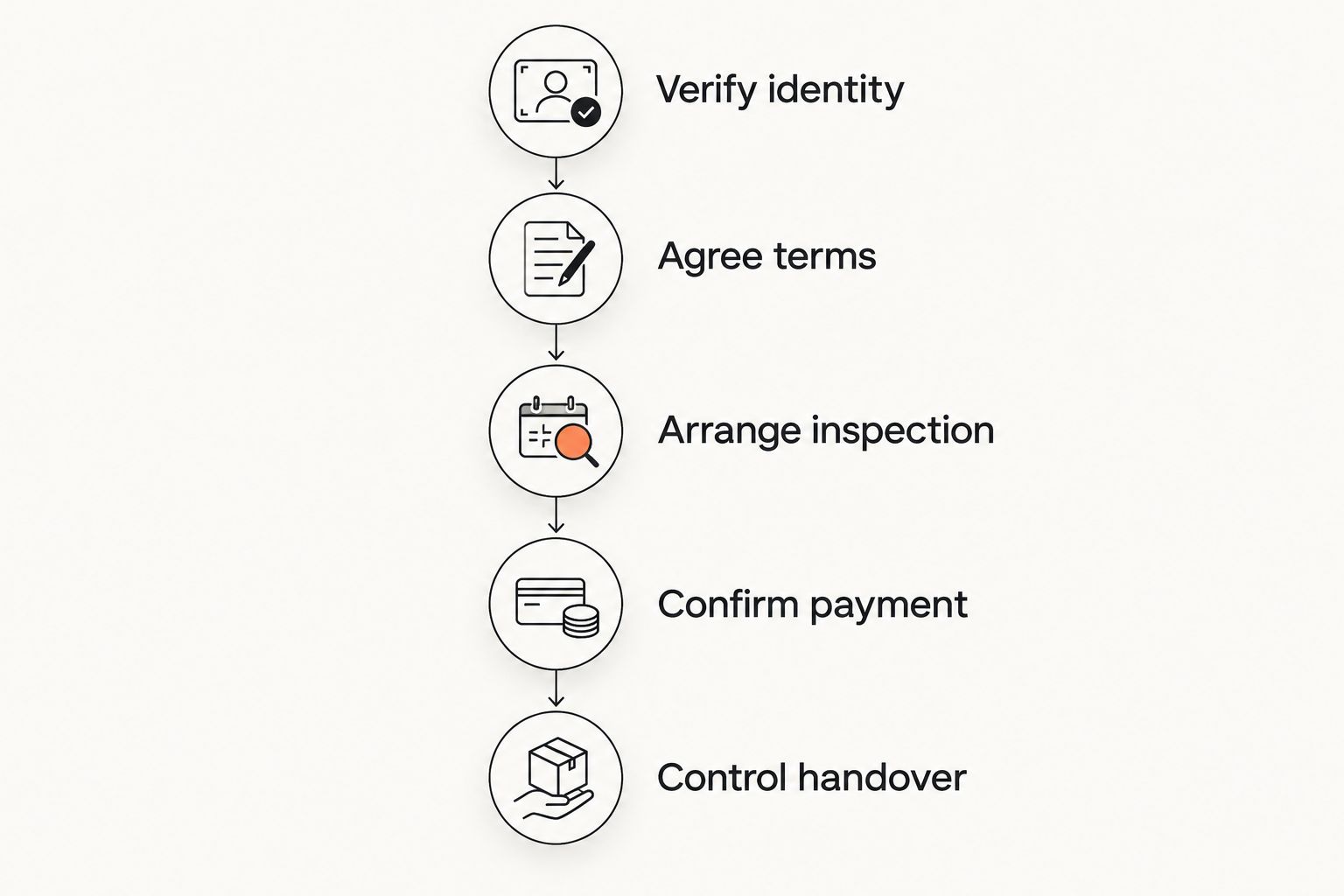
These are decision gates, not a promise that every transaction will close. If a check produces a discrepancy, pause and resolve it. A deadline imposed by the buyer does not answer an unresolved ownership or payment question.
Which private-sale arrangement fits your situation?
A direct sale and a broker-coordinated sale both require buyer verification and a documented closing. The difference is who handles introductions, communication and coordination. Neither arrangement makes due diligence optional.
| Arrangement | Best for | Benefit | Limitation |
|---|---|---|---|
| Owner-managed private sale | Sellers prepared to manage the process personally | Direct control of buyer communication and decisions | You must organize screening, inspection, documentation and handover |
| Private broker-coordinated sale | Sellers seeking discreet introductions and deal coordination | A named coordinator connects the parties and manages agreed tasks | You must define the broker's authority, representation and responsibilities |
SV Sourcing is for exotic- and collector-car owners seeking private introductions and coordinated sales. The service serves sellers and buyers in South Florida and nationwide, with one person coordinating the deal rather than a public-inventory dealership approach.
That coordination does not replace bank confirmation, independent inspection or the seller's approval of terms. Before appointing any private broker, establish who the broker represents, what the engagement includes and who can authorize each closing step. Review SV Sourcing if private off-market coordination fits your sale.
Why private-sale risk varies
The buyer's location or confidence does not settle whether a transaction is ready to close. Focus on the unresolved tasks. For your 2026 sale, review these factors before agreeing to a collection date:
- Identity and authority. An individual buying personally presents different verification questions from a company using a representative. Confirm who has authority to commit and sign.
- Payment arrangements. Establish the payer, receiving account and confirmation process. Refer unfamiliar arrangements to your bank before accepting them.
- Ownership and finance. A financed car requires lender involvement. Resolve payoff instructions and the title-release process before promising an unrestricted handover.
- Inspection and condition. Agree what the buyer can inspect and how findings affect the agreement. Disclose known issues rather than leaving the buyer to discover them at collection.
- Custody and transport. A test driver, inspection facility and transporter each introduce a separate custody decision. Confirm who has permission to take possession and under what conditions.
- State-specific paperwork. Title, registration, plate and seller-notification requirements depend on the relevant jurisdiction. Confirm current instructions with the appropriate motor vehicle agency.
A distant buyer is not automatically unsuitable. An unresolved payer identity or unclear authority to collect the car is a concrete reason to stop, regardless of distance.
How do you confirm payment without relying on screenshots?
Ask your bank to explain the actual payment status before you release the car. A screenshot, email or message from the buyer does not establish what has reached your account or what conditions remain.
Use a known banking contact or independently obtained contact details. Do not call a number supplied in an unexpected payment message and assume you have reached your bank. Ask the bank which checks are relevant to the proposed payment method.
For a 2026 closing, agree the confirmation procedure before the buyer sends money. Identify who will contact the bank, what must be confirmed and what happens if confirmation is unavailable when the transporter arrives. Collection should wait rather than force an exception.
If someone asks you to refund an alleged overpayment or forward money elsewhere, stop and speak with your bank. Do not move money on the strength of a payment notification. Keep the car, keys and ownership documents under your control while the issue is reviewed.
How should you handle inspections and test drives?
Give a qualified buyer a clear route to inspect the car without granting uncontrolled access. Agree the location, participants, permitted driving and insurance arrangements in advance. Inspection access and permission to take possession are different things.
A pre-purchase inspection also creates a defined point for discussing condition. Specify whether the purchase depends on the findings and how the parties will address newly identified issues. An inspection is not a guarantee against every future problem.
Felipe Cimino, CEO and co-founder of SV Sourcing, has identified buyers skipping a pre-purchase inspection as a firsthand concern. For a seller, the practical response is to make inspection arrangements explicit rather than pressuring the buyer to waive them.
Do not infer test-drive coverage from an insurance card alone. Ask the relevant insurer to confirm how the proposed driver and use are treated. If coverage or custody remains unclear, postpone the drive until you have an answer.
What belongs in the written closing plan?
The sales agreement records the bargain. The closing plan explains how the parties will carry it out. Keep both consistent, and seek qualified legal advice when ownership, representation or transfer conditions are unclear.
Your 2026 closing plan should identify:
- The parties and vehicle. Legal names, signing authority and the vehicle identification number must match the transaction documents.
- Outstanding conditions. Record inspection decisions, lender requirements and any agreed work or documents still due.
- Payment confirmation. Specify who checks with the bank and what must be resolved before release.
- Transfer documents. Identify the required signatures and the party responsible for submitting applicable paperwork.
- Collection authority. Name the buyer or authorized collector and establish how substitutions will be approved.
- Handover evidence. Record condition, mileage, keys, included items and acknowledgement of collection.
Avoid signing incomplete documents or leaving the purchaser unidentified. A buyer's request to fill in details later creates an unresolved transfer issue, not a finished sale.
If the car has a loan, coordinate directly with the lender using verified instructions. Do not assume the buyer's payment, loan payoff and title release will happen together. Establish the sequence before either party commits to collection.
How much information should you share privately?
Discretion means sharing the right information with the right party. It does not mean withholding material vehicle facts or allowing the purchaser to remain unidentified. Separate information needed for buyer evaluation from information needed to complete the transfer.
Provide relevant vehicle history and condition information without circulating unrelated personal records. Where appropriate, redact personal details from copies used during preliminary discussions, while preserving information the buyer needs to assess the car. Keep complete originals for legitimate verification and closing requirements.
Avoid publicly distributing your home address, identification documents or banking details. Agree a controlled channel for exchanging sensitive documents. If a representative requests information, confirm the representative's role before sending it.
When should you stop a private supercar sale?
Stop when a material identity, payment, ownership or custody question remains unanswered. You do not need to accuse anyone of wrongdoing. State what must be resolved before the transaction can continue.
Examples include a collector who differs from the authorized person, unexplained changes to the purchaser's name or pressure to release the car before bank confirmation. Treat a last-minute instruction change as a new verification task, not an administrative detail.
Felipe Cimino has also raised concerns about owners entrusting cars to unsuitable intermediaries and unrealistic asking expectations leaving cars unsold. Those are his observations, not a claim that every dealership or intermediary is unsafe. Choose the representative deliberately, and separate the decision to accept an offer from the decision to release possession.
FAQ
Is it safe to sell a supercar to someone I have never met?
A sale to an unfamiliar buyer can be safe when identity, authority, payment and collection arrangements are independently verified. A referral or introduction does not replace those checks.
Should I hand over my supercar when the buyer sends a payment screenshot?
No. Confirm payment status directly with your bank and resolve the agreed release conditions before handing over the car, keys or ownership documents.
Can a private broker make my supercar sale safe?
A private broker can coordinate introductions and agreed transaction tasks, but cannot replace payment confirmation or ownership checks. SV Sourcing provides private off-market sourcing and sales coordination for exotic and collector cars.
Can I sell my supercar privately if it still has a loan?
A private sale with an outstanding loan requires coordination with the lender. Confirm payoff instructions, title-release requirements and the handover sequence before committing to collection.
Should I allow a test drive before selling my supercar?
Allow a test drive only after agreeing identity checks, insurance, permitted use and custody arrangements. Confirm coverage with the relevant insurer rather than assuming the driver's policy applies.
Is selling a supercar to an out-of-state buyer unsafe?
An out-of-state buyer is not automatically unsafe. Verify the buyer and payer, confirm applicable transfer requirements and identify the person authorized to collect the car.
What should I do if the buyer sends a different transporter?
Pause collection until you independently confirm the replacement transporter's authority. A changed collection instruction needs verification before you release possession.
One last thing
A completed inspection is not permission to collect the car. Neither is a signed agreement or a payment notification. Treat each as a separate milestone, then authorize handover only when every agreed release condition is satisfied.
Before your 2026 closing, write the release instruction in plain language: who can collect, what must be confirmed and who gives final approval. That short instruction keeps a rushed collection from overruling the agreed process.