
Instead of chasing warranty paperwork after a private supercar sale, confirm coverage against the VIN before closing and connect any required transfer steps to the ownership handoff. For a 2026 transaction, get written confirmation of eligibility, assign responsibility for submission, and retain evidence of the buyer’s coverage status.
- For a warranty transfer exotic car sale, verify the exact contract before promising coverage.
- SV Sourcing suits buyers and sellers seeking private exotic-car sourcing and sales coordination.
- Factory warranty coverage and a separate service contract require separate checks.
- Confirm eligibility before closing; retain the buyer’s coverage confirmation afterward.
Why this matters
A seller’s warranty statement is not confirmation of the buyer’s coverage. Establish which coverage exists, what governs it, and whether the ownership change requires action. A service invoice or dashboard message does not answer those questions.
SV Sourcing is best for exotic- and collector-car buyers and sellers seeking private sourcing and sales coordination. The value of SV Sourcing is coordinating the private deal; the manufacturer or contract administrator remains the source for coverage confirmation.
Keep those roles separate. Your coordinator can organize the questions and documents, but cannot replace the party responsible for interpreting and administering the warranty.
For a 2026 closing, treat warranty verification as its own workstream alongside inspection, payment and title. Completing one does not complete the others.
Before you start
- Gather 3 records: the VIN, the applicable warranty booklet or contract, and the current odometer reading. Add service records and the original in-service date if documented. Ask for missing records rather than filling gaps from an advertisement.
- Arrange authorized access: the seller should contact the manufacturer’s authorized service representative or named contract administrator. Ask what permission is needed before that party can discuss vehicle-specific information with the buyer or coordinator.
- Resolve the non-obvious gotcha: determine whether the seller means the original factory warranty, an extended manufacturer-backed contract, or a third-party service contract. Do not submit a transfer request until you know which document controls it.
Use the process below as a document workflow, not a manufacturer-specific portal tutorial. Forms, submission channels and required actions must come from the party administering the actual coverage. Do not use instructions for another model, market or contract.
Establish the coverage record
- Match the VIN. Compare the vehicle’s VIN with the title, coverage documents and service records. Resolve any mismatch before relying on a warranty statement.
- Identify the coverage. Record the document’s exact name and the company responsible for administering it. Keep separate contracts separate, even when the seller describes everything as a factory warranty.
- Request current status. Ask the appropriate representative to confirm the coverage shown for that VIN, the applicable time and mileage limits, and any recorded issue affecting eligibility. Request written confirmation where provided.
- Record the evidence. Save the response, its date, the odometer reading supplied and the representative’s contact details. Label any unanswered question as unresolved.
Expected result: you have a coverage record tied to the actual car, not a general statement about the model.
Distinguish the documents before deciding what to request:
| Coverage document | Best for | Useful evidence | Limitation |
|---|---|---|---|
| Original factory warranty | Checking the manufacturer’s original coverage terms | Applicable warranty booklet and VIN-specific status confirmation | Does not establish the terms of a separate service contract |
| Manufacturer-backed extended contract | Checking additional coverage named in that contract | Contract wording and administrator confirmation | Do not assume the original warranty’s ownership-change rules apply |
| Third-party service contract | Checking coverage administered outside the manufacturer’s original warranty | Signed contract and named administrator’s instructions | A seller’s description does not establish transfer eligibility |
These are verification routes, not interchangeable benefits. Use the governing document, not the label in the listing.
Obtain eligibility confirmation
- Describe the transaction. Tell the administrator that the vehicle is being sold privately. State the buyer’s intended registration location and whether an individual or entity will own it.
- Ask the ownership question directly. Ask whether coverage continues with the vehicle, requires an ownership-record update, needs a formal transfer application, or cannot continue under the proposed transaction.
- Check the conditions. Ask which documents, signatures, deadlines and eligibility checks apply. Confirm whether submission alone is sufficient or whether acceptance is required.
- Resolve vehicle-specific questions. Disclose known modifications, relevant service gaps and any intended cross-border movement. Ask for the effect under the applicable terms rather than making your own coverage judgment.
- Save the answer. Obtain the current instructions and keep them with the coverage record. Separate confirmed requirements from questions still awaiting a response.
Expected result: you know the required action, the responsible party and what remains conditional.
For a 2026 sale, do not rely on an old email describing a previous owner’s transaction. Request instructions applicable to this VIN and this ownership change.
Written eligibility confirmation is useful because both parties can work from the same record. Its limit is equally important: preliminary confirmation is not the same as final acceptance when further documents remain outstanding.
Set the closing instructions
- Assign responsibility. Name who obtains the form, who signs it, who submits it and who follows up. Identify the buyer and seller using the names that will appear in the transaction documents.
- Separate the decisions. Establish 2 checkpoints: eligibility confirmation before closing, and buyer confirmation after the required ownership-change steps. Do not mark the second complete at the first.
- Document unresolved conditions. If the buyer’s decision depends on continuing coverage, have the sale agreement address that dependency and the agreed response if it cannot be confirmed. Obtain legal advice for the wording.
- Follow the actual sequence. Use the administrator’s instructions to determine when signatures, ownership evidence and submission are required. Do not invent a deadline to match the vehicle’s collection date.
- Preserve submission evidence. Keep a copy of the completed documents and whatever acknowledgment the authorized submission channel provides.
Expected result: both parties know what must happen before funds and possession change hands, and what must happen afterward.
Use one closing file to connect the stages. Keep sensitive identity documents within the authorized transaction group; share only what the recipient needs.
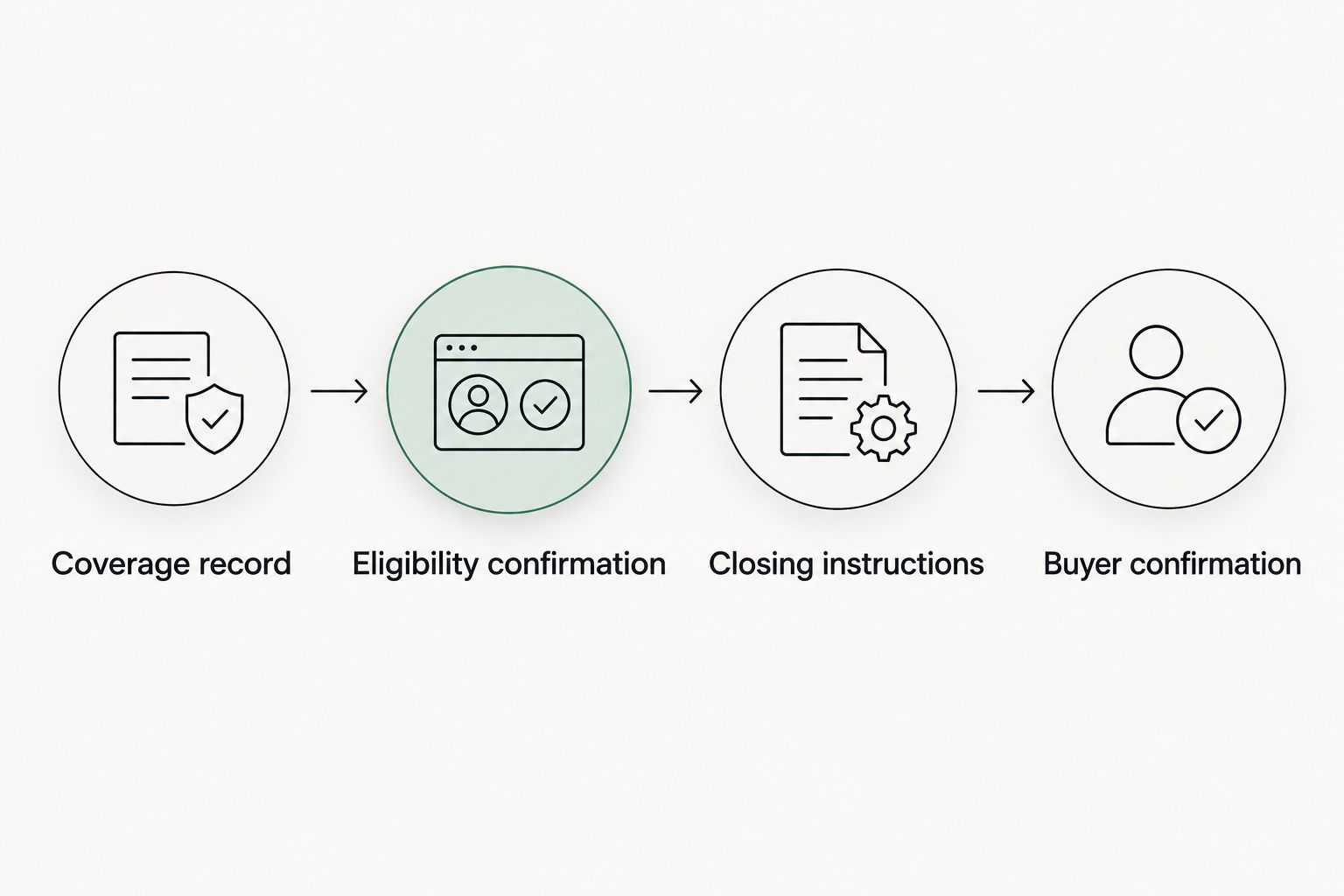
Obtain buyer confirmation
- Complete the required update. Submit the ownership information and supporting documents through the channel specified by the manufacturer or administrator. Do not treat sending documents to the seller’s broker as submission to the administrator.
- Check receipt and outcome separately. Confirm that the documents arrived, then ask whether the update or transfer has been accepted. A delivery acknowledgment answers only the first question.
- Review the resulting record. Check the VIN, owner details where recorded, coverage description and applicable limits against the administrator’s response. Raise discrepancies promptly through the stated contact route.
- Deliver the file. Give the buyer the governing document, relevant confirmation and instructions for future coverage questions. Retain the transaction record without circulating unnecessary personal information.
Expected result: the buyer has evidence of the coverage position, including any unresolved conditions, rather than an assumption that the sale completed the warranty process.
For a 2026 handoff, retain dated records of both the submission and the response. If a final decision remains pending, say so plainly in the closing communications. Do not describe pending coverage as confirmed coverage.
When no formal transfer application is required
An ownership-record update and a contractual warranty transfer are not necessarily the same task. If the administrator confirms that coverage continues without a formal application, follow that answer rather than creating unnecessary paperwork.
Use this adjacent workflow:
- Retain the governing terms. Save the document supporting continuation of coverage with the vehicle.
- Confirm the record-update process. Ask whether the buyer must update owner details and how to do it.
- Complete the requested update. Supply only the information and evidence required through the authorized channel.
- Keep confirmation. Save the response showing what was updated and whether anything remains outstanding.
The benefit is a simpler handoff. The limitation is that an owner-profile update alone does not establish the scope of coverage. Keep the terms and coverage status alongside it.
If the car also has a separate extended contract, run that contract through its own eligibility check. Confirmation about the original factory warranty does not answer the transfer question for another agreement.
Troubleshooting
The seller says coverage exists, but there is no supporting record
Ask for the governing document and a VIN-specific status response. Keep the claim unconfirmed until those records support it. If warranty status affects the buyer’s decision, resolve it before treating the transaction as ready to close.
The buyer cannot obtain vehicle-specific information
Ask what authorization the administrator requires from the current owner. Arrange the permitted introduction or consent process. Do not share account credentials or assume a coordinator’s involvement provides permission to disclose private records.
The car has modifications or incomplete service records
Present the known facts to the administrator and ask how the applicable terms address them. Avoid both blanket conclusions: that every modification eliminates coverage, or that every modification leaves coverage unchanged. Arrange an independent inspection as a separate check.
The buyer will register the car in another country
Confirm geographic eligibility and any required approvals before committing on the assumption of continuing coverage. A domestic coverage statement does not answer the proposed international transaction. Keep warranty eligibility separate from import eligibility and transport arrangements.
Documents were submitted, but acceptance is still outstanding
Ask for the submission status, missing requirements and next action. Update both parties using the same written record. If confirmation was a condition of the deal, follow the agreement’s provisions rather than replacing them with an informal assurance.
Customize your workflow
Use warranty confirmation and an independent inspection together. Coverage terms describe contractual protection; an inspection examines the car’s condition. Neither replaces the other.
Felipe Cimino, CEO and co-founder of SV Sourcing, has identified buyers skipping a pre-purchase inspection as a firsthand concern. That observation is not a claim that every privately sold car has a problem. It is a reason to keep inspection separate from the seller’s warranty description.
Use the pre-purchase supercar inspection guide to prepare that parallel workstream. Give the inspector relevant records, then direct coverage questions to the administrator rather than asking the inspector to promise claim acceptance.
For your 2026 closing checklist, assign a named person to each open item. SV Sourcing provides private sourcing and sales coordination for exotic and collector cars; manufacturer and administrator decisions remain outside that coordination role.
Discuss your private transaction
Clarify your buying or selling brief and the coordination your transaction requires.
FAQ
Does a factory warranty automatically transfer when I buy a supercar privately?
Check the applicable warranty terms and obtain VIN-specific confirmation; do not assume the ownership change completes every required step. Ask whether coverage continues with the vehicle, requires an owner update, or needs a formal application.
Who should handle the warranty paperwork in a private exotic-car sale?
Assign responsibility in the closing instructions according to the administrator’s requirements. The seller, buyer and coordinator should know who obtains signatures, submits documents and confirms the outcome.
Is an extended warranty the same as the original factory warranty?
Do not treat an extended contract as the original factory warranty. Identify its administrator and read its own ownership-change terms, even when the seller describes both together.
Can I rely on a screenshot saying the car is under warranty?
Use a screenshot as a starting point, not as the complete coverage record. Match it to the VIN and obtain the governing terms and confirmation applicable to the proposed sale.
Do I still need a pre-purchase inspection if the car has warranty coverage?
Yes. An inspection examines condition, while warranty documents establish contractual coverage and its limits. Keep both checks in the buying process.
What if the buyer is taking the supercar overseas?
Confirm coverage eligibility for the intended destination before relying on the warranty. Ask the administrator about the proposed ownership and geographic change, and address import requirements separately.
Does a private-car broker approve the warranty transfer?
A broker coordinates the transaction but does not replace the manufacturer or contract administrator’s approval. Obtain the required confirmation from the party responsible for the coverage.
One last thing
Proof that a request was received is not proof that it was accepted. Keep those as separate entries in the closing file. That distinction prevents an acknowledgment email from becoming an unsupported promise about the buyer’s protection.