A Miami car broker coordinates a nationwide handoff by connecting the buyer and seller, organizing due diligence, confirming the closing responsibilities, and aligning vehicle release with transport. The handoff is not complete when a carrier collects the car: payment, title documents, condition records, and delivery acceptance need separate checks. For a private exotic- or collector-car transaction in 2026, agree on those checks before anyone commits to pickup.
- For a car broker Miami search, prioritize a documented nationwide handoff over a quick pickup promise.
- SV Sourcing suits exotic- and collector-car buyers and sellers seeking private introductions and one person coordinating the deal.
- Complete a pre-purchase inspection before committing to transport; a pickup condition report serves a different purpose.
- Separate payment confirmation, title handling, vehicle release, and delivery acceptance in the closing instructions.
How does a Miami car broker coordinate a nationwide handoff?
A nationwide handoff needs a named owner for each task, an agreed sequence, and a clear reason to stop if a condition remains unresolved. Coordinate the transaction first. Schedule the truck around it.
SV Sourcing provides private, off-market sourcing and sales coordination for exotic and collector cars in South Florida and nationwide. Its role is deal coordination, not a substitute for an independent inspection, lender confirmation, or the destination state's registration requirements.
Use the following sequence when discussing a proposed handoff with a private broker. It describes the responsibilities to agree on, not a promise that every transaction follows an identical closing process.
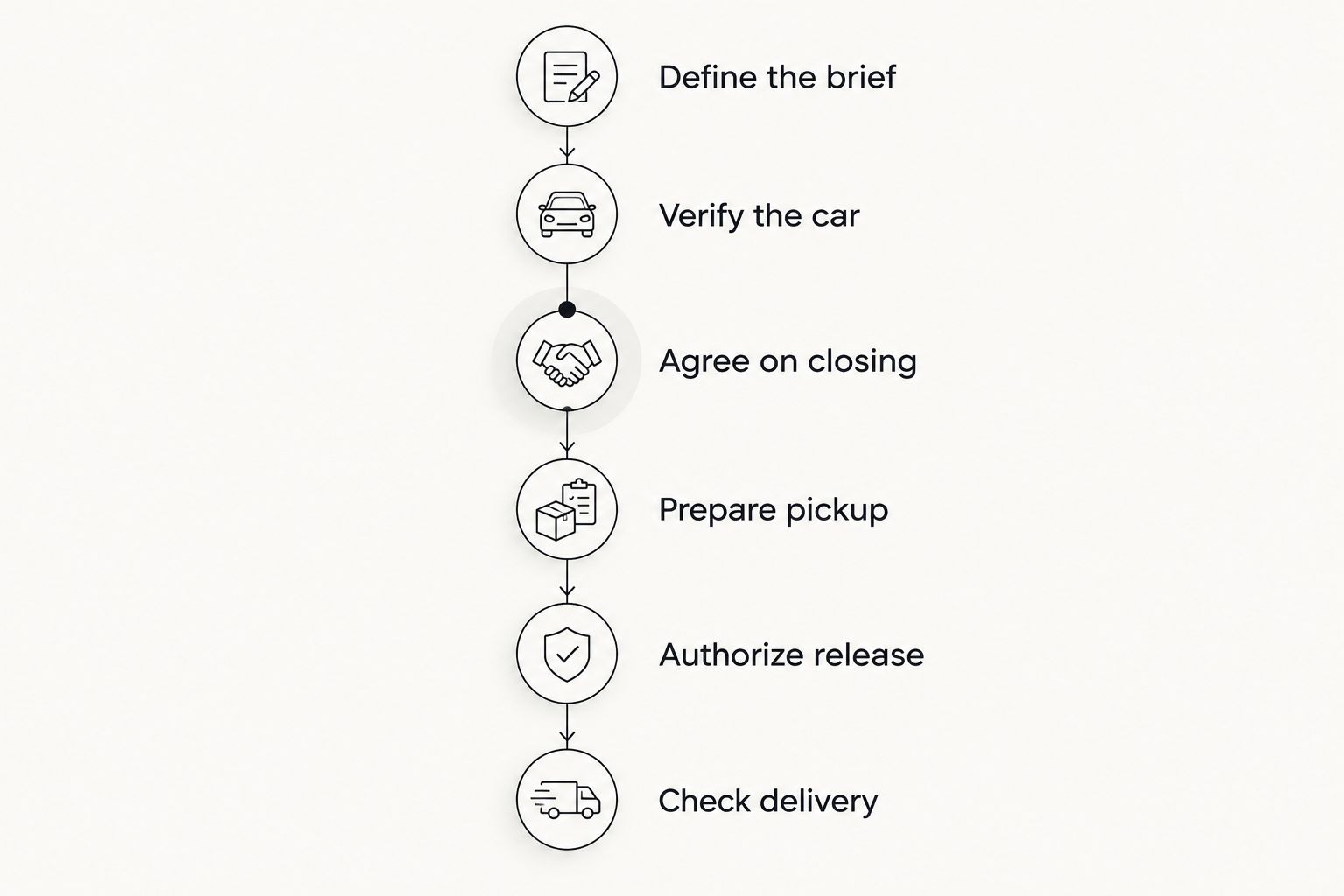
1. Define the brief
For buyers, start with the car specification, budget, location, and timing. Identify what is essential and what is negotiable: configuration, condition, service documentation, modifications, and intended use. A car that meets the model brief but fails the condition brief is not ready to proceed.
For sellers, establish who can discuss the car, what information can be shared, and when an introduction becomes serious enough to justify inspection access. Keep private ownership details separate from the information a buyer needs to assess the vehicle.
Name the coordinating contact. Also identify who represents whom and who can approve changes. An introduction does not, by itself, establish authority to accept an offer, receive funds, or release a vehicle.
2. Verify the car
Match the vehicle identification number across the car and the transaction documents. Review ownership information, service records, disclosed modifications, and the proposed title transfer. If a lender is involved, establish the payoff and title-release process before setting the closing sequence.
Arrange an independent inspection with someone qualified to evaluate the specific vehicle. Give the inspector the buyer's questions, not just a request to look it over. Clarify whether the inspection includes a road test, diagnostic review, underbody examination, or other work relevant to the car.
Use the pre-purchase supercar inspection guide to frame that discussion. An inspection assesses the car before purchase; a transport condition report records its condition at handoff. Do not treat one as a replacement for the other.
3. Agree on closing
Put the agreed transaction terms and outstanding conditions in writing. Specify who prepares the documents, who signs them, where payment goes, and what must happen before the seller authorizes release. Record any unresolved inspection findings and the agreed response.
Ask the receiving financial institution how it confirms receipt of funds. Do not rely on a payment screenshot, forwarded message, or unfamiliar caller to establish that the seller has been paid. Verify any changed payment instructions through a previously established contact channel.
For a 2026 transaction, confirm the current requirements with the lender and the relevant state motor vehicle agencies. The broker can coordinate conversations, but the responsible institution or agency must confirm its own requirements. Keep unanswered questions out of the release authorization.
4. Prepare pickup
Choose transport only after the car's location, release conditions, and delivery destination are clear. Ask the carrier about loading suitability, custody, insurance documentation, exclusions, and the procedure for reporting damage. Do not assume a transport description answers all of those questions.
Identify the person authorized to release the car and the person authorized to receive it. Confirm access at both locations, including any loading restrictions. Tell the carrier about low clearance, starting instructions, or special handling needs that apply to the actual vehicle.
Record condition with dated photographs and a written handoff report. List the keys, documents, accessories, and loose items that should accompany the car. Agree separately on how original ownership documents will travel rather than assuming they belong inside the vehicle.
5. Authorize release
Use a written release checklist. Confirm that the agreed payment condition has been met, the required documents are signed or otherwise handled as agreed, and the carrier's identity matches the booking. The seller or another expressly authorized person should approve release.
If something changes, pause the handoff and resolve it with the responsible party. A substituted carrier, altered destination, unexpected recipient, or revised payment instruction deserves verification. A pickup appointment is not a reason to bypass an unresolved condition.
Keep the broker, seller, buyer, and carrier working from the same approved instructions. Where their responsibilities differ, state that difference plainly. Coordination works when each participant knows the limits of their role.
6. Check delivery
The buyer or authorized recipient should inspect the car at delivery and compare its condition with the pickup record. Record discrepancies through the carrier's stated process before treating the delivery paperwork as routine. Keep photographs and the relevant documents together.
Check the accompanying items against the agreed list. A delivered car with missing keys or unresolved ownership documents still leaves work to do. Assign that follow-up to a named person rather than leaving it in a group conversation.
Close the coordination loop by confirming receipt, documenting unresolved items, and identifying the next action for each. Physical delivery and administrative completion are separate milestones. Neither should disappear into the assumption that the other has happened.
The sequence below keeps the central decisions visible. Release belongs after verification and closing arrangements, not ahead of them.
Why this matters
Distance separates the people making decisions from the people holding the car. The buyer can approve the purchase from another state while the seller, inspector, lender, and transporter each work on a different part of the transaction. Clear instructions connect those parts.
For the buyer, the priority is knowing what is being purchased and what remains unresolved. For the seller, it is knowing who is authorized to act and when the vehicle can leave. Discretion does not remove either responsibility.
SV Sourcing co-founder Felipe Cimino's stated firsthand concerns include owners entrusting cars to unsuitable intermediaries, unrealistic asking prices leaving cars unsold, and buyers purchasing internationally or skipping a pre-purchase inspection. These are his observations, not a claim that dealerships or international purchases are inherently unsafe. The practical response is to examine the intermediary, the terms, and the car separately.
What should buyers and sellers prepare before pickup?
For a 2026 nationwide handoff, prepare a shared closing checklist without circulating unnecessary personal information. Each party needs the instructions relevant to its role. Not everyone needs the entire transaction file.
Buyer preparation
Give the coordinator a precise brief and a real decision path. If an inspection finding changes your interest, communicate that before transport is booked. Decide who can receive the car and who will check its condition if you cannot attend.
Ask your insurer when the intended coverage begins and what it covers during the handoff. Confirm the destination state's ownership and registration requirements through the appropriate agency. Do not assume the seller's paperwork alone answers those questions.
Seller preparation
Gather the ownership documents and relevant vehicle records. Identify any lender involvement and explain who currently holds the car. State what accompanies the sale so that keys, accessories, and documents do not become last-minute disagreements.
Set boundaries for inspections, test drives, and disclosure of the car's location. Discreet introductions still require enough verified information for a serious buyer to make a decision. Privacy should control access, not obscure material information about the car.
Shared preparation
Create one approved instruction sheet containing the vehicle identifier, authorized contacts, release conditions, pickup destination, delivery destination, and unresolved tasks. Keep sensitive financial instructions in the appropriate secure channel rather than distributing them with general transport details.
Ask every participant to confirm its part. A broker's summary is useful, but the lender must confirm lender instructions and the carrier must confirm transport instructions. Assign responsibility where the actual authority sits.
Why nationwide handoffs vary
There is no useful universal delivery promise for a private transaction. The sequence depends on the car, the parties, and the conditions they agree to satisfy.
- Ownership and lender involvement. A financed vehicle needs a confirmed payoff and title-release process. A seller holding the title has a different document path, but ownership still needs verification.
- Inspection findings. A buyer's decision can change after an independent inspection. Resolve acceptance, further investigation, or withdrawal before authorizing transport.
- Vehicle handling needs. Clearance, operating condition, and disclosed modifications affect the loading questions you should ask. Describe the actual car, not just its model.
- Pickup and delivery access. The authorized people and suitable locations must be ready. Confirm any restrictions directly with the carrier and the property contact.
- Destination requirements. Registration, tax, and document requirements depend on the jurisdiction and transaction. Check the applicable 2026 instructions rather than reusing another buyer's checklist.
- Party availability. Signatures, lender responses, inspection access, and delivery acceptance require different people. Confirm their availability before committing to a handoff appointment.
Is a private broker better than coordinating the handoff yourself?
A private broker is relevant when you want private introductions and a central coordinating contact. Self-coordination suits someone prepared to manage the counterparties and follow every unresolved item personally. Neither approach removes the need for independent checks.
Compare the responsibilities, not just the service description. For a 2026 broker selection, ask who actually manages the handoff and what falls outside the engagement.
| Approach | Best for | Main benefit | Main limitation |
|---|---|---|---|
| Private broker coordination | Buyers and sellers seeking private introductions and a central contact | A defined coordinating role across the deal | Scope must be agreed; the broker does not replace inspectors, lenders, or carriers |
| Self-coordinated private transaction | Buyers and sellers prepared to manage each participant directly | Direct control over the instructions and follow-up | You must track each dependency and resolve conflicting instructions yourself |
SV Sourcing suits exotic- and collector-car buyers and sellers seeking private introductions and one person coordinating the deal. Confirm the proposed engagement before assuming it includes a particular closing, payment, or transport arrangement. The service's stated focus is private sourcing and sales coordination, not public inventory browsing.
Discuss your private handoff
Bring your car brief or selling plans, location, timing, and questions about nationwide coordination.
Can the car leave before every closing task is finished?
The car should leave only when the agreed release conditions are satisfied. Some administrative follow-up can remain if the parties expressly accept the arrangement, but an unresolved payment or ownership question is not merely a transport detail.
Write down what remains, who controls it, and how it will be completed. Do not let collection imply agreement to a changed closing arrangement.
Does a transport condition report replace an inspection?
A transport condition report does not replace a pre-purchase inspection. It records condition for the handoff; it does not provide the same assessment of mechanical condition, maintenance needs, or suitability for purchase.
Complete the buying decision before shifting attention to transport. A clean pickup record cannot resolve a defect that was never investigated.
Who should receive the car if the buyer cannot attend?
The recipient should be someone the buyer has expressly authorized and briefed. Give that person the pickup condition record, accompanying-item list, and carrier reporting instructions.
Receiving the car is an active task. The recipient needs to compare, document, and report discrepancies, not simply acknowledge that a vehicle arrived.
FAQ
What does a Miami car broker do for an out-of-state buyer?
A Miami car broker can coordinate private introductions, due diligence conversations, closing responsibilities, and handoff arrangements. Confirm the engagement's scope and who handles inspection, payment, title documents, and transport.
Can I buy an exotic car privately without traveling to Miami?
A remote purchase can be coordinated without the buyer attending every step. Arrange an independent inspection and authorize someone to check the car at delivery rather than relying only on photographs or the seller's description.
Who chooses the transporter for a nationwide car handoff?
The buyer and seller should agree who selects and contracts with the transporter. Confirm that responsibility in the closing instructions, along with loading suitability, insurance documentation, and authorized release.
Should I arrange transport before the pre-purchase inspection?
Complete the inspection and resolve the purchase conditions before committing to collection. Transport planning must not pressure you into accepting unresolved findings.
How is a loan payoff handled when the seller still owes money?
The lender must confirm its payoff and title-release instructions. The parties should document how those instructions fit into payment, ownership transfer, and vehicle release.
What should I check when my collector car arrives?
Compare the car's condition with the pickup record and check the agreed keys, documents, and accessories. Document discrepancies and follow the carrier's reporting procedure.
Does private car sourcing mean the transaction skips paperwork?
Private car sourcing does not remove documentation or due diligence. Discretion limits unnecessary disclosure; it does not replace ownership checks, inspection, or written closing instructions.
One last thing
Before a 2026 pickup, ask one question: Who can stop the release if a closing condition is unresolved? Name that person in the instructions and ensure the person holding the car understands the answer.
That decision exposes gaps a transport booking can hide. A coordinated handoff is not simply a car moving between states. It is a transfer with clear authority, documented condition, and an agreed path for anything still outstanding.