
Evaluate modifications on a supercar for sale by matching the installed parts and software to written records, checking their compatibility, and commissioning an independent pre-purchase inspection before committing. For a 2026 purchase, treat claimed performance gains as unverified until supported by evidence; also check road-use legality, insurance acceptance, and what returning the car to its original configuration would involve.
- A modified supercar for sale needs installation records, software documentation, and an independent pre-purchase inspection.
- Documented modifications still require checks for condition, compatibility, road-use legality, and insurance acceptance.
- SV Sourcing suits buyers and sellers seeking private supercar sourcing and sales coordination.
- Original parts help assess reversibility; they do not prove the car can be returned to factory condition.
How do you evaluate modifications on a supercar for sale?
Start with the actual car, not the description. Establish its factory specification, identify every departure from that specification, and ask an independent specialist to assess the resulting configuration. A modification list is the beginning of due diligence, not its conclusion.
SV Sourcing is suited to buyers and sellers who want private supercar sourcing and sales coordination. That service addresses access and coordination. Technical acceptance still rests on the car's records and independent inspection.
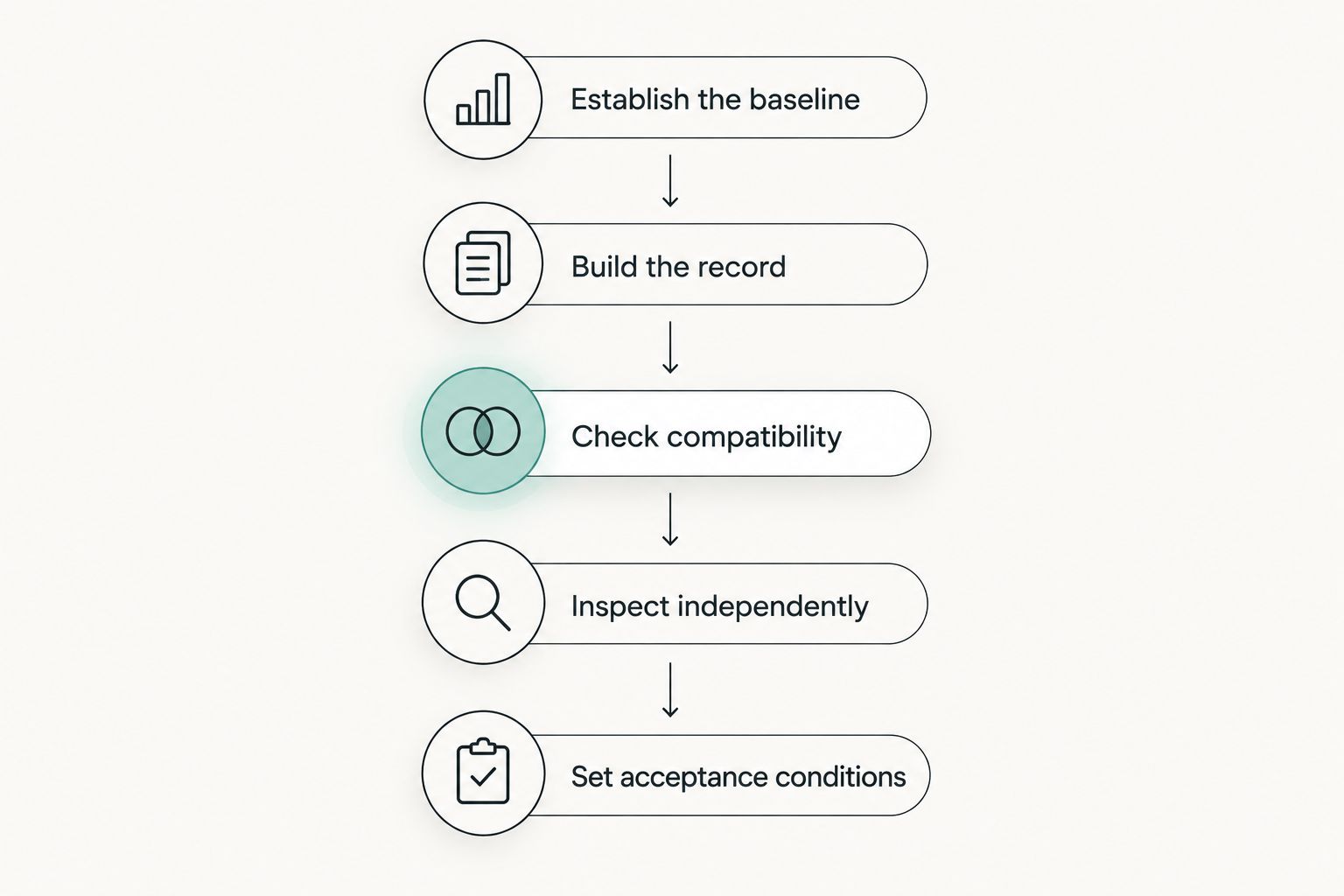
Use this sequence before making an unconditional commitment.
1. Establish the baseline
Obtain the vehicle identification number and supporting factory specification records. Compare those records with the car in front of you. Separate factory equipment from parts fitted later, including accessories that resemble factory options.
Ask the seller to distinguish cosmetic changes, mechanical changes, software changes, and replacement parts installed during repairs. A replacement component is not necessarily a performance modification, but its installation history still matters.
Write down what you cannot verify. An unresolved specification question should remain unresolved in your assessment, rather than becoming an assumption that favors the sale.
2. Build the record
Request an itemized modification list with part identifiers, installation invoices, installer details, and subsequent service records. For software changes, ask who supplied the calibration, what hardware it requires, and whether the original calibration is documented.
Connect each record to this specific vehicle. A parts receipt establishes a purchase; it does not establish correct installation. Likewise, a photograph of a component does not establish its internal condition or compatibility.
For a 2026 review, request the current configuration as well as historical invoices. Parts and calibrations can change after the paperwork was issued. Ask the seller to explain any mismatch before arranging inspection.
3. Check compatibility
Assess modifications as a system. An engine calibration, exhaust change, altered cooling arrangement, or drivetrain modification should not be evaluated in isolation from the components it affects.
Ask the inspecting specialist to identify required supporting hardware and check whether it is present. Review wheel and tire fitment, suspension travel, brake clearance, and any settings associated with adjustable components.
For bodywork, ask how parts are attached and whether installation changed the original panels. Reversibility depends on what was done to the car, not merely whether the replacement part can be removed.
4. Inspect independently
Choose a specialist familiar with the model and the types of changes installed. Give the specialist the modification list before the appointment and agree on the inspection scope in writing.
Request diagnostic checks, a physical inspection, and an assessment of installation quality. Ask what cannot be confirmed through that inspection. A scan alone cannot establish the condition of every mechanical component or validate every claim about a tune.
Use the pre-purchase supercar inspection guide to frame the broader review. Modification checks belong alongside checks of the underlying car, not instead of them.
5. Set acceptance conditions
Decide which findings you can accept, which require correction, and which end the purchase. Record those conditions before negotiations become a discussion about enthusiasm rather than evidence.
Confirm the proposed configuration with your insurer and check the applicable registration and emissions requirements. If a seller proposes restoring the car, specify the work, records, and verification required before acceptance.
Proceed on a verified configuration, not a promise to resolve it later. For a 2026 transaction, keep the agreed specification and outstanding conditions together in the transaction records.
Why this matters
Modifications change the questions you need answered. You are assessing the original vehicle, the added components, the installation, and the way those elements work together. A familiar model name does not establish a familiar specification.
Buyers need evidence of condition and suitability. Sellers need a clear account of what they are offering. A well-organized record gives both sides something concrete to discuss without exposing private client identities or unrelated transaction details.
Felipe Cimino, CEO and co-founder of SV Sourcing, has identified buyers skipping a pre-purchase inspection as a firsthand concern. That observation supports a clear decision rule: private access does not replace independent due diligence.
Factory specification or modified: what are you accepting?
Neither a factory-specification car nor a modified car earns approval from its description alone. Use the configuration to set your inspection priorities.
| Configuration | Best for | Useful feature | Limitation | Acceptance check |
|---|---|---|---|---|
| Verified factory specification | Buyers prioritizing the original configuration | A defined baseline for assessing departures and repairs | Original specification does not prove condition or maintenance quality | Confirm records and inspect the car |
| Documented modifications | Buyers seeking those particular changes | Records explain parts, installation, and intended configuration | Documentation does not prove present condition or correct integration | Match records to hardware and obtain specialist findings |
| Undocumented modifications | Buyers prepared to investigate before deciding | Physical inspection can help identify visible changes | Software, installation history, and supporting work can remain unresolved | Establish the configuration before committing |
Choose the configuration you understand and want to own. Do not accept modifications solely because someone else paid to install them. Their usefulness depends on your intended use and the evidence supporting this particular car.
Why modification risk varies
The badge on the car does not settle the risk. These factors determine the scope of the investigation:
- Extent of change. A removable trim piece raises different questions from changes to engine management, suspension geometry, or structural components.
- Quality of evidence. Detailed invoices and identifiable parts provide a stronger starting point than an unsupported description.
- System compatibility. Supporting components and calibration must be assessed together, rather than approved separately.
- Present condition. The installation history does not establish how the components perform or fit today.
- Reversibility. Retained original parts help, but cuts, wiring alterations, and missing records complicate restoration.
- Intended use. Your road use, inspection obligations, insurance requirements, and willingness to maintain the configuration shape acceptance.
Ask the specialist to connect findings to these factors. A useful report explains what was observed, what it means, and what further verification is required. A list of aftermarket parts alone does not answer those questions.
Which modification details deserve closer inspection?
Engine software and exhaust changes
Ask for the calibration provider, installation record, required fuel specification, and supporting hardware. Request a diagnostic assessment and an explanation of any fault codes or monitor status relevant to the inspection.
A performance chart is supporting material, not a substitute for mechanical inspection. Ask what vehicle and configuration it represents. Do not assume an exhaust or software package is legal for your intended road use because it is already installed.
Suspension, wheels, and brakes
Ask the specialist to assess fitment, clearances, mounting, wear, and evidence of contact. Where components are adjustable, request the current settings and any relevant alignment records.
Judge the car against your intended use. A configuration selected for circuit driving needs a separate assessment before you accept it for road driving. Appearance alone cannot establish suitable travel, clearance, or tire fitment.
Bodywork and interior changes
Inspect attachment points, panel condition, wiring changes, and the operation of affected equipment. Ask whether installation involved drilling, cutting, bonding, or removal of original components.
Distinguish a removable cosmetic addition from an alteration to the underlying car. If originality matters to you, inspect the retained factory parts as carefully as the fitted replacements. Missing brackets or damaged removed parts affect the restoration plan.
What should a seller prepare before a private introduction?
Prepare a factual modification schedule before discussing the car with a prospective buyer. Include installed parts, available invoices, known software changes, original components retained, and questions that still need specialist confirmation.
For a 2026 sale, make that schedule describe the car as it stands today. Historical photographs can support the record, but they should not replace current documentation. Separate your personal impressions from claims that an inspector can verify.
Make records available through a controlled process. Redact unrelated personal information without removing the vehicle details, dates, or installation information needed for due diligence. Do not disclose previous client identities or private deal details to strengthen a description.
SV Sourcing provides discreet introductions to serious buyers and deal coordination. Its private supercar sourcing and sales coordination service does not make undocumented changes self-verifying. A seller still needs an accurate account of the car and a clear response to inspection findings.
Disclose changes before the buyer invests in inspection and negotiation. Late disclosure creates another issue to resolve when the transaction should be narrowing toward acceptance.
Should I reject a modified supercar automatically?
Do not reject a modified supercar solely because it has modifications. Assess whether you want the configuration and whether the records and inspection support accepting it. Reject unresolved changes when they prevent you from establishing condition, compatibility, or suitability for your intended use.
Does keeping the original parts make modifications reversible?
Keeping original parts does not prove that modifications are reversible. Have a specialist assess installation changes, the condition and completeness of the removed parts, and any software restoration requirements. Specify the proposed restored configuration before agreeing to accept it.
Can an inspection verify a modified car completely?
An inspection does not verify every aspect of a modified car completely. Its findings depend on the agreed scope, access, equipment, records, and the specialist's familiarity with the configuration. Ask the report to identify limitations rather than treating an inspection as a guarantee.
FAQ
What should I ask first about a modified supercar for sale?
Ask for the current modification list and the records supporting each change. Establish the factory specification so you can distinguish original equipment, repairs, and later alterations.
Is a factory-specification supercar better than a modified one?
A factory-specification supercar is the clearer fit when you prioritize the original configuration. A modified car needs separate checks of its parts, installation, compatibility, and suitability; neither description establishes condition.
Can I rely on the seller's inspection report?
Use the seller's inspection report as supporting evidence, not as a replacement for an independently agreed inspection. Check its date, scope, vehicle details, and whether it assessed the current modifications.
How do I evaluate an engine tune before buying?
Request the calibration provider, installation records, required supporting hardware, and fuel requirements. Have a model-familiar specialist assess the configuration and explain what diagnostics can and cannot verify.
Will my insurer accept a modified supercar?
Acceptance depends on the insurer and the specific configuration. Disclose the modifications accurately and obtain confirmation for the proposed coverage before committing to the purchase.
Should I remove modifications before selling privately?
Decide on removal only after assessing the work required and the configuration you intend to offer. Document any restoration and verify the resulting car rather than describing it as factory specification without evidence.
How should a private broker handle modification questions?
A private broker should coordinate the exchange of records, inspection access, and responses to outstanding questions. Technical conclusions belong with the qualified specialist assessing the car, and unresolved findings should remain explicit.
One last thing
Treat a promise to return the car to stock as a proposed job, not a completed fact. Ask what will be changed, who will perform the work, and how the resulting configuration will be verified. The presence of original parts in storage does not answer those questions.
Before signing in 2026, read the agreed specification again. Make sure it describes the car you will receive, including any work required before acceptance. That final check applies equally to a buyer seeking a particular configuration and an owner presenting a car privately.