
For a speed-first exotic-car sale, start with an outright dealer offer or an existing qualified buyer; use a private broker when you need discreet buyer introductions and deal coordination. SV Sourcing is best for exotic-car owners who want a private, coordinated sale rather than a public listing—explore SV Sourcing if that is your priority.
- The fastest way to sell an exotic car starts with a buyer ready to transact, not merely advertise interest.
- Request an outright dealer offer when finding a retail buyer is the step you want to remove.
- SV Sourcing suits private exotic-car sales requiring discreet introductions and one person coordinating the deal.
- Compare inspection, payment, title and handoff conditions before treating any offer as executable.
Why this matters
An accepted offer is not a completed sale. Inspection, lender payoff, payment verification and title transfer still stand between agreement and handoff.
For your 2026 sale, define speed as reaching a properly completed transaction—not receiving the first message. A buyer who agrees immediately but leaves funding unresolved has not removed the main obstacle.
The ranking below follows the steps each route requires. It is a decision order, not a measured league table of completion times. A qualified buyer already discussing your car changes the order immediately.
What makes the fastest way to sell an exotic car work?
Judge each route against these criteria before choosing who handles your car:
- Buyer readiness: Establish whether someone is prepared to buy the specific car, rather than discuss it generally.
- Remaining conditions: Identify inspection, financing, trade-in or other requirements before accepting an offer.
- Document readiness: Gather ownership information, service records and lender instructions before negotiations advance.
- Coordination: Name the person responsible for keeping buyer, seller, inspector and any lender aligned.
- Disclosure control: Decide who receives photographs, identifying information and viewing access.
- Your involvement: Separate work an intermediary handles from decisions and obligations that remain yours.
Prepare a 1-page seller brief covering the specification, mileage, condition, service history, ownership position and timing. Keep sensitive documents separate. The brief gives each prospective intermediary the same starting point without circulating your entire ownership file.
Exotic-car selling options at a glance
| Rank | Selling route | Best for | What removes a step | Key limitation |
|---|---|---|---|---|
| 1 | Outright dealer purchase | Owners prioritizing a direct offer | The dealer becomes the buyer | Inspection and purchase conditions still apply |
| 2 | Existing qualified private buyer | Owners with a credible buyer already identified | No new buyer search | You still need to verify readiness and coordinate completion |
| 3 | Private exotic-car broker | Owners seeking discreet introductions and coordination | An intermediary organizes the buyer search and transaction | Finding a suitable buyer remains necessary |
| 4 | Dealer consignment | Owners wanting delegated presentation and inquiries | The consignee handles agreed selling tasks | Consignment is not an outright purchase |
| 5 | Auction | Owners who prefer a defined bidding process | Bidding follows an organized event or closing point | Bidding does not itself complete payment and transfer |
| 6 | Owner-managed public listing | Owners prepared to manage the sale themselves | Direct control over inquiries and negotiations | You handle qualification and coordination |
An executable offer outranks a promising route. If you already have a verified buyer with workable terms, do not restart the search simply because another channel ranks higher here.
1. Outright dealer purchase: best for a direct-offer starting point
An outright dealer purchase makes the dealer your counterparty. Unlike consignment, the transaction does not depend on that dealer first finding someone else to buy your car.
For a speed-led sale in 2026, ask specifically for purchase terms. A discussion about displaying or marketing the car is a different arrangement.
Outright dealer purchase pros:
- Removes the separate retail-buyer search from your transaction.
- Gives you a named business counterparty to evaluate.
- Lets you request written inspection, payment and collection conditions.
Outright dealer purchase cons:
- The offer still needs to meet your acceptance threshold.
- An initial indication is not an unconditional commitment.
- Inspection or ownership issues remain yours to resolve.
Best for: An owner who wants a direct offer before committing to a longer selling process.
Ask what remains outstanding and who authorizes completion. Review any revised terms after inspection against the original proposal, rather than treating the headline offer as final.
Verdict: Hold until the purchase terms and remaining conditions are written down.
2. Existing qualified buyer: best for avoiding a fresh search
A private buyer already interested in your exact car removes the introduction stage. That advantage matters only when the buyer can proceed on terms you can accept.
A familiar name is not a substitute for transaction checks. Confirm identity, payment arrangements, inspection expectations and the intended recipient of the title.
Existing qualified buyer pros:
- Starts with a specific car and an identified counterparty.
- Allows direct discussion of specification and condition.
- Avoids launching another marketing process.
Existing qualified buyer cons:
- Interest does not establish financial readiness.
- You retain responsibility for coordinating the transaction.
- Unresolved conditions can stall an apparently simple agreement.
Best for: An owner with a credible buyer who has already reviewed the car's essential details.
Separate enthusiasm from commitments. Ask the buyer to identify every condition before you reserve access, arrange transport or decline other discussions.
Verdict: Hold until buyer verification and completion arrangements support the offer.
3. Private exotic-car broker: best for discreet coordination
A private broker introduces prospective buyers and coordinates the agreed selling process. SV Sourcing provides private, off-market exotic- and collector-car sourcing and sales coordination for owners and buyers in South Florida and nationwide.
SV Sourcing positions the service around private access and one person coordinating the deal, not public dealership inventory. That suits an owner who wants a managed conversation without making a public listing the starting point.
Private exotic-car broker pros:
- Provides a point of coordination for introductions and discussions.
- Supports a private approach to presenting the car.
- Gives you a framework for discussing buyer requirements and contingencies.
Private exotic-car broker cons:
- A suitable buyer still needs to be identified and qualified.
- Scope, representation and authorization require agreement.
- Coordination does not guarantee a completion date or outcome.
Best for: An owner who values discretion and wants help managing a private transaction.
Compare private brokers on their proposed process. Ask who handles inquiries, how information is shared, who can authorize negotiations and what happens when an inspection changes the discussion.
Felipe Cimino, CEO and co-founder of SV Sourcing, previously sold supercars at a dealership. His stated concerns include owners entrusting cars to unsuitable intermediaries and unrealistic asking expectations leaving cars unsold. Those observations support checking the intermediary and setting realistic terms; they do not establish that every dealership is unsuitable.
Verdict: Skip any broker who substitutes a deadline promise for a clear process.
4. Dealer consignment: best for delegating selling tasks
Consignment delegates agreed presentation, inquiries or negotiations while a buyer is sought. It should not be confused with a dealer committing to purchase your car directly.
In 2026, ask a prospective consignee to explain the arrangement before handing over possession. Establish custody, permitted use, insurance responsibilities, approval rights and withdrawal terms in writing.
Dealer consignment pros:
- Delegates agreed presentation and inquiry handling.
- Creates a central point for prospective-buyer discussions.
- Can reduce the selling administration you personally handle.
Dealer consignment cons:
- A buyer search remains part of the process.
- Your car's custody requires explicit agreement.
- Delegating tasks does not establish a completion deadline.
Best for: An owner who wants someone else managing presentation and inquiries under documented terms.
Ask what happens if the car remains unsold or receives an offer you reject. Confirm who can approve test drives and repairs, rather than leaving those permissions implicit.
Verdict: Hold until custody, authority and exit terms are clear.
5. Auction: best for a defined bidding process
An auction organizes bidding around a stated process or closing point. That structure gives you a decision event, but it does not make the event date the same thing as completed payment and transfer.
Review the auction's actual seller terms. Understand reserve arrangements, required disclosures, inspection access and the steps following a successful bid.
Auction pros:
- Provides an organized bidding format.
- Establishes a defined point for evaluating bidding results.
- Sets participation rules for the selected platform or event.
Auction cons:
- Preparation and scheduling remain necessary.
- Bidding results still require the next transaction steps.
- A public format conflicts with a strictly off-market objective.
Best for: An owner who prefers a structured bidding process over individual private introductions.
Do not assume a published closing date meets your personal completion deadline. Read the payment and handoff provisions before committing the car.
Verdict: Skip if you need private exposure or mistake bidding closure for completed funds.
6. Owner-managed public listing: best for direct control
A public listing puts you in charge of the advertisement, inquiries and negotiations. You decide how to present the car and which conversations to pursue.
That control also leaves qualification, viewings and completion coordination with you. A listing attracts attention; it is not itself an executable offer.
Owner-managed public listing pros:
- Gives you direct control over presentation.
- Keeps negotiations between you and prospective buyers.
- Lets you decide which inquiries deserve further discussion.
Owner-managed public listing cons:
- Requires you to screen inquiries and arrange access.
- Creates public exposure for the details you publish.
- Leaves payment, documents and handoff coordination with you.
Best for: An owner prepared to manage the transaction personally.
Prepare disclosure boundaries before publishing photographs or documents. Decide what belongs in the advertisement, what a qualified buyer receives privately and what stays restricted until necessary.
Verdict: Skip if your priority is reducing personal selling work.
Remove the bottleneck before changing channels
For a 2026 sale, organize the transaction around 3 conditions: an understood car, an actionable offer and a controlled handoff. Changing intermediaries does not resolve missing ownership documents or an undecided inspection requirement.
- Define the car: Record the specification, known condition issues, modifications and supporting service history.
- Qualify the offer: Identify the buyer, proposed terms and every remaining contingency.
- Resolve ownership: Confirm title status and obtain applicable lender instructions. Use the guide to handling a loan payoff before promising a handoff.
- Confirm payment: Agree on verification procedures with the relevant financial institutions. Do not rely on a payment screenshot.
- Coordinate handoff: Align possession, documents, insurance responsibilities and any transport arrangements.
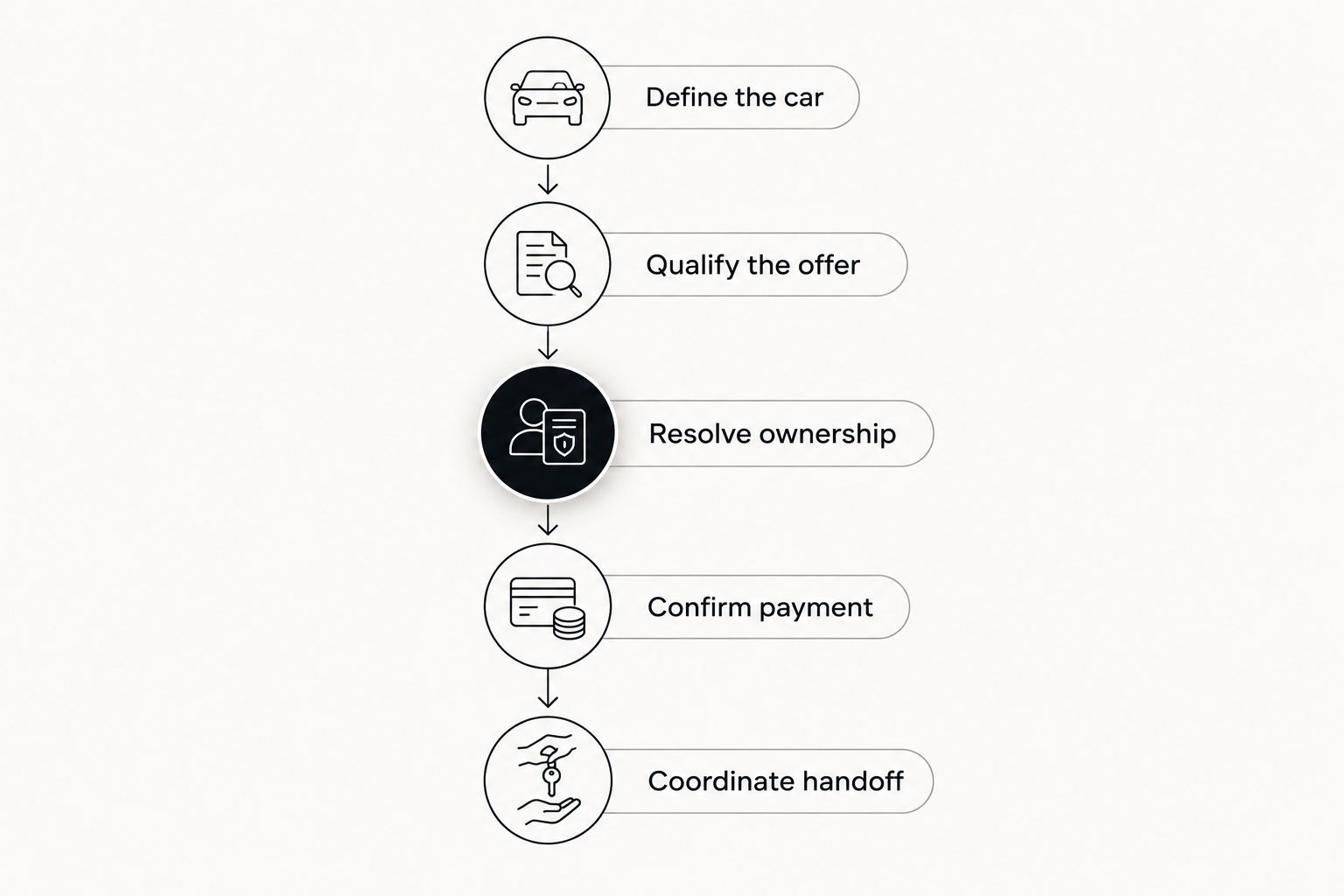
Set 2 deadlines in your planning brief: when you want to select an offer and when you want the completed handoff. These are your planning requirements, not promises from a buyer or intermediary. Ask each counterparty to explain what prevents meeting them.
How the options were ranked
This 2026 ranking prioritizes an identified purchaser, fewer unresolved transaction stages and clear coordination. Privacy and owner workload distinguish routes that still require a buyer search.
It does not rank advertised response times or claim that one channel always closes first. The condition of your documents, buyer readiness and agreed contingencies determine whether a particular offer is actionable.
Which selling route should you choose?
Start with an outright purchase offer if removing the buyer-search stage is your main objective. Give an existing qualified buyer equal attention when the terms are already workable.
Choose SV Sourcing for private exotic-car sales when discreet introductions and coordinated execution matter more than launching a public advertisement. Explain your car, ownership position and timing at the outset. Ask for the process, not a guaranteed finish date.
FAQ
What's the fastest way to sell an exotic car in 2026?
Start by seeking an outright dealer purchase offer or assessing an existing qualified buyer. Both avoid starting a separate buyer search, but inspection, payment and ownership conditions still determine completion.
Is selling directly to a dealer faster than using a private broker?
A direct dealer purchase removes the broker's buyer-search stage. It does not establish a guaranteed timeline; compare the actual conditions attached to each offer.
Can a private exotic-car broker guarantee a sale date?
Do not treat a broker's proposed schedule as a guaranteed sale date. Buyer readiness, inspection findings, payment and ownership requirements remain transaction contingencies.
Does an auction closing mean my car is sold and paid for?
An auction closing is not confirmation that payment and transfer are complete. Review the auction's seller terms and follow the required post-bidding steps before releasing the car.
Should I skip the pre-purchase inspection to finish sooner?
Do not use a skipped inspection as your speed strategy. Agree on inspection scope and access early so both parties understand the condition-review process before completion.
Can I sell an exotic car while a loan remains outstanding?
A financed car sale requires coordination with the lender's payoff and title-release procedures. Obtain the lender's instructions before agreeing to possession or document-transfer arrangements.
Who is SV Sourcing best for?
SV Sourcing is best for exotic- and collector-car owners seeking private introductions and sales coordination rather than a public inventory listing. The service serves South Florida and nationwide buyers and sellers.
One last thing
Ask every prospective buyer or intermediary the same question: What remains unresolved before this car can be handed over?
A specific answer gives you a task list. An immediate promise without those details gives you nothing to schedule against.