
The best way to buy an exotic car for first-time collectors in 2026 is to choose the buying channel around the help you need: a private broker for coordinated sourcing, a dealership for evaluating a specific car, a direct owner purchase for direct discussion, or an auction for a defined bidding opportunity. SV Sourcing suits first-time exotic-car buyers who want private sourcing and one person coordinating the deal.
- The best way to buy an exotic car for first-time collectors depends on inspection access, representation, and transaction control.
- SV Sourcing offers private off-market sourcing and sales coordination, not a public-inventory shopping experience.
- Choose a dealership to evaluate a specific car; choose a private broker when you need a coordinated search.
- Keep independent inspection, ownership records, and written contingencies separate from enthusiasm for the car.
Why the buying channel matters
Your first exotic-car purchase involves more than finding the right specification. Someone must establish who owns the car, arrange access, review its history, resolve inspection findings, and coordinate the transfer.
The buying channel changes who handles that work. It does not remove your responsibility to understand the agreement or approve the purchase. A private introduction is not proof of condition; a public advertisement is not proof of ownership.
For sellers, the same distinction matters. A discreet introduction should lead to a qualified conversation about the car, not unrestricted circulation of personal information or private documents.
What makes a buying option fit a first-time collector?
Use these criteria to assess your 2026 search before choosing a broker, seller, or auction:
- Search fit: Does the channel help find your specification, or only sell a car already identified?
- Representation: Who does the intermediary represent, and who authorizes decisions?
- Evidence access: Can you review records and arrange an independent inspection before committing?
- Decision control: Which commitments become binding, and what contingencies protect your review?
- Deal coordination: Who tracks documents, payment instructions, transport arrangements, and handoff?
- Privacy: Who receives your identity, ownership information, and transaction documents?
No channel wins every category. The useful choice is the one that covers the work you cannot confidently manage yourself.
Exotic-car buying options at a glance
| Buying option | Best for | Standout function | Key limitation |
|---|---|---|---|
| Private sourcing broker | Buyers needing a coordinated search | Connects the search brief with private introductions and deal coordination | Scope and representation require a clear agreement |
| Specialist dealership | Buyers assessing a particular advertised car | Provides a seller-side point of contact for that vehicle | The dealership's stock is not the whole market |
| Direct private-owner purchase | Buyers ready to manage the transaction | Gives direct access to the owner's account of the car | You must organize independent checks and closing |
| Collector-car auction | Buyers with a settled target and bidding discipline | Provides a defined bidding process | Inspection access and withdrawal rights depend on the terms |
1. Private sourcing broker: for a coordinated first purchase
A private sourcing broker starts with what you want rather than an advertised car. SV Sourcing provides private, off-market sourcing and sales coordination for exotic and collector cars in South Florida and nationwide.
This route fits a buyer who wants a clear search brief and one person coordinating the deal. It also fits owners who want discreet introductions to serious buyers rather than a public listing.
Private sourcing broker pros:
- You can define the specification before considering individual cars.
- Private introductions provide an alternative to public listings.
- A coordinator can keep the transaction's open questions together.
- Buyer and seller discussions can begin with defined requirements.
Private sourcing broker cons:
- A private network does not establish a car's condition or history.
- An introduction does not guarantee a matching car or completed deal.
- You still need to understand representation, authority, and compensation arrangements.
Ask who the broker represents before sharing sensitive documents or authorizing negotiations. Then establish who arranges the inspection, who receives its findings, and which decisions remain yours.
SV Sourcing's co-founders, Felipe Cimino and Alejandro S., are both involved in private sourcing, sales, and deal coordination. Felipe previously sold supercars at a dealership. That background does not replace independent due diligence on the particular car.
Best for: First-time collectors seeking private access and a coordinated process rather than a public-inventory search.
Verdict: Buy through a private broker when the written scope matches the help you need.
2. Specialist dealership: for evaluating a specific car
A dealership route makes sense when you have already identified a car that fits your brief. You can direct questions about that vehicle to its seller and assess the proposed purchase terms together.
Treat the dealership as a transaction counterparty, not an independent adviser representing you. Ask whether the dealership owns the car or is selling it on someone else's behalf.
Specialist dealership pros:
- Your inquiry starts with an identified vehicle.
- You have a seller-side contact for records and access requests.
- You can assess the car and proposed agreement together.
Specialist dealership cons:
- A suitable car outside that dealership remains outside your immediate search.
- Sales materials do not replace an independent condition assessment.
- Any warranty, inspection provision, or return right needs written confirmation.
Keep the specification brief visible while reviewing the car. An appealing presentation should not quietly turn an essential requirement into an optional preference.
If inspection access is restricted, understand the restriction before proceeding. Do not assume dealership status answers questions about repairs, modifications, title, or service history.
Best for: Buyers who have found a particular car and want to evaluate it through its selling dealership.
Verdict: Buy when the car, evidence, and written terms stand on their own.
3. Direct private-owner purchase: for hands-on buyers
Buying directly from an owner lets you ask about the car's use, maintenance, and storage without routing every question through an intermediary. The owner's answers are a starting point for verification.
This option puts more coordination on you. You must organize inspection access, reconcile documents, understand any lien, and agree how payment and possession will change hands.
Direct private-owner purchase pros:
- You can discuss the car directly with its owner.
- You can ask follow-up questions about specific records or changes.
- Buyer and seller can agree the inspection process directly.
Direct private-owner purchase cons:
- Personal rapport is not evidence of ownership or mechanical condition.
- You must manage the transaction or appoint suitable help.
- Incomplete records can leave important questions unresolved.
A seller should also verify whom they are dealing with before sharing sensitive information or arranging access. Privacy applies to both sides; it is not a reason to avoid legitimate verification.
Felipe has identified owners entrusting cars to unsuitable intermediaries as a firsthand concern. For a direct purchase, the practical lesson is to identify every participant and their authority before documents or funds move.
Best for: Buyers prepared to organize independent checks and manage the purchase themselves.
Verdict: Buy directly only when you can manage the work, not merely the conversation.
4. Collector-car auction: for a settled target
An auction provides a defined process for bidding on a particular car. Read the actual terms before participating; auction formats, inspection arrangements, and contractual obligations differ.
For a first-time collector in 2026, an auction is a fit only after the search brief is settled. Bidding should follow your assessment of the car, not become the method for deciding whether you want it.
Collector-car auction pros:
- You can focus your review on a specific vehicle.
- The published terms establish how bidding works.
- A defined bidding event gives your preparation a clear deadline.
Collector-car auction cons:
- Your opportunity to inspect depends on the sale's arrangements.
- A successful bid can create obligations before further investigation.
- The bidding deadline does not resolve unanswered condition questions.
Before bidding, identify the documents you have reviewed and the questions still open. Understand what happens if the car differs from your expectations and which contractual remedies, if any, apply.
Best for: Buyers who know the target specification, have completed their review, and understand the bidding obligations.
Verdict: Wait if the auction deadline arrives before your due diligence is complete.
How these options are ranked
The order prioritizes search support, independent evidence, and transaction coordination for a first-time collector. It is not a ranking of individual businesses or a claim that one channel produces better cars.
Private sourcing comes first for buyers who need help defining and conducting the search. A dealership follows when the car is already identified; direct purchases and auctions require more buyer-led preparation. Your experience and the particular agreement can change that order.
Build the purchase around decision gates
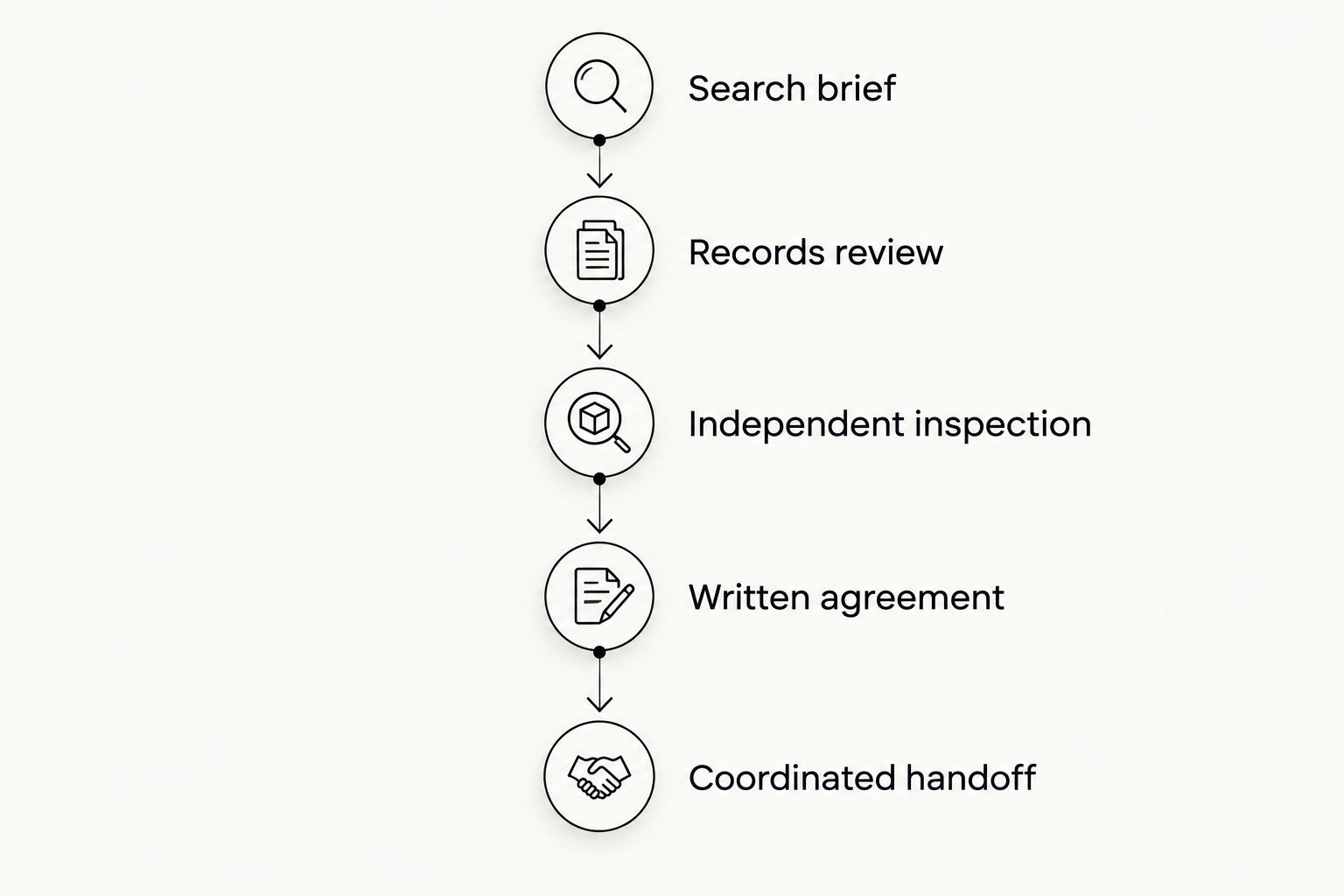
Use this sequence for a 2026 purchase regardless of where the car appears. Each stage should answer a question before you authorize the next commitment.
Search brief
Write down the intended use, essential specification, acceptable alternatives, budget boundaries, and timing. Separate requirements from preferences so an attractive car does not rewrite the brief during negotiations.
Tell the coordinator whether you are replacing a car, starting a collection, or adding a particular configuration. Sellers benefit too: a defined brief helps establish whether an introduction is relevant before private details circulate.
Records review
Request the ownership and service documents needed to assess the particular car. Compare the vehicle identity across the documents and investigate inconsistencies rather than explaining them away.
Ask about modifications, accident history, deferred work, and missing records. Treat unsupported answers as unresolved questions, not established facts.
Independent inspection
Arrange an inspection by an appropriate independent specialist before the commitment becomes unconditional. Agree its scope and access with the seller in advance.
Use the findings to decide whether to proceed, investigate further, or stop. The guide to what a pre-purchase supercar inspection should cover helps frame that discussion.
Written agreement
Record the vehicle, parties, agreed conditions, required documents, and responsibilities. Where a broker is involved, distinguish the brokerage agreement from the vehicle purchase agreement.
Do not assume a conversation about an inspection creates a contractual right to withdraw. Have the relevant terms reviewed before signing when you need legal advice.
Coordinated handoff
Establish the order of payment verification, lien resolution where applicable, document transfer, transport, and possession. Confirm any changed payment instructions through an independently established contact method.
Keep an open-items list. A car ready for transport is not necessarily a transaction ready to close.
What first-time collectors should not delegate blindly
A coordinator can organize the process. You still approve the specification, accept or reject findings, and decide whether the agreement reflects your intentions.
Felipe's stated concerns include buyers skipping a pre-purchase inspection and purchasing internationally. Those are his observations, not a claim that every overseas purchase is unsafe. An international transaction needs its own review of import eligibility, documentation, transport, and applicable requirements.
He also identifies unrealistic asking prices leaving cars unsold. Buyers should not treat an asking figure as proof of value; sellers should separate their preferred outcome from the evidence supporting the car's position.
Which buying option should you choose?
Choose private sourcing when you want help finding the car and coordinating the transaction. Choose a dealership when the identified vehicle is the reason for the conversation. Buy directly only when you can manage the work; use an auction only after reviewing the car and the obligations.
For a first-time collector planning a 2026 purchase, SV Sourcing is the relevant starting point when private access and deal coordination are the requirements. Bring a clear specification, budget boundaries, timing, and unresolved questions. The conversation should establish fit, not presume a transaction.
FAQ
What's the best way to buy an exotic car for first-time collectors?
Choose the channel that matches the help you need. A private sourcing broker fits a coordinated search; a dealership fits an identified car; direct purchases and auctions require more buyer-led preparation.
Is an off-market exotic car better than a publicly listed car?
Off-market status does not establish better condition, history, or suitability. Assess the individual car through records, independent inspection, and written purchase terms.
Should I use a private broker for my first exotic car?
Use a private broker when you need help defining the search, obtaining private introductions, and coordinating the deal. Confirm representation, scope, and decision authority before proceeding.
Do I still need an inspection when buying from a dealership?
Arrange an independent pre-purchase inspection rather than treating dealership status as evidence of condition. Agree access and any inspection-related contractual conditions before committing.
Can a seller keep an exotic-car sale private?
A seller can pursue private introductions rather than a public listing. Privacy still requires appropriate verification of the buyer and controlled sharing of documents.
What should I prepare before contacting SV Sourcing?
Prepare the target specification, intended use, budget boundaries, timing, and acceptable alternatives. SV Sourcing provides private off-market sourcing and sales coordination for exotic and collector cars in South Florida and nationwide.
One last thing
Before requesting introductions, write down what would make you walk away. Include unresolved ownership questions, inadequate inspection access, or terms you do not understand. A clear stopping rule belongs in the search brief, not in a hurried discussion before signing.