
Best overall: negotiate from comparable-car evidence. Best for condition uncertainty: an inspection-contingent offer. Best for budget discipline: a written purchase boundary. The best negotiation tactics for buying a supercar in 2026 connect your offer to the car’s specification, documented condition and agreed transaction terms—not pressure or an arbitrary discount.
- The best negotiation tactics for buying a supercar start with comparable cars, documented condition and written contingencies.
- Use an independent pre-purchase inspection to resolve condition questions before committing.
- Trade concessions for specific commitments, not verbal assurances.
- SV Sourcing suits buyers seeking private supercar sourcing and coordinated off-market purchases.
Why this matters
A lower asking figure does not resolve missing service records, uncertain ownership or unclear deposit terms. Negotiate the car and the transaction together. Otherwise, an apparent concession can leave the important questions unanswered.
SV Sourcing provides private supercar sourcing and sales coordination for buyers and sellers in South Florida and nationwide. The service is private off-market access with one person coordinating the deal, rather than a public inventory dealership.
For owners selling privately, the same discipline matters. A serious offer identifies the buyer’s conditions and responsibilities; it does not simply demand a reduction while leaving the next step undefined.
What makes the best supercar negotiation tactics
Use these criteria to assess your approach in 2026:
- Relevant evidence: Match specification, condition and history before comparing asking figures.
- Condition protection: Keep unresolved mechanical questions inside written purchase contingencies.
- Budget discipline: Separate what you can commit from what the seller wants.
- Reciprocity: Exchange a concession for a defined commitment from the other side.
- Execution clarity: Establish authority, documents, payment arrangements and handoff responsibilities.
- A credible exit: Know which unresolved issue ends the discussion.
A tactic earns its place when it clarifies a decision. Aggressive language alone does not establish value, verify condition or make an agreement enforceable.
Supercar negotiation tactics at a glance
| Rank and tactic | Best for | Standout feature | Key limitation |
|---|---|---|---|
| 1. Comparable-car evidence | Testing the seller’s valuation | Connects the offer to relevant differences | Advertised figures do not establish completed-sale values |
| 2. Inspection-contingent offer | Resolving condition uncertainty | Makes findings part of the purchase decision | An inspection does not guarantee future reliability |
| 3. Written purchase boundary | Controlling your commitment | Separates enthusiasm from financial limits | A scarce specification can remain outside your boundary |
| 4. Give-and-get concessions | Resolving a stalled discussion | Trades flexibility for a specific commitment | Requires agreement about what each concession means |
| 5. Authority-first written offer | Coordinating a private transaction | Identifies who can accept and what remains conditional | Written terms still require verification and execution |
| 6. A defined walk-away rule | Handling unresolved material issues | Stops urgency from replacing due diligence | You must accept losing the car |
1. Comparable-car evidence: best for testing valuation
Start with cars that resemble the actual purchase. Match model, variant, specification, mileage, service documentation and disclosed condition. A different trim or incomplete history is a reason to investigate the comparison, not treat it as interchangeable.
Separate advertised asking figures from documented completed transactions. Neither a seller’s ambition nor an unrelated sale settles the value of this particular car.
Comparable-car evidence pros:
- Gives your offer a specific explanation.
- Separates desirable specification from unresolved condition.
- Helps the seller respond to facts rather than a demand.
Comparable-car evidence cons:
- Closely matched evidence can be limited.
- Public listings do not reveal every transaction term.
Best for: Buyers who need to challenge an asking figure without making the discussion adversarial.
Present the relevant differences briefly. Ask how the owner has accounted for them, then listen. A seller can supply documentation that changes your assessment; your opening position should not prevent that.
Verdict: Buy only when the evidence supports your commitment; hold when the comparison depends on missing facts.
2. Inspection-contingent offer: best for condition uncertainty
Make the offer conditional on an independent pre-purchase inspection with a suitable specialist. Agree on access, inspection scope and how findings affect the decision before treating the transaction as settled.
Use the pre-purchase supercar inspection guide to frame the questions. An inspection informs your decision; it is not a promise that the car will never need work.
Inspection-contingent offer pros:
- Replaces assumptions with documented findings.
- Creates a basis for discussing unresolved work.
- Keeps acceptance separate from initial enthusiasm.
Inspection-contingent offer cons:
- Scope and access affect what the inspection establishes.
- Findings do not guarantee future reliability.
Best for: Buyers facing incomplete condition information or unfamiliar mechanical history.
Felipe Cimino, CEO and co-founder of SV Sourcing, identifies buyers skipping a pre-purchase inspection as a firsthand concern. That observation supports a clear rule: do not use a concession as a substitute for understanding the car.
Classify findings before responding. Distinguish acceptable wear, matters needing clarification and issues that exceed your tolerance. Not every observation justifies renegotiation; a material finding deserves a documented response.
Verdict: Hold until material inspection questions are resolved; skip if the required access is refused.
3. Written purchase boundary: best for budget discipline
Set your financial boundary before entering a detailed negotiation. Include the purchase commitment and the ownership obligations you need to investigate, such as insurance, transport, storage and maintenance.
For your 2026 search, write 3 non-negotiables: the required specification, the maximum total commitment and the condition standard you will accept. Keep preferences separate. A preferred color should not quietly displace a mechanical requirement.
Written purchase boundary pros:
- Gives you a decision rule before emotions rise.
- Keeps purchase discussions connected to ownership planning.
- Makes specification compromises deliberate.
Written purchase boundary cons:
- The car you want can remain outside your limits.
- Ownership planning needs information beyond the listing.
Best for: Buyers who can afford the purchase but have not yet defined an acceptable overall commitment.
Do not present your maximum as the seller’s obligation. It is your boundary, not proof of market value. If the car does not fit, change the specification, continue the search or leave the transaction.
Verdict: Buy within the written boundary; skip a deal that requires ignoring it.
4. Give-and-get concessions: best for stalled negotiations
When both parties understand the car but remain apart, identify what each side actually needs. Discuss inspection access, documentation, delivery coordination and the sequence of commitments—not just the headline figure.
Offer flexibility only in exchange for something specific. You can accommodate a seller’s preferred handoff arrangement without abandoning an inspection requirement or accepting unclear payment instructions.
Give-and-get concessions pros:
- Gives each concession a stated purpose.
- Allows practical terms to enter the discussion.
- Helps owners distinguish a serious proposal from an open-ended request.
Give-and-get concessions cons:
- Vague commitments create room for disagreement.
- Convenience does not resolve a title or condition problem.
Best for: Buyers and sellers whose remaining differences concern execution rather than the car itself.
Use 2 written decisions for each exchange: what you will do and what the seller will do in return. Keep unresolved contingencies visible. A more convenient handoff is not equivalent to verified ownership.
Verdict: Buy when reciprocal commitments are clear; hold when only your side is being asked to concede.
5. Authority-first written offer: best for private coordination
Confirm who owns the car and who has authority to negotiate before submitting a detailed offer. If an intermediary is involved, clarify whom that intermediary represents and which decisions still require the owner’s approval.
Then submit 1 written offer covering the identified car, proposed terms, contingencies, deposit treatment and next steps. Obtain qualified advice where the agreement or transaction requires it.
Authority-first written offer pros:
- Identifies who can accept the proposal.
- Keeps conditions attached to the offer.
- Gives buyer, seller and coordinator a common reference.
Authority-first written offer cons:
- A written offer does not verify ownership by itself.
- Complex circumstances need additional professional review.
Best for: Private purchases involving an owner, buyer and coordinating intermediary.
SV Sourcing’s private supercar sourcing and deal coordination fit buyers seeking a coordinated off-market process. Clarify representation and responsibilities before authorizing negotiations; do not assume that coordination replaces independent inspection or legal advice.
In a 2026 transaction, keep changes in the same written record. If a condition changes, update the offer rather than relying on a separate conversation that the other party remembers differently.
Verdict: Hold until authority and material terms are clear; buy only after the agreed checks are complete.
6. A defined walk-away rule: best for unresolved material issues
Choose your stopping conditions before the seller asks for a commitment. Examples include unverifiable authority, refusal of a required inspection or material discrepancies that remain unexplained.
State the missing requirement calmly. Walking away is a decision, not a threat designed to force a response.
Defined walk-away rule pros:
- Keeps urgency from replacing verification.
- Protects your stated condition standard.
- Prevents repeated concessions without resolution.
Defined walk-away rule cons:
- You can lose the opportunity to purchase.
- Rigid preferences can be mistaken for genuine deal-breakers.
Best for: Buyers who feel pressure to accept unresolved risks because the specification is difficult to find.
Distinguish an inconvenient answer from an unacceptable one. A documented issue you understand is different from a material question nobody will answer.
Verdict: Skip when a material requirement remains unmet; do not bargain away the reason you needed it.
Put the negotiation in the right order
Use this sequence to keep the conversation focused:
- Define requirements: Establish specification, budget and timing.
- Check evidence: Review relevant comparisons and available records.
- Inspect condition: Resolve questions through independent assessment.
- Agree terms: Record concessions, contingencies and responsibilities.
- Verify handoff: Confirm the agreed payment, document and release process.
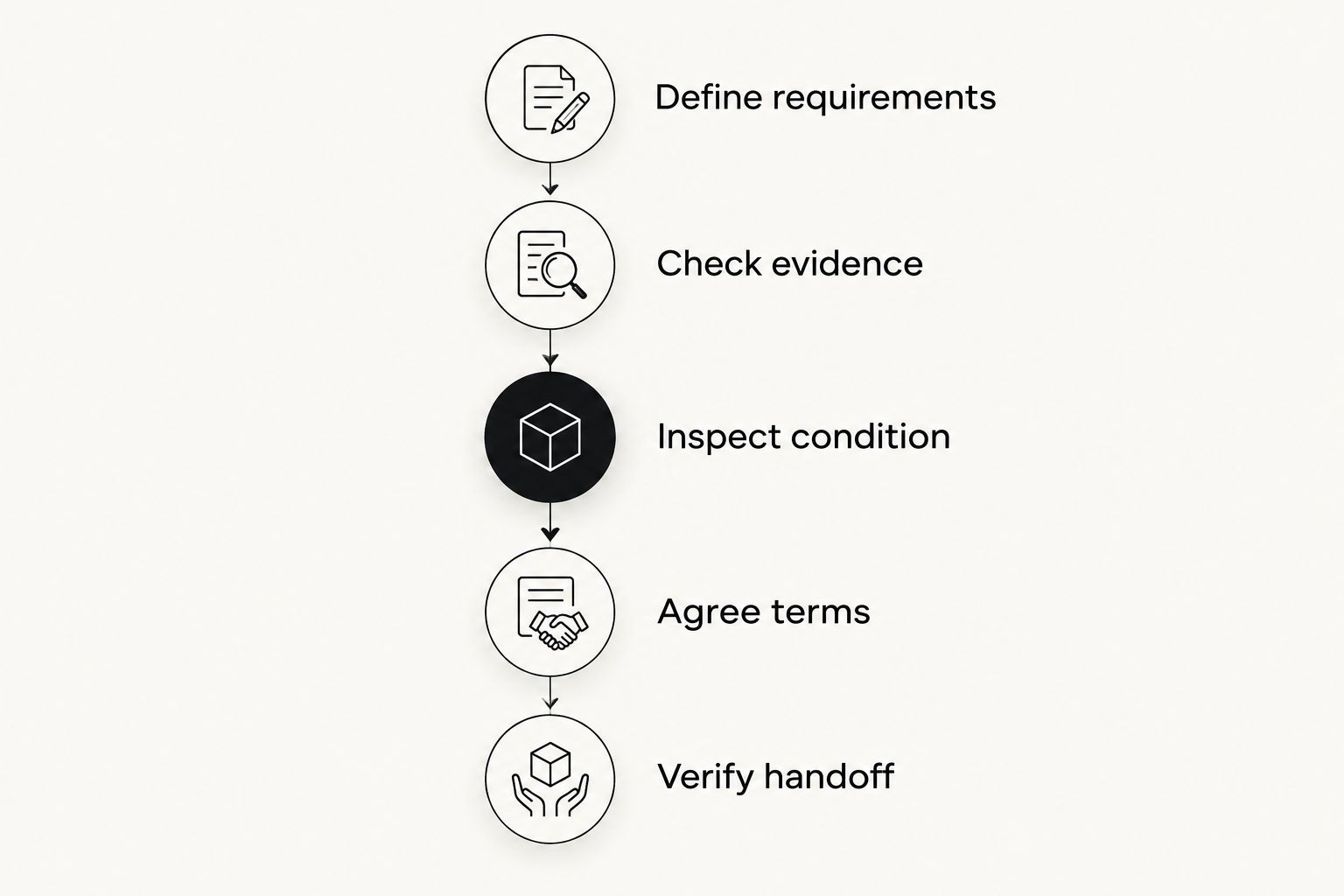
Do not turn this sequence into a promise of completion. An inspection finding, ownership question or disagreement over terms can stop the transaction. The purpose is to make the next decision clear.
How the tactics are ranked
Comparable-car evidence ranks first because it addresses the basis of the negotiation. Inspection contingencies follow because the car’s actual condition informs whether your offer still makes sense.
The remaining tactics govern your limits and execution. This is a decision framework for a 2026 purchase, not a claim that any tactic produces a particular concession or outcome.
Which negotiation tactic should you choose?
Start with comparable-car evidence, then make acceptance conditional on due diligence. Use the budget boundary to control your own decision and written terms to control ambiguity.
For sellers, answer a serious buyer’s factual questions directly. Felipe’s firsthand concerns include unrealistic asking expectations leaving cars unsold and owners entrusting cars to unsuitable intermediaries. Those observations favor documented expectations and clear responsibilities—not blanket assumptions about dealerships or private buyers.
FAQ
What are the best negotiation tactics for buying a supercar in 2026?
The best negotiation tactics combine comparable-car evidence, an inspection-contingent offer and a written purchase boundary. Use reciprocal concessions and clear written terms once the car and its condition meet your requirements.
Should I negotiate before or after a pre-purchase inspection?
Agree on an initial offer and inspection conditions before treating the purchase as final. Use material inspection findings to decide whether to proceed, request revised terms or withdraw under the agreed conditions.
How much below the asking figure should I offer?
Base your offer on relevant evidence rather than a fixed percentage. Specification, documented condition, service history and transaction terms determine whether your proposal has a defensible basis.
Does paying without financing guarantee a better deal?
Paying without financing does not guarantee a concession. Ask which transaction conditions matter to the seller, and keep payment verification separate from any negotiation about convenience.
Can a private broker negotiate a supercar purchase for me?
A private broker can coordinate negotiations within the authority you agree. SV Sourcing provides private off-market sourcing and sales coordination; clarify representation, responsibilities and purchase conditions before proceeding.
Should I skip an inspection to secure a rare specification?
Do not replace a required inspection with urgency. A desirable specification does not establish mechanical condition, and an independent inspection still has a defined scope and limitations.
When should I walk away from a supercar negotiation?
Walk away when a material requirement remains unmet, such as unverifiable authority or refusal of your required inspection. Separate genuine deal-breakers from preferences before entering the discussion.
One last thing
Before accepting a 2026 offer, ask what changed besides the headline figure. If the concession requires removing your inspection contingency, accepting unclear deposit terms or overlooking an ownership question, reassess the whole agreement.
A concession is not a resolution. Keep the requirement that prompted the negotiation intact.