
For owners who want discreet introductions and one person coordinating the transaction, the best way to sell a supercar privately is a broker-led, off-market sale. SV Sourcing fits that brief; a direct sale suits an owner with a known buyer, while owner-managed referrals suit sellers prepared to handle the deal themselves.
- SV Sourcing suits owners seeking private supercar sales with off-market introductions and one person coordinating the deal.
- The best way to sell a supercar privately depends on whether you already have a credible buyer.
- Direct sales give you control but leave buyer verification, inspection arrangements and payment coordination with you.
- Keep buyer qualification, inspection and verified payment separate from your decision to accept an offer.
Why this matters
A private sale is not simply a sale without an advertisement. You still need a credible buyer, an accurate description of the car and agreed conditions for completing the transaction. Discretion does not replace documentation.
For a 2026 sale, choose who will control introductions, information sharing and the handoff before discussing the car widely. Keep the audience narrow, not the evidence. A serious buyer still needs enough information to assess condition, ownership and the proposed transaction.
What makes a private selling route suitable?
Use these criteria before choosing a route. The right arrangement depends on what you want to retain control over and what you want someone else to coordinate.
- Buyer access: Does the route introduce prospective buyers, or does it depend on someone you already know?
- Information control: Who receives photographs, records and identifying details, and who can forward them?
- Responsibility: Who handles inquiries, inspection scheduling, negotiation and closing arrangements?
- Due diligence: Can the buyer inspect the car and review its history without pressure to skip checks?
- Release conditions: Who confirms payment, title requirements and permission to collect the car?
Private supercar selling routes at a glance
| Route | Suited to | Standout feature | Key limitation |
|---|---|---|---|
| SV Sourcing: broker-led sale | Owners seeking introductions and coordinated execution | Private off-market sourcing and sales coordination | You must agree the mandate, authority and communication boundaries |
| Direct sale to a known buyer | Owners with an identified prospective purchaser | Direct communication between buyer and seller | You remain responsible for verification and transaction arrangements |
| Owner-managed private referrals | Owners willing to find buyers through selected contacts | You control outreach and follow-up | Introductions do not establish buyer readiness or transaction competence |
These are different working arrangements, not promises about the eventual result. None removes the need to agree terms, establish ownership and confirm payment before releasing the vehicle.
1. SV Sourcing: for a broker-coordinated private sale
SV Sourcing provides private, off-market sourcing and sales coordination for exotic and collector cars in South Florida and nationwide. The arrangement suits an owner who wants discreet buyer introductions and one person coordinating the deal rather than managing a public listing.
Start by defining the assignment. Explain the specification, condition, ownership position and timing, then agree what the coordinator can share and which decisions remain yours.
Broker-led sale advantages
- You can combine buyer introductions with transaction coordination.
- You have a defined point of contact for the deal.
- You can establish information-sharing boundaries before outreach begins.
- You can discuss inspection and handoff arrangements as part of the assignment.
Broker-led sale limitations
- An introduction is not a commitment to buy.
- Coordination does not replace independent mechanical, legal or payment checks.
- Unclear authority creates uncertainty about who can negotiate or approve terms.
Best for: An owner who needs both private buyer access and help coordinating the transaction.
Before engaging a private exotic-car broker in 2026, ask who represents whom and how compensation, authority and termination are documented. Agree whether anyone takes custody of the car, who authorizes appointments and how offers reach you. Do not assume those arrangements from the word broker.
Verdict: Choose SV Sourcing for private introductions and deal coordination, with the assignment agreed before outreach.
2. Direct sale: for an owner with a known buyer
A direct private sale puts you and an identified buyer in contact without an intermediary managing the transaction. It fits an owner who already has a prospective purchaser and is prepared to arrange the remaining steps.
Knowing the buyer changes how you start the conversation. It does not remove the need to check identity, document the agreement or arrange an independent inspection.
Direct sale advantages
- You communicate directly about condition, timing and proposed terms.
- You decide what information to share and when.
- You approve inspection access and collection arrangements yourself.
Direct sale limitations
- You handle negotiation, scheduling and follow-up.
- Familiarity does not establish the buyer's ability to complete the purchase.
- Any disagreement reaches you directly, including disputes about condition or timing.
Best for: An owner with a credible buyer already identified and the time to manage the transaction.
For a direct sale in 2026, write down inspection contingencies before treating an offer as settled. Specify what happens if the inspection identifies an issue, who can authorize further work and when either party can withdraw under the agreement.
A personal relationship is a reason to make the terms clearer, not less formal. Both parties should understand the same condition disclosures and release requirements.
Verdict: Choose a direct sale when the buyer is identified and you can manage the closing responsibilities.
3. Private referrals: for an owner managing buyer discovery
An owner-managed referral sale starts with selected introductions from people you know, such as fellow owners or professional contacts. Unlike a direct sale to an existing buyer, this route still requires you to find the purchaser.
You control the outreach. You also decide which introductions deserve further information, an inspection appointment or a negotiation.
Private referral advantages
- You choose the initial audience rather than publish a general listing.
- You can explain the car's specification directly to interested parties.
- You retain control of follow-up and negotiations.
Private referral limitations
- A referral does not verify identity, funds or purchase readiness.
- Recipients can forward material unless sharing boundaries are understood.
- You remain responsible for converting interest into a documented transaction.
Best for: An owner with relevant contacts who wants to manage buyer discovery and execution personally.
Give each contact the same factual description. Include material condition information rather than relying on enthusiasm about the model or specification. Ask recipients to seek permission before circulating photographs or ownership documents.
Do not let several contacts negotiate separately on your behalf. Decide who can introduce a buyer and reserve approval of terms to a clearly identified person.
Verdict: Choose private referrals when you want controlled outreach and will manage every subsequent step.
Build the sale before introducing the car
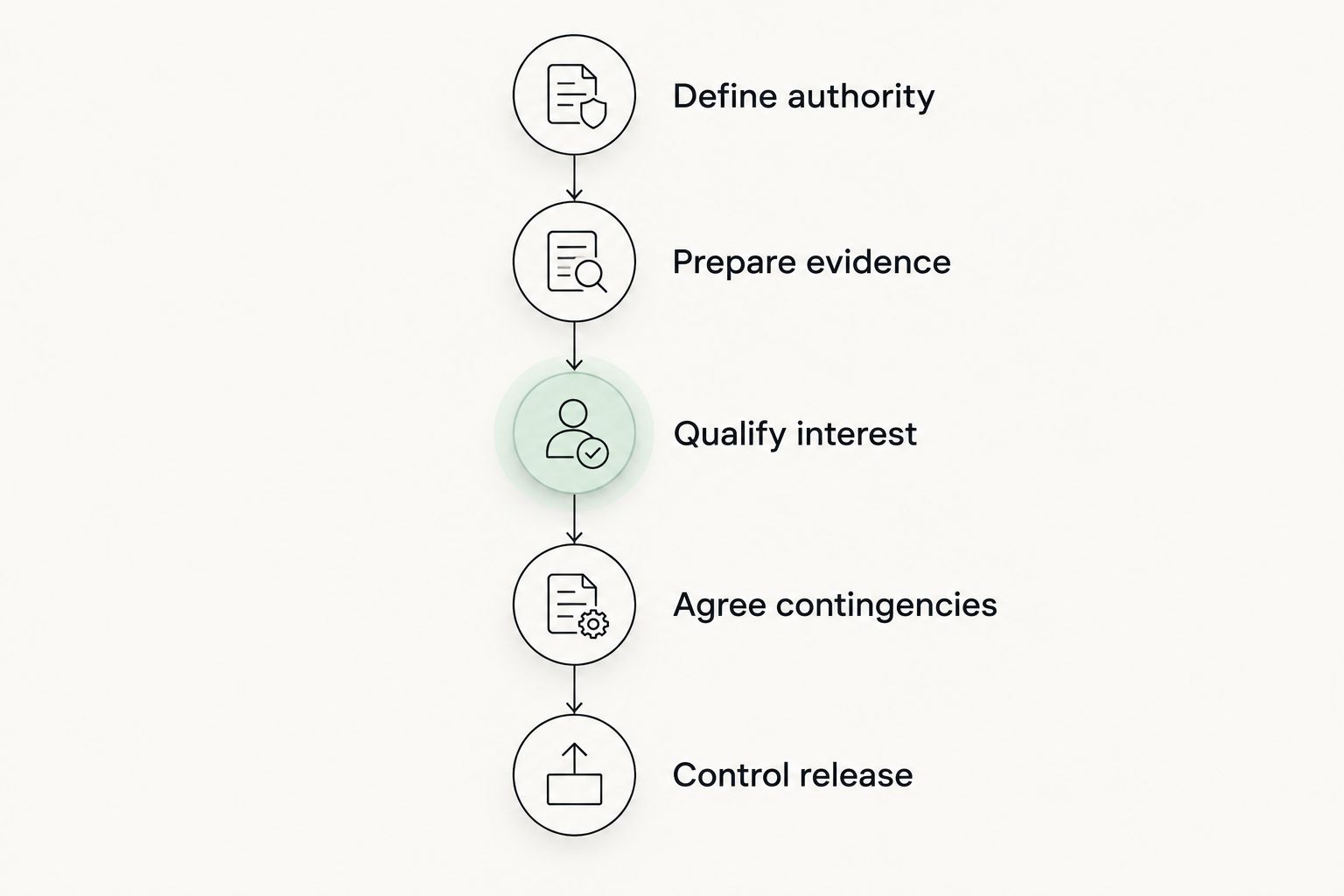
Whichever route you choose, use the same sequence. It separates interest in the car from readiness to complete a transaction.
Define authority
Create 1 written mandate for anyone acting on your behalf. It should identify the car, the assignment, information-sharing permissions and who can approve terms. For a broker-led transaction, review what an exotic-car broker agreement should include.
Ask about representation and any potential conflicts before introductions begin. Confirm whether the intermediary can appoint other people, receive money or take custody; none of those permissions should be assumed.
Prepare evidence
Gather ownership documents, service records, condition photographs and details of modifications or known defects. Check that descriptions agree across the material you share. Explain missing records directly rather than treating silence as disclosure.
Keep personal identifiers separate from the initial vehicle summary. A prospective buyer needs useful evidence about the car, not unrestricted access to your personal documents.
Qualify interest
Establish who the prospective buyer is, what they want and whether their timing fits yours. Ask how they intend to complete the transaction. A referral or an enthusiastic message is a starting point, not qualification.
Use 3 sharing stages: an initial vehicle summary, relevant supporting records after qualification, and transaction documents for the agreed closing process. This is a practical information-control structure, not a substitute for professional advice about document handling.
Agree contingencies
Set out inspection access, acceptable uses of the car and how findings affect the agreement. Identify any lender involvement or title-release requirements before promising a handoff date.
Use a written agreement suited to the transaction and the applicable jurisdiction. Get professional advice where ownership, tax, cross-border or contractual questions require it.
Control release
Set 2 release conditions: confirmed payment and completed transfer requirements. Confirm payment through your financial institution rather than relying on a screenshot or message supplied by the buyer.
Coordinate possession, title documents, keys and transport instructions within the agreed closing process. An approaching collection appointment is not a reason to bypass an unresolved condition.
What should stop a private sale from progressing?
Pause when a required check remains unresolved. That applies even when the buyer is known, the introduction is credible or the collection arrangements are already discussed.
- Unclear representation: You cannot establish whose interests an intermediary represents.
- Uncontrolled circulation: Vehicle details or personal records move beyond the agreed audience.
- Inspection pressure: A party asks you to dismiss an unresolved condition concern without documenting it.
- Payment uncertainty: Confirmation depends only on a buyer-supplied message or image.
- Ownership uncertainty: The proposed transfer does not account for a lender or other ownership requirement.
Felipe Cimino, CEO and co-founder of SV Sourcing, has raised concerns about owners entrusting cars to unsuitable intermediaries or dealerships and unrealistic asking prices leaving cars unsold. His concerns also include buyers purchasing internationally or skipping a pre-purchase inspection.
Those are Felipe's observations, not a claim that dealerships or overseas transactions are inherently unsafe. The practical response is to examine the intermediary, the car and the proposed transaction separately.
How these routes are ranked
The order follows the needs of an owner seeking discretion and coordinated execution in 2026. Broker-led selling comes first for that brief because it combines introductions with coordination. A direct sale fits an existing buyer; private referrals fit an owner still finding one.
This is a fit-based ranking, not a claim about achieved sale values, speed or buyer-network size. Your existing buyer relationships and willingness to manage the transaction determine which route belongs first for you.
Which private selling route should you choose?
Choose a broker-led sale if you need introductions and a coordinator. Choose a direct sale if you already have a credible buyer. Choose private referrals if you want to manage the search yourself.
Before starting a 2026 sale, write down your specification, ownership position, timing and non-negotiable conditions. Give the same facts to every authorized participant. Consistency makes offers easier to assess and prevents conflicting descriptions from becoming part of the negotiation.
FAQ
What's the best way to sell a supercar privately?
A broker-led, off-market sale fits owners who need discreet buyer introductions and transaction coordination. A direct sale fits owners who already have a credible buyer and can manage the remaining steps.
Can I sell my supercar without a public listing?
Yes. Private broker introductions, direct approaches to a known buyer and selected referrals are alternatives to a public listing. Each still requires buyer qualification, accurate disclosures and documented terms.
Is a private broker better than selling the car myself?
A private broker fits a seller who wants help finding buyers and coordinating the transaction. Selling yourself gives you direct control but leaves inquiries, inspection arrangements, negotiation and closing with you.
Should a private buyer arrange a pre-purchase inspection?
An independent pre-purchase inspection is a useful condition check before completing a private supercar purchase. Agree access, scope and how findings affect the transaction before the inspection takes place.
Can I sell a supercar privately if it has an outstanding loan?
A privately sold supercar with an outstanding loan requires a lender-coordinated payoff and title-release process. Confirm the lender's requirements before agreeing collection or transfer arrangements.
When should I release the car to the buyer?
Release the car after payment is confirmed and the agreed transfer requirements are complete. Verify payment through your financial institution and resolve any title or lender conditions before handoff.
What information should I share with a prospective buyer?
Start with an accurate vehicle summary and relevant condition information. Share supporting records after qualification, and reserve sensitive transaction documents for the agreed closing process.
One last thing
The person who introduces a buyer is not automatically authorized to negotiate, accept funds or release your car. Put those permissions in writing separately. A private transaction needs clear authority more than it needs a wide audience.