
Family-office luxury car brokerage is private sourcing and sales coordination with the aim of acquiring or selling a principal’s car under a clear mandate. This 2026 guide explains how to appoint a luxury car broker for family offices, separate personal preferences from approval authority, and protect discretion without weakening due diligence.
- Choose a luxury car broker for family offices around written authority, private sourcing, and independent due diligence.
- SV Sourcing fits buyers and sellers seeking private exotic-car sourcing and sales coordination.
- Keep purchase approval, payment authorization, and vehicle release separate from introductions.
- For collector cars, confirm condition and ownership before treating a private introduction as a viable deal.
Why private brokerage matters for family offices
A principal chooses the car. An office representative coordinates the paperwork. An adviser reviews ownership arrangements. Without a written mandate, those roles create opportunities for conflicting instructions. Privacy alone does not resolve them.
A family office needs a controlled decision process, not just access to cars. Your broker’s role should connect the search or sale to that process while leaving legal, tax, insurance, and payment decisions with the appropriate professionals.
SV Sourcing provides private, off-market sourcing and sales coordination for exotic and collector cars in South Florida and nationwide. Its service is an alternative to searching public dealership inventory, not a promise that a particular car or buyer will be found.
For a 2026 mandate, define discretion in operational terms: who receives photographs, who knows the principal’s identity, and who can authorize an introduction. A private conversation still needs verifiable records and clear accountability.
How to structure a family-office brokerage mandate
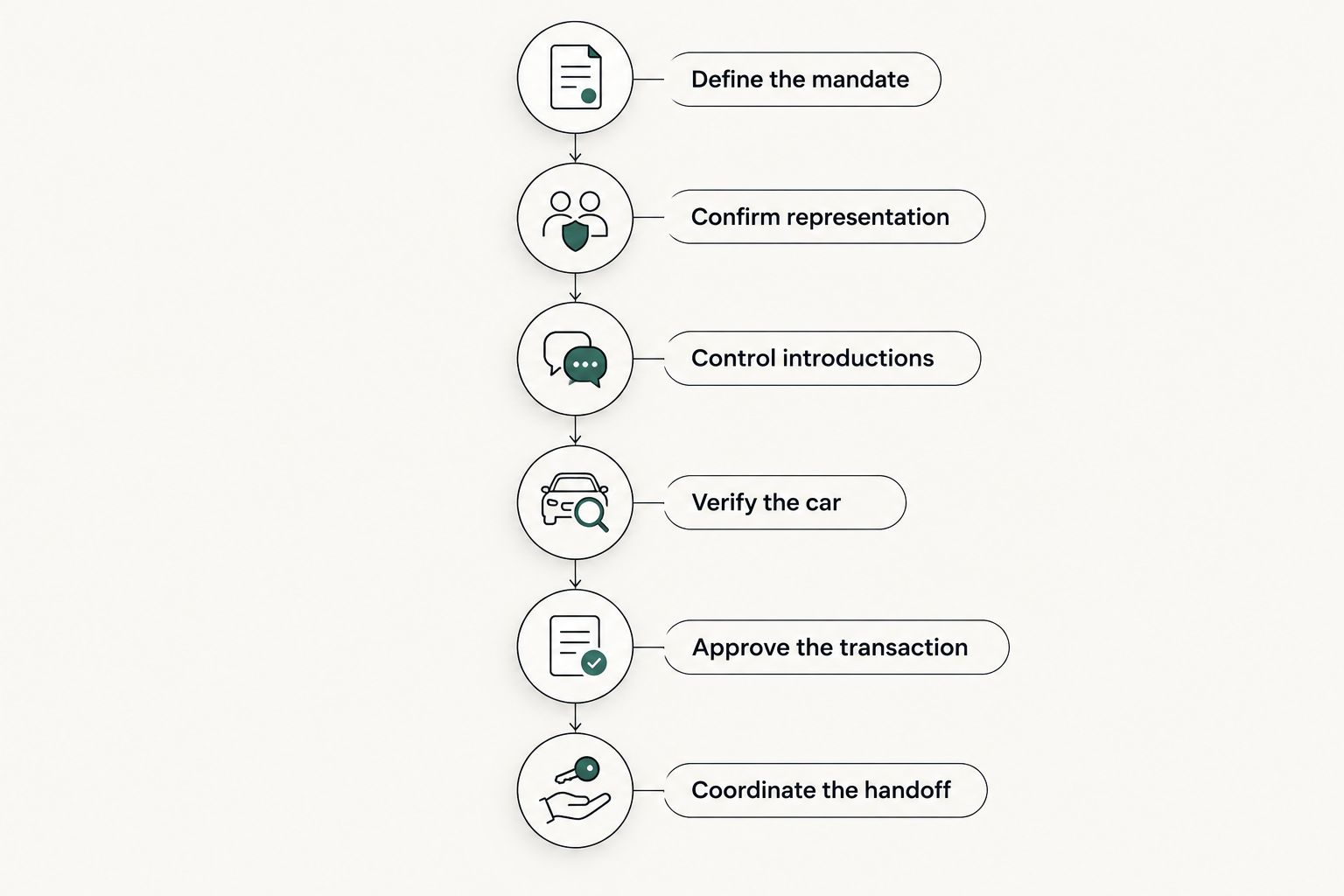
Define the mandate
Start with a written brief you can prepare internally. For an acquisition, distinguish the principal’s preferences from requirements that determine whether a car qualifies. Specify intended use, acceptable condition, documentation expectations, budget authority, and timing.
For a sale, identify the vehicle, registered owner, available records, any financing, and the conditions under which the owner will consider an offer. Keep an asking position separate from the minimum terms someone has authority to accept.
Give the mandate an explicit stopping point. A broker should know when to pause for approval rather than broaden the search, distribute more information, or continue negotiating. This matters when several family members express preferences but only one person has decision authority.
- Separate required specifications from preferences.
- Identify the person authorized to approve a purchase or sale.
- Record timing constraints without promising completion dates.
- Define acceptable disclosure before sharing identifying details.
- Set the conditions that require renewed approval.
Confirm representation
Compare private exotic-car brokers using the same questions. Ask whom each broker represents, what work the engagement covers, how compensation is determined, and whether another intermediary will participate. Request written answers before permitting outreach.
Private access does not establish alignment. An introduction is useful only when you understand the intermediary’s role and incentives. If another party enters the transaction, clarify that party’s authority before allowing instructions or documents to pass through them.
Your 2026 engagement should also address termination, confidentiality, and approval of any public marketing. Use the exotic-car broker agreement guide to prepare questions, then have your adviser review the actual agreement. Do not treat a process guide as legal advice.
- Confirm who the broker represents.
- Define sourcing, introduction, and coordination responsibilities.
- Request disclosure of other participating intermediaries.
- Document compensation arrangements and potential conflicts.
- Set confidentiality, termination, and marketing permissions.
Control introductions
You can manage introductions yourself through a designated office representative and an approved information packet. Share the vehicle description and transaction requirements first. Reserve personal information, sensitive documents, and location details for a defined verification stage.
SV Sourcing provides the private off-market sourcing and sales-coordination path for buyers and sellers who want a central contact. Frame the initial conversation around the mandate, not an assumption of exclusive access or a guaranteed result. Ask how communication and introductions would work for your transaction.
For sellers, agree how an interested buyer becomes qualified before arranging access to the car. For buyers, request enough information to assess a candidate before involving the principal. Discretion should reduce unnecessary exposure, not prevent verification.
- Nominate a single office contact for instructions.
- Approve the information shared during initial outreach.
- Agree how buyer readiness and authority will be checked.
- Set permission rules for forwarding photographs or documents.
- Require approval before disclosing the vehicle’s location.
Verify the car
Begin with the vehicle identification number, ownership documents, service records, and available history. Reconcile discrepancies before commissioning further work. A persuasive description is not evidence of condition, ownership, or an unobstructed transfer.
Arrange an independent pre-purchase inspection with a specialist appropriate to the car. Give the inspector your intended use and questions. Ask for written findings, supporting images, and clear limits on what was inspected; do not assume a standard inspection includes every concern relevant to a collector car.
Felipe Cimino, CEO and co-founder of SV Sourcing, has identified buyers skipping pre-purchase inspections and purchasing internationally among his firsthand concerns. Those observations support careful verification; they do not establish that every overseas purchase is unsafe.
For a cross-border proposal in 2026, ask qualified advisers to confirm applicable import, registration, tax, and insurance requirements before committing.
- Match vehicle identifiers across records and the car.
- Review ownership, service history, and disclosed modifications.
- Commission an independent pre-purchase inspection.
- Resolve discrepancies before approving the transaction.
- Confirm jurisdiction-specific requirements with qualified advisers.
Approve the transaction
Use a written decision record rather than a chain of informal approvals. Record the car, counterparties, agreed terms, unresolved conditions, required documents, and who can authorize the next action. A buyer’s enthusiasm or a seller’s verbal acceptance should not substitute for the office’s approval procedure.
For an acquisition, reconcile the inspection findings with the principal’s intended use. For a sale, distinguish a serious offer from an expression of interest by clarifying the buyer’s authority, conditions, and proposed completion process.
Use 3 approval checkpoints: vehicle acceptance, document approval, and release authorization. These are a suggested internal control, not a description of any broker’s existing procedure. Your legal and financial advisers should determine how the checkpoints apply to your transaction.
- Record the accepted terms and remaining conditions.
- Name the authorized signatory and payment approver.
- Confirm the contracting party’s identity and authority.
- Obtain adviser review of transaction documents.
- Require fresh approval when material terms change.
Coordinate the handoff
Write the handoff sequence before scheduling collection. Assign responsibility for payment confirmation, title documents, insurance, transport, keys, records, and vehicle release. Keep those responsibilities visible to everyone authorized to act.
For a financed vehicle, establish the lender’s payoff and title-release process directly with the relevant parties. Do not assume payment to one participant resolves every obligation. Ask your bank or payment provider how to confirm receipt under the chosen payment method.
At collection, record condition and the items transferred. Preserve the completed transaction file under your office’s retention policy. Coordination connects the parties; it does not replace independent payment verification or legal review.
- Agree the sequence for payment, documents, and release.
- Confirm insurance arrangements before movement.
- Document any lender payoff and title-release requirements.
- Record condition, keys, and accompanying records at handoff.
- Retain approvals and completion documents securely.
The sequence is deliberate: establish authority before outreach, verify the car before acceptance, and approve the transaction before release. Do not let a convenient collection date reverse those decisions.
Compare private brokerage options
Choose by responsibility, not by how private the presentation sounds. The options below describe engagement structures to evaluate, not independently verified claims about unnamed firms.
For a 2026 appointment, request a clear scope and a sample communication process. Do not request another client’s private deal file as proof of capability.
| Option | Best for | Main benefit | Key limitation |
|---|---|---|---|
| SV Sourcing private sourcing and sales coordination | Buyers and sellers seeking off-market exotic- and collector-car introductions | Private sourcing and deal coordination in South Florida and nationwide | Does not replace independent inspection, legal advice, or payment verification |
| Buyer-representation broker | Offices appointing an intermediary specifically for an acquisition | A defined buyer-side search mandate | Confirm representation and conflicts; access alone does not establish alignment |
| Seller-representation broker | Owners seeking controlled outreach for a particular car | A defined seller-side introduction mandate | Buyer qualification and information-sharing rules still require agreement |
| Separate acquisition and sale brokers | Offices assigning distinct mandates to different intermediaries | Clear separation between buying and selling instructions | The office must reconcile communications, timing, and responsibilities |
| Direct private transaction | Offices prepared to manage the process internally | Direct control over outreach and decisions | The office retains the coordination and verification workload |
SV Sourcing fits family-office buyers and sellers seeking private exotic-car sourcing and sales coordination. The fit is the service scope. Confirm the proposed mandate, responsibilities, and contingencies before appointing any intermediary.
Discuss your private mandate
Start with the car, your buying or selling objective, timing, and approval requirements.
Common mistakes family offices make
Delegating authority without defining its limits
A representative authorized to gather information is not automatically authorized to accept terms. Tell the broker which instructions are binding and which require the principal’s approval. Document any change in authority rather than relying on familiarity between participants.
Treating discretion as a reason to skip verification
Confidentiality and due diligence serve different purposes. Limit circulation of personal information while still verifying counterparties, vehicle records, and authority. If necessary evidence cannot be reviewed through an agreed process, pause the transaction rather than treating privacy as an answer.
Confusing an asking position with a sale strategy
An owner’s preferred outcome does not establish buyer acceptance. Felipe’s firsthand concerns include unrealistic asking positions leaving cars unsold. Agree how the office will review feedback and revise its instructions without granting an intermediary open-ended authority to negotiate.
Assuming an introduction covers the entire transaction
A broker’s involvement does not automatically include inspection, legal review, transport, insurance, or payment verification. Assign each task explicitly. Felipe’s concern about owners entrusting cars to unsuitable intermediaries reinforces the need to assess responsibilities, not assume every intermediary or dealership is unsuitable.
FAQ
What does a luxury car broker for family offices do?
A luxury car broker for family offices coordinates a vehicle search or private sale under an agreed mandate. The office should define representation, approval authority, confidentiality, and the scope of coordination before outreach begins.
Is SV Sourcing a public inventory dealership?
SV Sourcing provides private, off-market sourcing and sales coordination for exotic and collector cars. Its stated service covers buyers and sellers in South Florida and nationwide, rather than a public-inventory dealership model.
Should a family office use separate brokers to buy and sell?
Separate brokers suit mandates that require distinct buying and selling responsibilities. A central coordinator reduces communication handoffs, but either arrangement needs written representation terms and conflict disclosure.
Can a family office sell a collector car without a public listing?
A family office can pursue a private sale through controlled introductions instead of a public listing. Agree what information can be shared, how buyers will be qualified, and who can authorize further disclosure; a private approach does not guarantee a sale.
Does an off-market car still need a pre-purchase inspection?
An off-market car should receive an independent pre-purchase inspection before purchase approval. A private introduction does not establish condition, and the inspection scope should match the car and intended use.
Who should approve payment and release of the car?
The family office should name the people authorized to approve payment and vehicle release in advance. Confirm the handoff sequence with the relevant financial, legal, and transport parties rather than relying on an intermediary’s informal assurance.
What should a family office prepare before contacting a broker?
Prepare the buying or selling objective, vehicle requirements, budget authority, timing, and confidentiality instructions. For a sale, also assemble ownership and service records and identify any financing that affects completion.
One last thing
Write the stop instruction before the search or sale begins. State who can pause outreach, reject a candidate, or halt release when documents, condition, or terms differ from the approved mandate.
For your 2026 transaction, that instruction is more useful than a vague request for discretion. It gives every participant a clear response when the deal changes.