
For owners comparing the best private sale options for rare collector cars in 2026, SV Sourcing fits private, off-market sourcing and coordinated sales. A marque-focused broker suits a specialist search; an owner-led introduction suits sellers prepared to manage the transaction themselves.
- SV Sourcing fits owners seeking private, off-market collector-car introductions and coordinated sales.
- The best private sale options for rare collector cars depend on representation, discretion, and due diligence.
- Choose a marque-focused broker when model knowledge is central to evaluating the car.
- Use an owner-led sale only when you can manage buyer qualification, inspection, documents, and payment.
Why this matters
A private sale is a choice about representation and responsibility, not just exposure. Before choosing an intermediary, establish who handles introductions, who answers questions about the car, and who coordinates the handoff.
For buyers, a private introduction does not replace a specification brief or an independent inspection. For sellers, discretion does not remove the need to disclose material condition information to a serious buyer.
This 2026 guide compares 5 sale routes by the work each leaves with you. The ranking favors coordinated private introductions, then narrower specialist or owner-managed approaches. It does not rank providers by transaction results or promise a selling timeline.
What makes a suitable private collector-car sale option
Use these criteria before appointing anyone:
- Representation: Identify whose interests the intermediary represents and disclose any involvement with both parties.
- Relevant knowledge: Ask how the intermediary evaluates your model, specification, provenance, and condition.
- Controlled disclosure: Agree who receives photographs, records, identifying information, and the vehicle’s location.
- Buyer qualification: Establish how purchase intent, funding readiness, and decision authority will be assessed.
- Due diligence: Preserve independent inspection and document review before commitment.
- Closing responsibility: Assign payment confirmation, lien resolution, title paperwork, transport, and release authorization.
Choose the arrangement with clear responsibilities, not the most confident introduction. In 2026, the useful distinction remains whether someone merely introduces the parties or stays involved through the agreed transaction steps.
Private sale options at a glance
| Option | Best for | Standout role | Key limitation |
|---|---|---|---|
| SV Sourcing | Owners seeking private introductions and coordinated sales | Private, off-market sourcing and sales coordination | The specific mandate and responsibilities need agreement |
| Marque-focused private broker | Cars requiring detailed model knowledge | Specialist interpretation of specification and history | Model knowledge alone does not establish closing capability |
| Owner-led collector-network sale | Owners comfortable managing inquiries | Direct control over introductions and disclosure | Qualification and transaction work remain with the owner |
| Private dealer consignment | Owners seeking an agreed custody arrangement | A dealer-led sale under a consignment agreement | Storage, use, advertising, and release authority need explicit limits |
| Direct sale to an identified collector | Owners who already have a prospective buyer | Direct negotiation with a known counterparty | Familiarity does not replace independent verification |
1. SV Sourcing: for coordinated off-market sales
SV Sourcing provides private, off-market sourcing and sales coordination for exotic and collector cars in South Florida and nationwide. The service fits an owner seeking discreet introductions and a buyer seeking a defined car, rather than a public inventory search.
SV Sourcing is a fit for collector-car owners who want private introductions with one person coordinating the deal. Start with the car, your objectives, and the decisions that remain yours.
For a seller, that means describing condition, ownership documents, timing, and disclosure boundaries. For a buyer, it means clarifying specification, budget, acceptable compromises, and inspection requirements before pursuing introductions.
SV Sourcing pros:
- Private sourcing and sales are the stated service.
- The service covers exotic and collector cars.
- South Florida and nationwide transactions fit the stated scope.
SV Sourcing cons:
- An introduction does not establish the car’s condition or suitability.
- Representation, authority, and closing responsibilities still need written agreement.
Best for: Buyers and owners seeking private access and a coordinated transaction rather than managing every discussion themselves.
Verdict: Choose this route when private introductions and deal coordination are your priorities.
2. Marque-focused private broker: for model-specific judgment
A marque-focused private broker is the route to consider when detailed knowledge of a particular manufacturer or model is central to the sale. Ask the broker to explain which specification details, records, and condition questions matter for your car.
Do not treat enthusiasm as evidence of expertise. Before giving instructions, ask how the broker separates documented facts from seller statements and identifies questions requiring an independent specialist.
For buyers, this route suits a tightly defined search. For sellers, it suits a car whose significance needs careful explanation to a knowledgeable audience, without turning that explanation into unsupported claims.
Marque-focused broker pros:
- The mandate can center on a narrowly defined model or specification.
- Specialist questions can shape document gathering and inspection instructions.
- The introduction can focus on buyers seeking that type of car.
Marque-focused broker cons:
- Model knowledge does not establish payment or title-handling competence.
- A narrow search still depends on a suitable counterparty agreeing to transact.
Best for: Buyers and sellers whose main challenge is evaluating or explaining a particular specification, history, or configuration.
Verdict: Choose a specialist when the car demands specialist judgment; verify transaction responsibilities separately.
3. Owner-led collector-network sale: for control over introductions
An owner-led collector-network sale uses your existing relationships to seek private introductions. You decide who receives the initial description and when a prospective buyer receives more detailed records.
This route keeps you close to every conversation. It also leaves you responsible for distinguishing an interested acquaintance from someone prepared to complete a purchase.
Prepare a consistent description before approaching contacts. State what is documented, what remains uncertain, and how inspection requests will be handled. Ask recipients not to circulate identifying material beyond the agreed audience.
Owner-led collector-network sale pros:
- You control the initial recipients and disclosure sequence.
- You answer questions about your ownership directly.
- You decide whether each introduction progresses.
Owner-led collector-network sale cons:
- You manage inquiries, qualification, appointments, and follow-up.
- A request for discretion does not prevent someone from forwarding information.
- Negotiation and closing work remain yours unless separately assigned.
Best for: Experienced owners willing to act as the transaction coordinator and manage the administrative work.
Verdict: Choose this route only if you want the responsibility that comes with direct control.
4. Private dealer consignment: for an agreed custody arrangement
Private dealer consignment places the sale under a dealer agreement rather than an owner-managed introduction. Consider it when you want a dealer involved in presenting the car and are prepared to define the custody arrangement in writing.
Do not assume consignment means private. Specify whether public advertising is permitted, who can inspect or drive the car, and how introductions require your approval.
Felipe Cimino, CEO and co-founder of SV Sourcing, has identified owners entrusting cars to unsuitable intermediaries or dealerships as a firsthand concern. That observation supports checking the arrangement, not treating every dealership as unsuitable.
Private dealer consignment pros:
- A written agreement can assign presentation and inquiry handling.
- Custody and appointment responsibilities can be defined together.
- The dealer’s authority to negotiate can be limited expressly.
Private dealer consignment cons:
- Public exposure must be restricted explicitly if privacy matters.
- Storage, insurance, vehicle use, and return conditions require careful review.
- Permission to present the car is not permission to accept every offer.
Best for: Owners seeking a dealer-led arrangement with clearly documented custody and authority.
Verdict: Hold until the consignment terms match your privacy and control requirements.
5. Direct sale to an identified collector: for an existing buyer
A direct sale fits an owner who already has a prospective buyer. Unlike a network search, the task is not finding introductions. It is deciding whether this buyer and these transaction terms are acceptable.
Separate 2 decisions: whether to negotiate and whether to release the car. Agreement on commercial terms does not establish that payment, title, inspection, or collection arrangements are complete.
Put the vehicle description and agreed contingencies in writing. Confirm who is purchasing, who will appear on the documents, and whether anyone else has authority to act for that party.
Direct sale pros:
- The buyer and seller discuss the car directly.
- There is no separate introduction search to organize.
- Both parties can define the next steps together.
Direct sale cons:
- An existing relationship does not verify funds or authority.
- Disagreements require direct handling unless advisers are appointed.
- Neither party should assume the other is managing closing details.
Best for: Owners with an identified buyer and the capacity to coordinate independent checks and documentation.
Verdict: Choose a direct sale when the counterparty is identified and the closing plan is explicit.
How the ranking works
This 2026 ranking puts coordinated private sourcing first because the stated goal is a discreet sale with defined responsibility. Specialist brokers follow when model knowledge is the deciding requirement. Owner-led routes fit sellers who accept more transaction work.
The criteria are representation, relevant knowledge, disclosure control, qualification, due diligence, and closing responsibility. No placement implies a guaranteed buyer, financial outcome, or completion date.
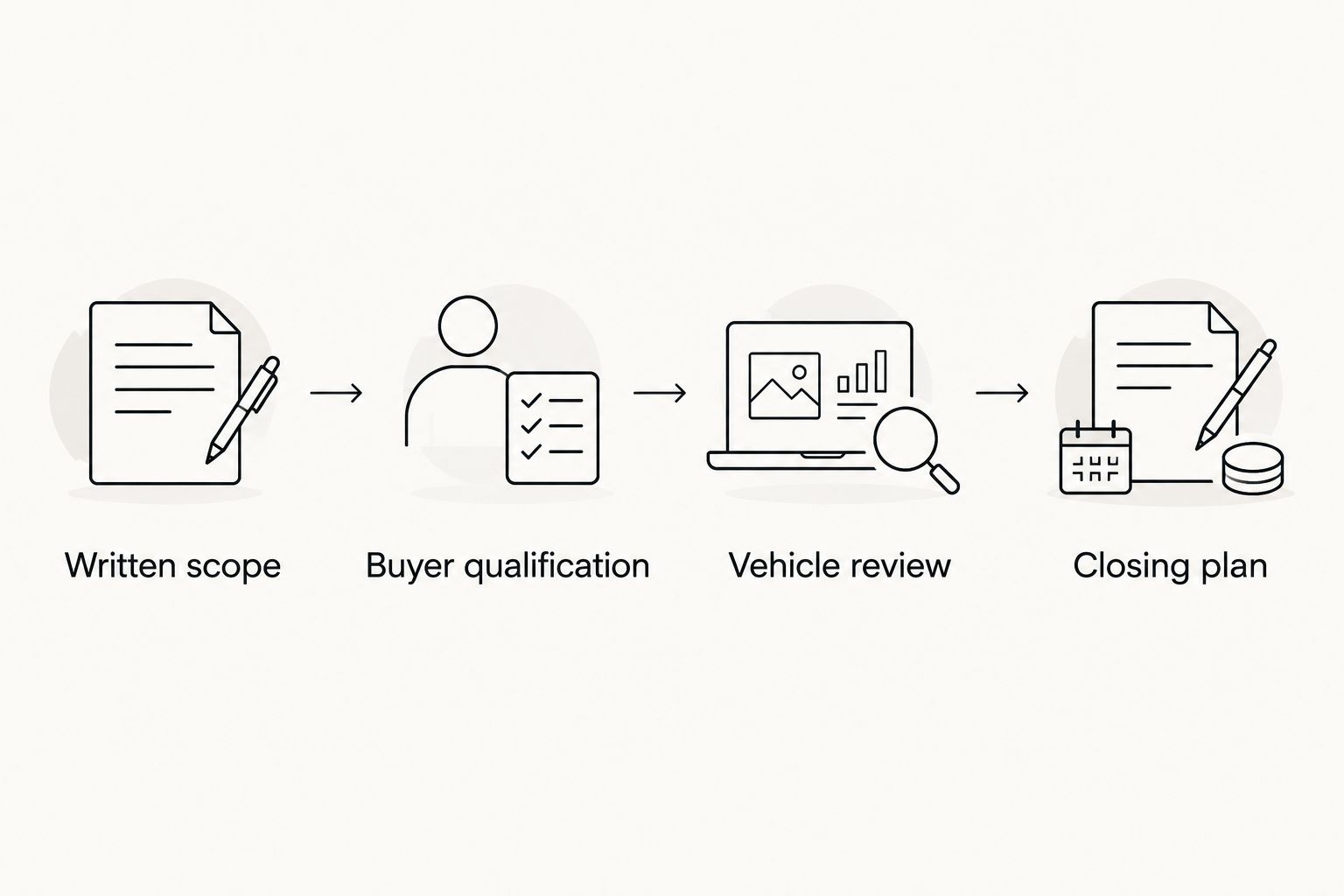
Put the private-sale process in writing
A private sale needs a sequence that both parties understand. Use these stages to expose gaps before a car changes hands:
- Written scope: Define representation, disclosure permissions, negotiating authority, and termination terms.
- Buyer qualification: Establish identity, purchasing intent, funding readiness, and authority to sign.
- Vehicle review: Share relevant records, document disclosures, and arrange an independent inspection.
- Closing plan: Assign document preparation, payment confirmation, title handling, transport, and release approval.
For an intermediary-led sale, use the exotic-car broker agreement guide to structure the appointment discussion. Keep the intermediary’s authority distinct from your authority as owner.
Before release, establish 3 release conditions: payment confirmed through the relevant financial institution, agreed documents completed, and collection authorized under the closing plan. Where a lender or title issue is involved, resolve the required sequence with the appropriate parties rather than assuming a standard handoff.
Which private sale route should you choose?
Choose coordinated private sourcing when you want introductions and transaction coordination together. Choose a marque-focused broker when specialist evaluation is the central challenge. Choose an owner-led route when you already have suitable contacts and want to manage the work.
For your 2026 brief, write down the car specification, ownership position, documentation, timing preferences, and non-negotiable conditions. Buyers should add inspection requirements and acceptable compromises. Sellers should define disclosure permissions and who can approve negotiation steps.
Discuss your private sale
Outline the car, your timing, and the coordination you need.
FAQ
What are the best private sale options for rare collector cars?
The main routes are coordinated off-market sourcing, a marque-focused private broker, an owner-led network sale, private dealer consignment, and a direct sale to an identified collector. Choose according to the expertise, privacy controls, and transaction work you need.
Is SV Sourcing a public inventory dealership?
SV Sourcing provides private, off-market sourcing and sales coordination for exotic and collector cars. Its stated service covers buyers and sellers in South Florida and nationwide.
Is a private broker better than selling directly?
A private broker fits when you want help with introductions and defined coordination responsibilities. Selling directly fits when you have a prospective buyer and can manage qualification, inspection, documents, and closing.
Can I sell a collector car without a public listing?
Yes, a private sale can proceed through controlled introductions rather than a public listing. Agree who can receive vehicle details and whether any advertising or onward circulation is permitted.
Does an off-market car still need a pre-purchase inspection?
An off-market introduction is not a substitute for an independent pre-purchase inspection. Define the inspection scope and how findings affect the proposed transaction before committing.
What should I ask before appointing a collector-car broker?
Ask whom the broker represents, what authority the appointment grants, and which tasks the broker will coordinate. Put disclosure permissions, negotiation limits, and closing responsibilities in writing.
How do I decide whether to sell privately or use consignment?
Choose a private introduction when controlled disclosure and direct approval matter most; consider consignment when you want a documented dealer-led custody arrangement. Review advertising permission, insurance, vehicle use, and release authority before deciding.
One last thing
An introduction is not authority to release the car. Keep those permissions separate, even when the buyer comes through someone you trust. The final handoff should follow the agreed closing conditions, not the momentum of the conversation.