
First-time collectors’ luxury car brokerage is a sourcing and transaction-coordination service aimed at finding a suitable car and completing a documented purchase. Your first collection car needs a clear specification, independent due diligence and an ownership plan—not just a compelling introduction.
- Choose a luxury car broker for access and coordination, not as a substitute for independent inspection.
- SV Sourcing serves buyers seeking private exotic-car sourcing and coordinated transactions.
- Define your specification, total ownership budget and timing before requesting off-market introductions.
- Keep document review, pre-purchase inspection and written transaction terms separate from the excitement of finding a car.
Why luxury car brokerage matters for first-time collectors
A first-time collector must judge both the car and the route to buying it. A private introduction does not establish condition, ownership history or whether the specification suits your intended use. Those questions need their own evidence.
SV Sourcing provides private, off-market sourcing and sales coordination for exotic and collector cars in South Florida and nationwide. SV Sourcing is for first-time collectors seeking private exotic-car access with one person coordinating the deal. It is not presented as a public-inventory dealership.
The distinction matters in 2026: decide whether you need access to privately offered cars, help coordinating a specific purchase, or both. A broker’s introduction is the start of due diligence, not its conclusion.
Felipe Cimino, CEO and co-founder, previously sold supercars at a dealership. His firsthand concerns include buyers skipping a pre-purchase inspection or purchasing internationally without addressing the additional transaction questions. These are his observations, not a claim that dealerships or overseas purchases are inherently unsafe.
How to approach your first collector-car purchase
Define the car before requesting introductions
Start with a one-page buying brief. Write it yourself before speaking with a broker. Describe the model, configuration, intended use and acceptable compromises in plain language.
Separate requirements from preferences. A particular transmission or documented history can be a requirement; a color preference can remain negotiable. If every detail becomes non-negotiable, your search has less room to work. If nothing is fixed, unsuitable cars become harder to reject.
For a 2026 search, specify timing as a constraint rather than demanding a delivery promise. Explain whether you are ready to proceed when a suitable car clears inspection or whether another event must happen first.
A useful brief tells a broker what to exclude. It also gives you a stable reference when a persuasive opportunity appears.
- Name the model and acceptable variants.
- Separate required equipment from preferred details.
- State acceptable mileage and condition in your own terms.
- Identify road use, collection use or a mix of both.
- Explain your purchase timing and dependencies.
Set an ownership budget beyond the purchase
Build your budget manually before asking anyone to source a car. Use three budget categories: acquisition, transaction expenses and ongoing ownership. This is a planning structure, not an estimate of what any particular vehicle will cost.
Request relevant quotes for insurance, transport, storage and specialist maintenance. Keep a separate allowance for work identified during inspection. Do not treat the purchase amount as the complete commitment.
The ownership plan also needs practical answers. Know where the car will live, who can service it and how you intend to use it. A configuration that appeals as a collectible still needs to fit your actual circumstances.
Set your acquisition limit before reviewing candidates. Revisit it only when your circumstances change, not simply because a particular car becomes emotionally difficult to pass up.
- Record your acquisition limit privately.
- Obtain insurance guidance for the intended vehicle and use.
- Request transport and storage quotes where relevant.
- Identify a suitable service provider.
- Reserve capacity for inspection findings and initial maintenance.
Choose a broker with a defined role
You can begin by interviewing private brokers directly. Ask each to describe the assignment, whom they represent and who will coordinate documents, inspection access and handover. Compare responsibilities before comparing introductions.
SV Sourcing offers private sourcing and sales coordination. Felipe Cimino and co-founder Alejandro S. are both involved in that work. The service fits buyers who want a coordinated private search; it does not replace the independent assessment of a car or advice on transaction-specific legal questions.
Use the guide to choosing an exotic-car broker for a private purchase to structure that conversation. Your objective is a clear scope, not an impressive list of contacts.
Ask how the broker handles a candidate that fails inspection or lacks adequate documentation. The answer should explain the process without promising a replacement car or completion date.
- Establish whom the broker represents.
- Identify your main coordinating contact.
- Request the scope and commercial terms in writing.
- Ask how potential conflicts of interest are disclosed.
- Confirm who arranges each transaction task.
- Agree on how unsuitable candidates are declined.
Review the documents before committing
Create a document checklist yourself. Request the vehicle identification details, ownership documents, available service records and the seller’s disclosures. Keep the information organized by candidate rather than mixing records from different cars.
Read the records for consistency. Compare identifying details across documents and ask about gaps, unexplained changes or statements that conflict. A missing record is an unanswered question; it is not proof of either a clean history or a defective car.
For your 2026 purchase, treat a vehicle-history report as one input. It does not replace the underlying records or a physical inspection. Where ownership, title or transaction authority is unclear, obtain appropriate professional advice before proceeding.
Do not let discretion become an excuse for insufficient evidence. Private handling can protect identities while still allowing the checks required for a serious purchase.
- Match vehicle identifiers across the supplied records.
- Review service history and supporting invoices.
- Request written disclosures about known damage or modifications.
- Clarify any outstanding finance and its resolution.
- Confirm the seller’s authority to transact.
- Resolve material gaps before accepting transaction obligations.
Commission an independent pre-purchase inspection
Find an inspector with relevant experience before you need one urgently. Ask about inspection scope, access requirements and exclusions. The appropriate checks depend on the car, its age, its configuration and the available records.
A broker can help coordinate access. Keep the technical judgment separate from the person introducing or selling the car. An inspection should produce findings you can review, not merely a verbal assurance that the car looks good.
Ask the inspector to distinguish immediate concerns, deferred maintenance and questions requiring further investigation. If an inspection cannot include a particular check, record the limitation. A restricted inspection is not equivalent to an unrestricted assessment.
Do not waive the inspection because the introduction is private or the seller appears credible. Felipe’s concern about buyers skipping this step belongs here: familiarity with the intermediary does not establish the car’s condition.
- Select an inspector experienced with the relevant vehicle type.
- Agree on the inspection scope before the appointment.
- Ask which checks require specialist equipment or access.
- Request written findings and supporting photographs.
- Review unresolved issues with the inspector directly.
- Decide whether to proceed, renegotiate or stop.
Coordinate written terms and handover
Start with a transaction checklist that names the parties, the vehicle and each unresolved condition. Have suitable professionals review legal or financial questions outside your expertise. Coordination helps organize the transaction; it does not remove the need to verify the details.
Use two decision gates: accept the car after reviewing the evidence, then authorize completion after checking the transaction arrangements. Do not collapse both decisions into a deposit request.
For a 2026 transaction, confirm instructions independently before transferring funds. Agree on document delivery, any finance settlement, collection arrangements and responsibility during transport. If a car is abroad, address the applicable import and registration requirements before treating the deal as executable.
The sequence is Car brief, Document review, Independent inspection, Written terms, Handover. Keep unresolved questions visible throughout it.
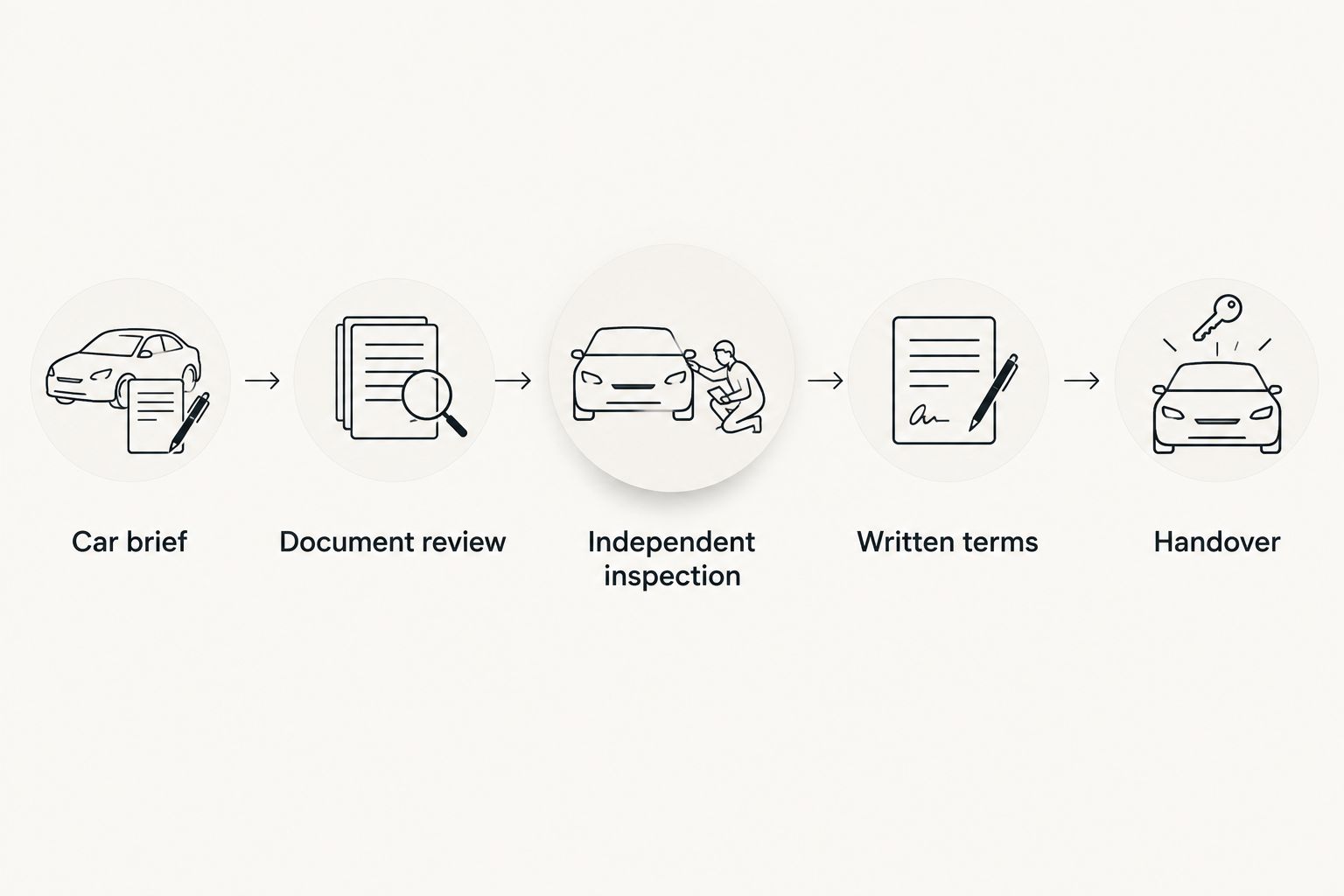
Do not release a decision simply because the next person in the process is waiting. Close the open question first.
- Record the parties and vehicle identifiers accurately.
- Put inspection-related conditions in the written terms.
- Clarify deposit handling before committing funds.
- Verify payment instructions through an independently confirmed contact.
- Confirm the document and handover sequence.
- Agree on transport, insurance and delivery responsibilities.
Discuss your buying brief
Clarify the car, budget, timing and coordination you need for a private purchase.
Compare your routes to a first collector car
Choose the route by the work you want someone else to handle. Private brokerage is relevant when access and coordination are the assignment. A direct purchase places more of that work with you.
The table separates private brokerage options from public-inventory buying. None removes the need to assess the specific car. Compare written responsibilities, not claims of a better network.
| Option | Best for | Practical advantage | Key limitation |
|---|---|---|---|
| SV Sourcing private brokerage | Buyers seeking off-market exotic or collector cars with a coordinating contact | Private sourcing and sales coordination in South Florida and nationwide | Sourcing does not replace independent inspection or transaction-specific advice |
| Another private exotic-car broker | Buyers comparing representation, search scope and coordination | You can assess whether the proposed assignment matches your brief | Access claims alone do not establish suitability; clarify responsibilities |
| Buyer-managed private purchase | Buyers prepared to organize diligence and completion themselves | Direct control over the search and transaction tasks | You must arrange records, inspection, advice and handover coordination |
| Public-inventory dealership purchase | Buyers starting with a car already publicly advertised | A specific advertised vehicle provides a clear starting point | Public inventory does not address the same off-market sourcing brief |
Ask every private broker the same questions. Who represents you? Who evaluates condition? Who coordinates completion? What happens if you decline the car? A clear answer to each is more useful than a broad promise of access.
Common mistakes first-time collectors make
Letting rarity override the buying brief
An unusual specification is not automatically the right purchase. Compare the car with your intended use and requirements before deciding that scarcity justifies a compromise. Pass when the compromise defeats the reason you wanted the car.
Treating introductions as endorsements
A trusted introduction can establish contact. It cannot establish mechanical condition or documentary completeness. Keep your inspection and records checklist unchanged regardless of who introduces the seller.
Leaving seller expectations untested
A private seller’s asking position still needs scrutiny. Felipe has observed unrealistic asking prices leaving cars unsold; that does not establish the correct value of your candidate. Seek relevant evidence and assess condition rather than treating the asking figure as validation.
Confusing confidentiality with opacity
You do not need a seller’s private life or another client’s deal details. You do need enough verified information to assess the car and complete the transaction properly. Protect confidentiality without accepting unexplained gaps.
Solving international logistics after agreeing to buy
Cross-border purchases add questions about transport, documentation, import eligibility and registration. Address the requirements for the actual vehicle and destination before committing. This is process discipline, not a blanket objection to buying internationally.
FAQ
What does a luxury car broker do for a first-time collector?
A luxury car broker helps source a car and coordinate the purchase within an agreed scope. Establish representation, document handling, inspection coordination and completion responsibilities before starting the search.
Is a private broker better than buying from a dealership?
A private broker fits an off-market sourcing brief; a dealership purchase starts with its offered inventory. Choose the route that matches your needs, and independently assess the specific car in either case.
Can SV Sourcing help me find a car that is not publicly listed?
SV Sourcing provides private, off-market sourcing for exotic and collector cars. A search begins with your specification, budget and timing; it does not establish that a particular car will be found.
Do I still need an inspection if a broker introduces the car?
Yes. A broker introduction does not replace an independent pre-purchase inspection. Agree on the inspection scope and review any limitations before deciding whether to proceed.
What should I prepare before contacting a luxury car broker?
Prepare a buying brief covering the model, required specification, acceptable compromises, budget and timing. Include your intended use and any conditions that must be satisfied before you can complete a purchase.
Can I buy my first collector car internationally?
An international purchase requires vehicle-specific checks on documentation, import eligibility, registration and transport before commitment. Obtain appropriate advice for the destination and keep independent inspection in the process.
Can a broker help if I need to sell a car before buying?
Private sales coordination is a separate assignment that should be agreed alongside the purchase search. Explain the dependency at the outset and do not assume the sale will complete by a particular date.
One last thing
Before starting your 2026 search, write down what would make you decline a car. Include unacceptable inspection findings, unresolved ownership questions and specification compromises you will not accept.
The ability to say no is part of a disciplined first purchase. Give that list to your coordinating contact. It makes your brief useful when the conversation becomes a real transaction.