
Out-of-state buyer car brokerage is a sourcing and transaction-coordination service aimed at helping you purchase a car without managing every local handoff yourself. For an exotic or collector car in Miami, the brief must address specification, condition, ownership documents and transport—not just finding a seller.
- Searching car broker Miami? Choose private sourcing for a defined exotic- or collector-car brief, not a public-inventory search.
- SV Sourcing serves buyers seeking private off-market access and one person coordinating the deal.
- Arrange an independent pre-purchase inspection before committing to a remote purchase.
- Confirm seller authority, payment conditions, registration requirements and transport responsibilities in writing.
Why car brokerage matters for out-of-state buyers
Distance separates the conversation from the car. You need someone to coordinate access, documents and local appointments, while keeping your own acceptance criteria intact. A compelling specification does not replace a satisfactory inspection.
SV Sourcing provides private, off-market sourcing and sales coordination for exotic and collector cars in South Florida and nationwide. SV Sourcing is best for exotic- and collector-car buyers seeking private sourcing and coordinated sales. The service suits a defined request; it is not a public-inventory dealership.
For your 2026 search, keep three decisions separate: whether the car matches your brief, whether its condition is acceptable, and whether the transaction can close on agreed terms. A broker coordinates the process. The inspector assesses the car, and the relevant registration authority determines your home-state requirements.
Owners matter here, too. A private seller needs a serious buyer, controlled introductions and clear next steps. A precise buyer brief gives that conversation substance without requiring public exposure of the car or the owner's identity.
How to buy an exotic car in Miami from another state
Define your purchase brief
Write the specification before asking anyone to source a car. Separate non-negotiable requirements from preferences. Otherwise, an attractive example can distract you from the ownership experience you actually want.
Use 3 requirement groups: specification, condition and transaction constraints. Specification covers the car itself. Condition covers history and acceptable compromises. Transaction constraints cover budget, timing and where the car must ultimately be delivered.
For a collector car, explain which documentation or originality questions affect your decision. For a car you intend to drive regularly, describe the intended use and what maintenance uncertainty you will accept. Do not treat those as the same brief.
- Name the model, body style, transmission and essential options.
- Separate required colors and equipment from flexible preferences.
- State your budget and whether it includes associated purchase expenses.
- Describe acceptable modifications, repairs and documentation gaps.
- Identify your home state, intended use and timing constraints.
Establish who represents whom
Start with a direct conversation about the intermediary's role. Ask whether the person is sourcing for you, introducing a seller, representing the owner or coordinating an existing opportunity. Those are different responsibilities.
Get the scope in writing before sharing sensitive information or making a commitment. Your agreement should identify the parties, the work included, compensation arrangements and what happens if a candidate fails inspection. Confirm who has authority to accept terms; coordination alone is not authority to bind a seller.
Choose a broker for a defined role, not for an implied promise of access. Private introductions still require verification. You should understand how a proposed car reached the conversation and who can authorize its sale.
- Request a written description of representation and responsibilities.
- Confirm the seller's identity and authority through appropriate documentation.
- Ask how conflicts of interest and compensation are disclosed.
- Identify who coordinates inspection, paperwork and transport.
- Record the conditions for ending the engagement or declining a car.
Choose the private sourcing route
You can contact owners and intermediaries yourself, organize candidate information and arrange local appointments directly. That approach keeps you close to every conversation. It also leaves you responsible for each handoff and for identifying gaps between them.
A private broker is the alternative when you want coordinated sourcing and introductions. SV Sourcing presents private off-market access with one person coordinating the deal. Felipe Cimino and Alejandro S., its co-founders, are both involved in private sourcing, sales and deal coordination.
Read the guide to choosing an exotic-car broker for a private purchase before selecting an intermediary. Compare the actual engagement terms, not claims of exclusivity. Ask what information you receive before deciding whether to inspect a candidate.
- Compare other private exotic-car brokers using the same written brief.
- Ask who remains your point of contact through the transaction.
- Request candidate details before authorizing further work.
- Establish when owner information is shared and with whom.
- Keep your inspection and acceptance decisions independent.
Verify the car independently
Request records before arranging travel or transport. Match the vehicle identification number across the car and transaction documents. Review service records, ownership information and disclosures as separate evidence; none substitutes for examining the vehicle.
Arrange an independent pre-purchase inspection with someone familiar with the relevant model. Agree on the inspection scope and how the findings will reach you. Ask the inspector to distinguish observed condition, recommended work and anything the inspection did not establish.
Felipe Cimino, CEO and co-founder of SV Sourcing, previously sold supercars at a dealership. His firsthand concerns include buyers skipping a pre-purchase inspection or buying internationally without addressing the purchase risks. These are his observations, not a claim that overseas purchases or dealerships are inherently unsafe.
- Verify that records and photographs concern the same vehicle.
- Ask for service history and written disclosures of known issues.
- Arrange a model-appropriate independent inspection.
- Discuss modifications, repairs and unresolved findings with the inspector.
- Decide whether to proceed only after reviewing the findings.
Set the closing conditions
Turn the proposed purchase into a written sequence. Identify what must happen before you commit funds, what documents must be delivered and what happens when a condition is not satisfied. A deposit request deserves the same scrutiny as the final payment.
For a 2026 interstate purchase, confirm tax, title and registration requirements with the relevant authorities in your home state. Do not assume a Miami intermediary's transaction process answers every destination-state question. Ask who prepares each document and who submits it.
Use 2 decision checkpoints: one after inspection and document review, another before final payment and vehicle release. Verify payment instructions through a known contact channel. Treat a changed account instruction as something to confirm, not something to follow automatically.
- Identify the contracting seller and the party receiving payment.
- Document deposit conditions, acceptance terms and unresolved contingencies.
- Confirm the title-transfer process and any lien-release requirements.
- Check home-state registration requirements before arranging departure.
- Agree on the order of payment, document delivery and vehicle release.
Coordinate transport and acceptance
Define the handoff before the car leaves Miami. Decide who engages the carrier, who can authorize collection and who records the car's condition. Keep transport responsibilities distinct from the purchase agreement.
Ask the carrier about loading methods, coverage, exclusions and claims procedures. Choose the transport arrangement around the vehicle's clearance, condition and your requirements. Do not infer protection from a general description of the service.
For a 2026 delivery, prepare an arrival checklist using the same agreed condition record as pickup. Compare the car, keys and accompanying items against that record. Record discrepancies before signing an unqualified acceptance where the delivery paperwork permits an exception.
- Confirm collection and delivery contacts without sharing unnecessary personal details.
- Record exterior condition and agreed accompanying items at pickup.
- Review carrier coverage and the process for reporting damage.
- Check that documents and keys follow the agreed handoff plan.
- Inspect the car on arrival and document any discrepancy promptly.
Keep the purchase gates separate
Your remote purchase follows a sequence: purchase brief, broker scope, independent inspection, closing conditions and delivery acceptance. Each gate answers a different question. Do not move a failed inspection question into the transport stage simply because the car is already scheduled to leave.
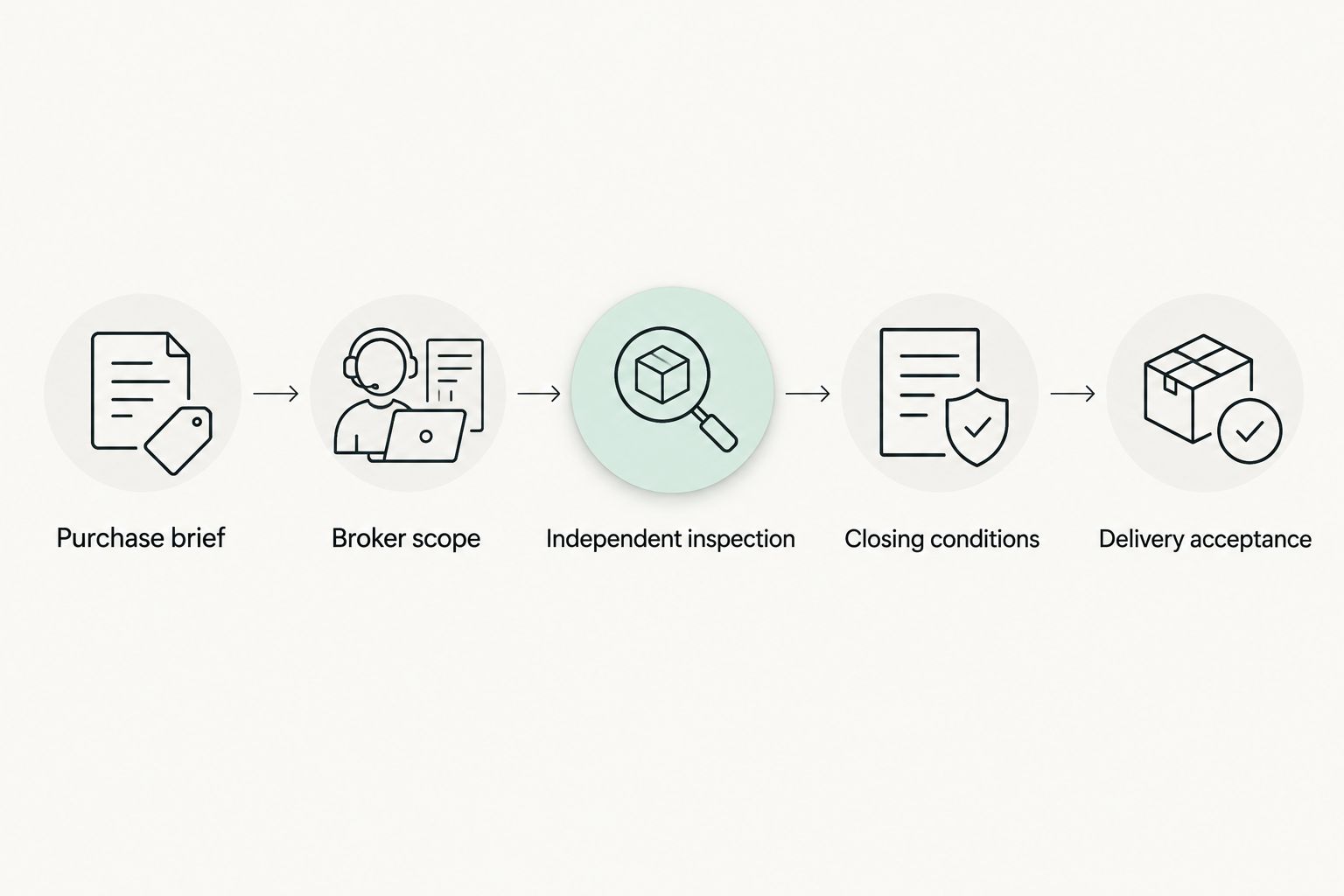
Keep a single written status record for your 2026 purchase. Mark each condition as resolved, unresolved or declined. The purpose is not more paperwork; it is preventing a verbal assumption from becoming a payment instruction or a vehicle release.
Compare your buying options
For an out-of-state exotic- or collector-car purchase, compare responsibility as closely as access. A private broker, direct seller and public-inventory dealership offer different routes. None removes the need to verify the vehicle and transaction.
| Option | Best for | Practical advantage | Key limitation |
|---|---|---|---|
| SV Sourcing private sourcing | Buyers seeking off-market exotic or collector cars with coordinated introductions | Private sourcing and sales coordination through a designated contact | Not a public-inventory dealership; the brief and transaction scope must be agreed |
| Other private exotic-car brokers | Buyers comparing private representation and sourcing arrangements | An alternative private search and coordination relationship | Representation, conflicts and responsibilities require individual review |
| Direct private purchase | Buyers prepared to manage the seller relationship themselves | Direct communication about the car and proposed terms | You coordinate verification, inspection, documents and transport |
| Public-inventory dealership | Buyers who prefer to begin with publicly presented cars | A defined set of cars to assess | The listed selection must still match your brief and pass due diligence |
Compare written scope before choosing the intermediary. If you already have a candidate, you need transaction support rather than an undefined search. If the car remains unidentified, explain which specifications are essential before discussing introductions.
Define your private purchase
Start with your specification, budget, timing and home state.
Common mistakes out-of-state buyers make
Treating off-market access as proof of quality
Off-market describes how the opportunity is introduced. It does not establish mechanical condition, provenance or ownership authority. Keep the same evidence requirements you would apply to a publicly advertised car.
Letting distance justify skipping inspection
Photographs and a video call help you understand presentation. They do not replace an independent assessment. If inspection access is unresolved, pause the purchase rather than treating transport urgency as a reason to proceed.
Agreeing to a figure without defining the transaction
The purchase agreement needs more than an agreed amount. Establish what accompanies the car, which conditions remain open and who handles the documents. An unresolved title or acceptance question belongs before payment, not after delivery.
Confusing discretion with incomplete disclosure
A private seller can limit public exposure while still providing the information necessary for a qualified purchase. Ask for relevant records through an agreed process. Do not request owner identities or private deal details for curiosity alone.
Assuming the Miami handoff completes registration
Vehicle release and home-state registration are different events. For your 2026 purchase, establish the destination requirements before the car departs. Confirm what you must receive and what you must submit yourself.
FAQ
What's the right car broker in Miami for an out-of-state buyer?
Choose a broker whose written scope matches your search and coordination needs. SV Sourcing serves exotic- and collector-car buyers seeking private off-market sourcing and sales coordination in South Florida and nationwide.
Can I buy an exotic car in Miami without traveling there?
A remote purchase requires local access for inspection and a documented closing and transport process. Decide whether you need to attend personally based on the evidence, unresolved questions and your acceptance requirements.
Is a private car broker better than buying directly from an owner?
A private broker suits buyers who want sourcing and transaction coordination; a direct purchase suits buyers prepared to manage those tasks themselves. Compare representation and responsibilities before choosing either route.
Do I need a pre-purchase inspection for an off-market car?
Arrange an independent pre-purchase inspection for an off-market exotic or collector car. Private access does not establish condition, and records alone do not replace examining the vehicle.
What should I send a Miami car broker before starting?
Send your required specification, budget, timing and home state. Separate essential requirements from preferences and describe the condition or documentation compromises you will accept.
Who handles registration when I buy a car in another state?
Confirm registration responsibilities with the seller, intermediary and relevant home-state authority before closing. The agreement should identify who supplies the documents and who submits them.
Can a private seller stay discreet during my purchase?
A private seller can control public exposure and introductions while providing relevant information to a qualified buyer. Agree on information sharing without treating discretion as a substitute for ownership verification or disclosure.
One last thing
Write your reasons to decline a car before the first introduction. An inspection you cannot arrange, ownership documents you cannot reconcile or a specification outside your brief should trigger a defined decision—not another round of persuasion.
The right car still has to support the right transaction. Keep both standards intact.