
You can buy a supercar without public listings by giving a private exotic-car broker a clear buying brief, authorizing discreet introductions, and checking the car before committing. The process connects your requirements with an owner willing to discuss a sale privately. Off-market access does not replace an independent inspection, ownership verification, or written transaction terms.
- A supercar for sale does not need a public listing; private sourcing starts with a precise buying brief.
- SV Sourcing suits buyers seeking private exotic-car sourcing and coordinated introductions rather than public inventory browsing.
- Verify ownership, service records, condition, and transaction terms before committing to an off-market car.
- Sellers should agree on disclosure boundaries before authorizing introductions to prospective buyers.
How do you buy a supercar without relying on public listings?
Start with the specification, not the search results. A private search needs enough detail to distinguish a suitable car from an interesting distraction. Your preferred model is only the beginning; condition, history, intended use, budget, and timing determine whether an introduction deserves your attention.
For buyers considering SV Sourcing, the service is private, off-market sourcing and sales coordination for exotic and collector cars in South Florida and nationwide. It is not a public inventory dealership. The conversation starts with what you want to buy or sell.
Use this sequence for a private purchase in 2026:
- Buying brief. State the car, required specification, intended use, budget boundaries, and timing.
- Private introduction. Establish whether an owner wants to discuss a sale and what information can be shared.
- Document review. Examine the vehicle identity, ownership position, service history, and supporting records.
- Independent inspection. Have an appropriate specialist assess the car and explain unresolved findings.
- Written agreement. Record the agreed terms, contingencies, payment arrangements, and handover responsibilities.
Keep these stages separate. An introduction is not evidence of condition, and an inspection is not proof that the person offering the car has authority to sell it.
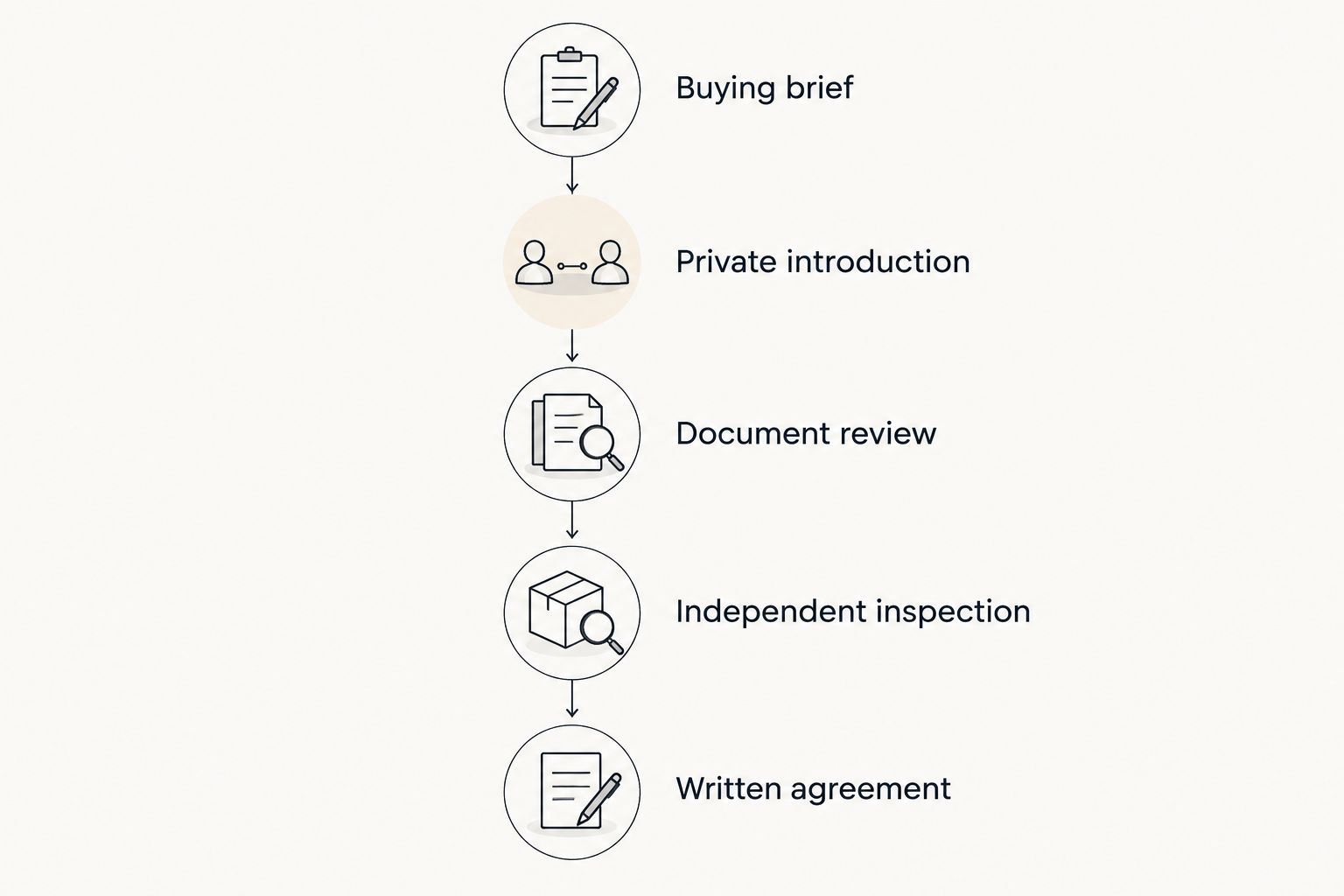
Why this matters
A public search shows cars that someone has chosen to advertise. A private search asks whether an owner is willing to discuss a sale matching your brief. Those are different routes to a conversation, not different standards of due diligence.
For your 2026 search, separate access from suitability. Finding a car privately is useful only when the specification, ownership position, condition, and transaction terms meet your requirements. Discretion alone tells you nothing about those points.
Owners face a related decision. A private sale limits the initial audience, but it still requires accurate disclosure to a prospective buyer. Privacy controls who receives information; it does not justify withholding material facts.
Private brokers, public listings, or direct introductions?
Choose the route according to the work you want coordinated. Private sourcing is relevant when you have a defined brief and want introductions handled discreetly. Public listings help you review advertised cars, while direct introductions let you approach an owner through an existing relationship.
| Route | Best for | Practical advantage | Limitation |
|---|---|---|---|
| Private exotic-car broker | Buyers with a defined brief and owners seeking discreet introductions | A point of contact can coordinate the search and transaction discussions | You must establish scope, representation, and responsibilities before proceeding |
| Public listings | Buyers who want to compare advertised cars themselves | Published descriptions provide a starting point for inquiries | A listing does not establish condition, ownership, or suitability |
| Direct owner introduction | Buyers and sellers who already have a relevant connection | The parties can discuss the car directly | The parties must arrange diligence and transaction coordination themselves |
No route removes the need to verify the car. Avoid treating a personal introduction as a substitute for records, or a polished advertisement as evidence that the transaction is ready to proceed.
When comparing private brokers, ask the same questions of each. Who is the client? Who authorizes the introduction? What work is included? Who handles inspection arrangements, document collection, and communication when a finding changes the deal?
SV Sourcing is suited to buyers seeking private exotic-car sourcing and sales coordination, rather than public inventory browsing. Its stated service also covers owners selling privately. Confirm the scope for your particular transaction before authorizing work; private access is not a promise that a matching car or buyer will be found.
Write a buying brief that supports a real search
A useful buying brief draws boundaries. It tells the person sourcing the car what qualifies, what needs discussion, and what should be declined without another call.
For a supercar for sale search in 2026, organize your brief around these decisions:
- Car and specification. Name the model and the attributes you require. Separate required features from preferences.
- Condition and history. State your expectations for service documentation, repairs, modifications, and originality.
- Intended use. Explain whether you want a road car, a collection addition, or a car for another defined purpose.
- Budget boundaries. Distinguish the amount reserved for the car from funds needed for inspection, transport, taxes, registration, and immediate work.
- Timing and location. State when you are ready to act, where the car will be kept, and whether you will consider a remote purchase.
Do not describe every preference as mandatory. If you will accept a different color but not missing service records, say so. The search needs that distinction.
Also explain your decision process. Identify who approves the purchase, whether financing is part of the plan, and what must happen before you can sign. Clear requirements prevent an introduction from becoming an open-ended conversation.
For owners, the equivalent brief describes the car accurately and sets boundaries for the sale. Specify what can be disclosed initially, which records are ready for review, and who can authorize an inspection or negotiate terms.
Check the car before negotiating the final agreement
The car must stand on its records and condition, not on the discretion of the introduction. Ask for the vehicle identification number and confirm that it corresponds with the car and relevant documents. Establish who owns the vehicle and who has authority to discuss or complete the sale.
Review the service history as a record, not a summary. Look for supporting invoices, dates, descriptions of work, and explanations for gaps. If a claim matters to your decision, ask what document or inspection finding supports it.
An independent pre-purchase inspection should address the actual car and your intended use. Choose an inspector familiar with the model, agree on the scope, and ask what the inspection excludes. A visual review, a road test, and a mechanical assessment do not answer identical questions.
Use findings to make a decision rather than collect paperwork. Identify unresolved issues, determine whether further specialist review is necessary, and decide which findings change your willingness to proceed. Do not convert an unanswered question into an assumption because the introduction feels credible.
Remote purchases need explicit arrangements for access to the car and records. Confirm who books the inspection, who receives the report, and whether you can speak directly with the inspector. Resolve those points before relying on someone else's account of the findings.
Agree on representation and responsibilities
Private coordination works best when every participant knows who is acting for whom. Ask whether the coordinator represents the buyer, the seller, or has another agreed role. Request a written explanation of scope, compensation arrangements, and any relationships relevant to the transaction.
Do not assume that a person arranging an introduction also provides legal advice, holds funds, verifies every document, or manages transport. Agree on responsibilities individually. Use appropriate legal, title, financial, and transport professionals where the transaction requires them.
The purchase agreement should describe the actual deal. Identify the vehicle, parties, agreed terms, required documents, inspection contingencies, payment arrangements, and delivery responsibilities. If a commitment matters, put it in writing.
For a nationwide purchase in 2026, resolve the handover sequence before money moves. Confirm how ownership documents, any lien release, payment, possession, and transport fit together. Independently verify payment instructions through a trusted communication channel rather than relying on an unexpected message.
A private introduction deserves the same financial discipline as any other vehicle transaction. Familiarity is not a payment control.
Why private sourcing varies from deal to deal
The work required depends on the brief and the car. These factors explain why one private search is not a reliable template for another:
- Specification flexibility. A narrowly defined requirement leaves fewer acceptable matches than a brief with clearly stated alternatives.
- Owner willingness. A private conversation begins only when an owner authorizes it; an introduction does not establish commitment to sell.
- Documentation readiness. Records already organized for review support a different process from records that still need to be located or explained.
- Inspection findings. Unresolved condition questions require decisions, further assessment, or a change in terms.
- Transaction dependencies. Financing, ownership documents, transport, and the parties' approvals affect what must happen before completion.
Ask for a description of the next dependency, not a promised completion date. That keeps the discussion tied to the transaction's actual requirements.
The same discipline applies to sellers. Before discussing a handover, confirm that the prospective buyer understands the car, has a defined approval process, and accepts the proposed diligence sequence.
How can an owner sell privately without unnecessary exposure?
A private sale starts with agreed disclosure boundaries. Decide which details can support an initial conversation, what requires a qualified buyer, and when identifying documents will be shared. Keep client identities and private deal details out of public discussion.
Qualification should serve a practical purpose. Establish the buyer's requirements, readiness to proceed, and decision process before arranging access to the car. Ask the coordinator to explain how financial readiness will be established without circulating unnecessary personal information.
SV Sourcing provides private exotic-car sourcing and sales coordination for buyers and sellers. For an owner, the relevant conversation is about discreet introductions and the work needed to coordinate a potential sale, not a public listing campaign.
Prepare accurate records before authorizing introductions. Privacy works better when the information released at each stage is clear, consistent, and sufficient for the decision being requested.
Can you buy a supercar that is not advertised?
Yes. An owner can agree to discuss a sale through a private introduction without publishing a listing. You still need confirmation of willingness to sell, authority to transact, and permission to inspect the car before treating the discussion as a viable purchase.
Is an off-market supercar automatically a better purchase?
No. Off-market describes how the car is introduced, not its quality or value. Judge a private car by the same evidence you would require from an advertised one: identity, ownership, condition, records, and written terms.
Should you stop checking public listings during a private search?
No. You can review advertised cars while pursuing private introductions, provided you keep your brief consistent. Tell the coordinator when your requirements change or you commit elsewhere so the private search does not continue on an outdated instruction.
FAQ
How do I find a supercar for sale without using public listings?
Give a private exotic-car broker a defined buying brief and authorize introductions to owners willing to discuss a sale. Verify the car, ownership position, inspection findings, and transaction terms before committing.
What should I tell a private exotic-car broker before a search starts?
State the model, required specification, condition expectations, budget boundaries, location, and timing. Explain your approval process and which preferences are flexible.
Does an off-market car still need a pre-purchase inspection?
Yes, a private introduction does not establish the car's condition. Arrange an independent inspection with a specialist familiar with the model and confirm the scope and exclusions.
Can I buy a privately sourced supercar from another state?
You can pursue a private purchase across state lines. Resolve inspection access, ownership documents, taxes, registration, payment, and transport requirements for your specific transaction before completion.
How does a seller protect privacy during a private car sale?
Agree on disclosure boundaries before introductions begin. Share the information needed for each stage with authorized parties, while providing accurate records and material facts for due diligence.
Who is SV Sourcing's private sourcing service for?
SV Sourcing serves buyers and sellers of exotic and collector cars in South Florida and nationwide. Its service centers on private, off-market sourcing and sales coordination rather than public inventory browsing.
One last thing
Before your 2026 search begins, write down what would make you decline an otherwise appealing car. Missing ownership evidence, unresolved condition findings, or unclear payment arrangements deserve an answer before commitment.
A precise refusal rule is as useful as a precise buying brief. It gives you a way to stay disciplined when the right specification appears through a private introduction.